





























Close
World of Concrete
Monday, November 2, 2026
AHR Expo 2027

AI Predicts Geopolymer Strength for Low-Carbon Construction

Note* - All images used are for editorial and illustrative purposes only and may not originate from the original news provider or associated company.

Related stories

Why Engine Identification Matters in Compact Equipment Repairs

For workshops sourcing Yanmar engine parts or Kubota engine...

Swiss Steel and Canada Nickel’s Low Carbon Steel Partnership

Swiss Steel Group and Canada Nickel Company have announced...

Building for Resilience Means Building for What Happens When the Grid Goes Down

When a hurricane, wildfire or winter storm takes down...
- Advertisement -
Super Terminal Expo 2026

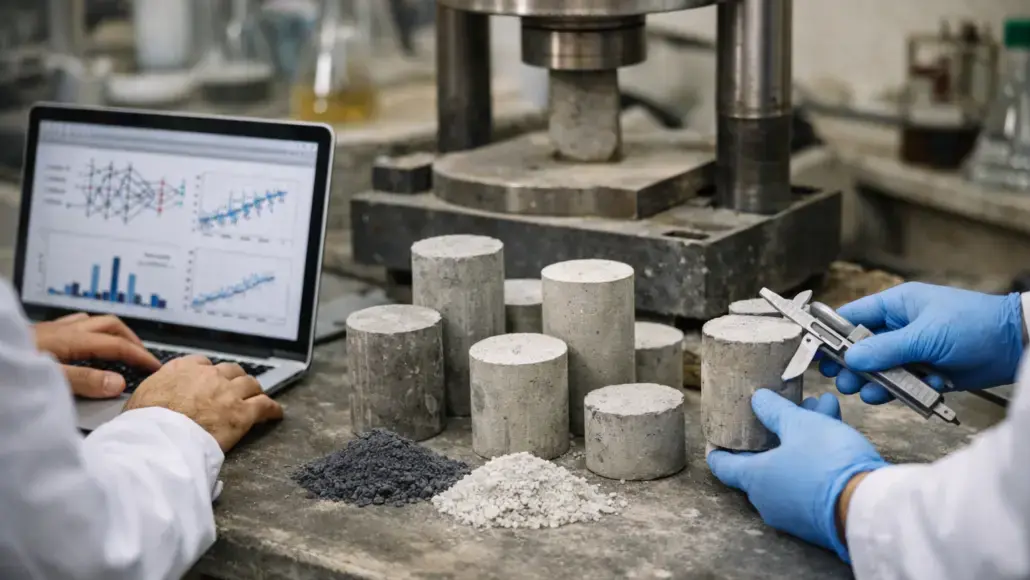
Researchers in Morocco developed a machine-learning framework to predict compressive strength in geopolymers made with fly ash and waste glass. Published in Case Studies in Construction Materials, the study assessed AI-based prediction.

Aymane Elyazidi, Fatiha Berroug, Lahcen Boukhattem and Rachid Bouferra compiled 429 experimental records from 11 peer-reviewed studies. The database covered mortar and paste mixtures and included 14 variables, including fly ash and glass powder quantities, activator composition, precursor oxide content, particle fineness and curing conditions. Recorded strength ranged from nearly zero to 96 megapascals, averaging 17.38 MPa.

The team compared seven algorithms, including neural networks, support vector regression, random forest, AdaBoost, CatBoost, gradient boosting and XGBoost. They used Differential Evolution to tune each modelโ€™s hyperparameters. DE-XGBoost achieved an R-squared of 0.9913 on test data, with a root mean squared error of 1.613 MPa and mean absolute error of 1.133 MPa. Conventionally tuned support vector regression recorded an R-squared of 0.8602.

Researchers used SHAP analysis to interpret predictions. Sodium hydroxide molarity emerged as the most influential input, followed by precursor silica content. Higher activator molarity generally increased predicted geopolymer strength, while high silica content was associated with lower values in the dataset. Calcium oxide content and curing age contributed positively.

Partial dependence analysis suggested that mixes commonly used less than about 20% glass powder replacement, an activator concentration near 12 moles per litre and curing temperatures of 60โ€“80ยฐC for roughly 24 hours. The researchers caution that these patterns reflect available records, not universal design limits.

The study identifies limitations, including bulk oxide composition inputs and no source-wise cross-validation. The team proposes optimization balancing strength, cost and embodied carbon, alongside an interactive prediction tool and transfer learning for other geopolymer materials. The findings could help researchers assess geopolymer strength while developing lower-carbon construction materials for more sustainable concrete mix design.

Packaging World Insights brings together the global packaging industry โ€” from materials innovators and design specialists to brand managers and supply chain leaders โ€” through trusted editorial, market intelligence, and digital engagement.

Our 2026 Media Pack offers integrated solutions to reach your audience:

  • Magazine & Digital Editions Showcase your brand within premium packaging industry coverage read by executives and decision - makers worldwide.
  • Industry Insights & Reports Align with data - driven analy sis, trend reports, and regional roundups across the global packaging and consumer goods value chain.
  • Brand Authority & Credibility Position your company as a thought leader through expert commentary, interviews, and special features.

Subscribe

- Never miss a story with notifications

- Gain full access to our premium content

- Browse free from any location or device.

Media Packs

Expand Your Reach With Our Customized Solutions Empowering Your Campaigns To Maximize Your Reach & Drive Real Results!

โ€“ Access the Media Pack Now

โ€“ Book a Conference Call

โ€“ Leave Message for Us to Get Back

Latest stories

Related stories

Why Engine Identification Matters in Compact Equipment Repairs

For workshops sourcing Yanmar engine parts or Kubota engine...

Swiss Steel and Canada Nickel’s Low Carbon Steel Partnership

Swiss Steel Group and Canada Nickel Company have announced...

Building for Resilience Means Building for What Happens When the Grid Goes Down

When a hurricane, wildfire or winter storm takes down...

The Grid Can’t Wait: How Utilities Are Solving the Transformer Lead-Time Crisis

Electric utilities cannot wait two years for new transformers....

Subscribe

- Never miss a story with notifications

- Gain full access to our premium content

- Browse free from any location or device.

Media Packs

Expand Your Reach With Our Customized Solutions Empowering Your Campaigns To Maximize Your Reach & Drive Real Results!

โ€“ Access the Media Pack Now

โ€“ Book a Conference Call

โ€“ Leave Message for Us to Get Back

Translate ยป