

























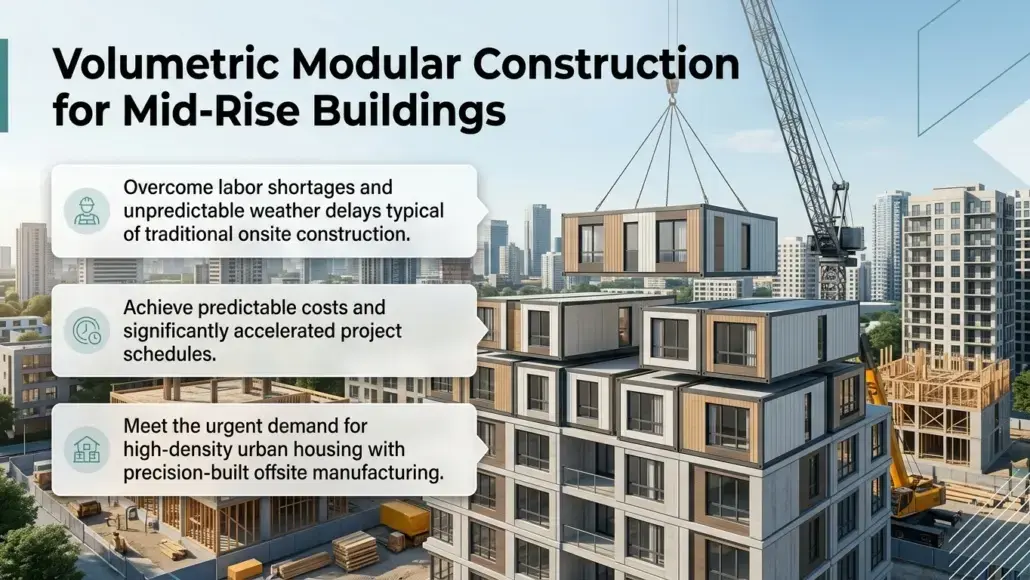


The urban development sector is currently undergoing a fundamental reorganization as the demand for high-density housing continues to outpace traditional delivery methods. For decades, mid-rise developments were defined by labor-intensive onsite processes that were subject to the whims of weather and the availability of local trades. This reality often resulted in prolonged schedules and unpredictable costs that challenged the viability of many urban projects. However, the introduction of industrialised delivery models is changing this environment. The implementation of volumetric modular construction for mid-rise buildings is providing developers with a more predictable and efficient path forward, allowing for the rapid assembly of residential and commercial spaces within tight urban constraints.
Central to this advancement is the ability to shift the majority of the construction activity into a controlled factory environment. Unlike panelised systems that require significant onsite assembly, volumetric modules arrive at the site as fully enclosed three-dimensional units, often complete with interior finishes, fixtures, and structural components. This level of offsite completion is essential for mid-rise projects where the speed of assembly is a critical factor in the economic success of the development. By utilizing standardized structural modules, the industry is reducing the reliance on a fragmented workforce and ensuring a level of quality and consistency that was previously unattainable with conventional methods.
Engineering Structural Integrity in Offsite Manufacturing
The design and the engineering of volumetric systems for multistory applications require a sophisticated understanding of load paths and structural connectivity. In a mid-rise context, the modules must not only support their own weight but also the cumulative loads of the levels above. Modern engineering platforms now allow for the creation of high-fidelity digital models that simulate the behavior of the entire building as a unified system. This capability ensures that the volumetric modular construction remains robust and resilient even in the face of seismic or wind-driven forces. The shift toward a more engineered and data-driven approach to structural design is a hallmark of the modern construction sector.
Furthermore, the integration of structural steel or reinforced concrete chassis within the modules provides the necessary strength for buildings exceeding four or five stories. These modular design strategies allow for the creation of open-plan spaces and large apertures that were once considered difficult for volumetric systems to achieve. By prioritizing the structural integrity of the individual unit, developers can ensure that the final building meets all national building codes and safety standards. The move toward more professional and standardized engineering practices is what earns the trust of municipal planners and institutional investors alike, providing a secure foundation for the next generation of urban housing.
Urban Density and the Economics of Construction Speed
One of the primary drivers for the adoption of offsite methods in the mid-rise sector is the need to maximize the utility of expensive urban land. Traditional construction projects in city centers are often delayed by logistical challenges, including limited access and the need to minimize disruption to the local community. Volumetric modular construction addresses these issues by significantly reducing the time spent on the physical site. Because the modules are manufactured concurrently with the foundation work, the overall project timeline can be compressed by as much as fifty percent. This acceleration of delivery allows for a faster return on capital and a quicker transition to occupancy for the residents.
Furthermore, the predictability of the factory environment eliminates many of the hidden costs associated with onsite waste and rework. When every component is cut and assembled with the precision of a computer-controlled machine, the variance in material consumption is minimized. This economic efficiency is vital for maintaining the sustainability of the mid-rise market, especially as land and material prices continue to rise. The ability to provide a clear and data-driven justification for the use of modular systems is a fundamental requirement for the modern developer. The focus remains on achieving the best possible balance between urban density and the operational speed of the project.
Standardized Structural Modules and Design Flexibility
A common misconception about volumetric construction is that it results in a lack of architectural diversity. In reality, the use of standardized structural modules provides a versatile framework within which a wide range of aesthetic and functional designs can be realized. By varying the dimensions and the orientation of the units, architects can create complex facades and internal layouts that meet the specific needs of the local market. The integration of digital design tools into the manufacturing process ensures that these variations can be handled with the same speed and accuracy as a standard unit.
Furthermore, the ability to customize the interior finishes and the external cladding of the modules allows for the creation of buildings that respond to the character of the surrounding neighborhood. Whether designing for luxury apartments or affordable student housing, volumetric modular construction provides the flexibility needed to deliver high-quality spaces. The focus is no longer just on the box itself, but on the ability to turn that structural unit into a sophisticated and desirable piece of architecture. This commitment to design excellence is what will define the leaders of the modular sector in the coming years, ensuring that the next generation of mid-rise buildings is both functional and beautiful.
The Future Strategic Landscape of Urban Development
As the construction industry continues to evolve, the role of industrialised delivery will only grow in importance. The successful implementation of volumetric modular construction for mid-rise buildings requires a fundamental reorganization of the relationships between the architect, the engineer, and the manufacturer. This involves the adoption of integrated project delivery models where the factory capabilities are considered from the earliest stages of the design. The focus is no longer just on the physical assembly of the building, but on the ability to manage the entire lifecycle with professional precision.
Looking ahead, the coordination of global supply chains and the adoption of shared digital platforms will be essential for further improving the productivity of the sector. By breaking down the silos that have traditionally separated the design and the construction teams, the industry can leverage a much larger pool of data to identify new opportunities and avoid redundant work. The commitment to transparency and professional collaboration is a key factor in the long-term success of the effort to advance offsite manufacturing. The ultimate goal is the creation of a global construction ecosystem that can deliver on the promise of affordable and high-quality urban housing for every community. By prioritizing the use of data-driven insights and offsite methods, developers can address the challenges of density and cost with a level of precision that was once considered unattainable. The future of the built environment lies in the ability to turn complex structural information into actionable therapeutic designs, providing a sustainable foundation for the continued growth of our cities around the world.