





















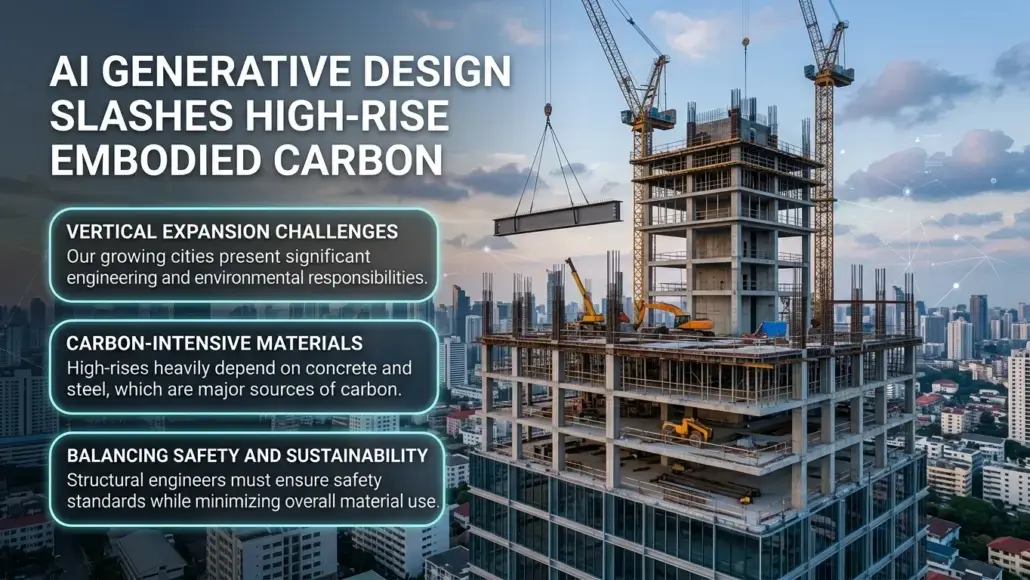


The vertical expansion of our cities represents one of the greatest engineering challenges and environmental responsibilities of the modern era. High-rise structures require immense volumes of concrete and steel, materials that are inherently carbon-intensive to produce. For structural engineers, the challenge has always been to ensure safety and stability while minimizing the volume of material used. Traditional design methods often rely on established archetypes and safety margins that, while effective, can lead to significant over-engineering. The introduction of computational intelligence is providing a new path forward, and it is becoming clear that AI generative design is the most powerful tool available for reducing the embodied carbon of large-scale buildings.
Generative design differs from traditional computer-aided design by shifting the role of the engineer from “drafter” to “curator.” Instead of manually drawing a structure and testing its performance, the engineer defines a set of constraints—such as structural loads, height limits, and material properties—and allows the artificial intelligence to explore thousands of potential configurations. This process identifies high-performance geometries that a human designer might never have considered, such as complex trusses or varied-thickness walls that put material only exactly where it is needed. The result is a structure that is both lighter and stronger, with a significantly lower environmental impact.
Structural Optimization and Material Efficiency
The primary driver for reducing embodied carbon in high-rise construction is the optimization of the structural frame. AI generative design can analyze the specific forces acting on every column and beam in a building, suggesting adjustments to the geometry that maximize efficiency. For instance, the system might suggest a tapering of the core or a specific diagonal bracing pattern that reduces the total volume of steel required by fifteen to twenty percent. In a fifty-story building, these incremental gains add up to thousands of tons of material, representing a massive reduction in the overall carbon footprint of the project.
Beyond reducing the quantity of material, artificial intelligence can also optimize the distribution of different material types. The system can identify areas where high-strength, low-carbon concrete can be used most effectively, or suggest timber-hybrid solutions for the upper floors where the loads are lighter. This granular approach to material selection ensures that every kilogram of material is utilized to its full potential. The ability of AI to manage the incredible complexity of these multi-material trade-offs is what makes it such a vital tool for sustainable engineering. By treating the entire building as a single, optimized system, generative design achieves a level of efficiency that is simply beyond the reach of traditional methods.
Accelerating the Design Cycle and Reducing Risk
One of the most significant benefits of using artificial intelligence in the early stages of a project is the speed at which different options can be evaluated. In a traditional workflow, exploring a single structural variation could take a team of engineers several days. AI generative design can iterate through hundreds of variations in a matter of hours, providing detailed data on the carbon cost and structural performance of each. This allows the design team to present the developer with a range of verified, low-carbon options at the very beginning of the process. This speed ensures that sustainability is built into the project from the start, rather than being an afterthought that is often compromised by budget or schedule constraints.
The reduction of risk is another critical factor in the adoption of these tools. Because every generative design is backed by thousands of simulated load tests, the structural performance of the proposed solution is verified to an unprecedented degree. This gives engineers the confidence to move away from the “safety-in-excess” philosophy of traditional design, allowing for the creation of more slender and efficient structures without compromising safety. For regulatory bodies and insurers, the availability of high-fidelity data on the performance of a novel design provides the necessary assurance to support innovative, low-carbon building techniques.
Integration with Advanced Construction Techniques
The geometries produced by AI generative design are often complex, requiring advanced fabrication and construction methods. However, this complexity is also what provides the performance benefits. The move toward robotic fabrication and 3D printing in construction is a natural partner for generative design, as these technologies can easily produce the varied and organic shapes that the algorithms suggest. When the structural design is synchronized with the capabilities of modern fabrication, the result is a highly integrated and efficient build. For high-rise construction, this might mean 3D-printing internal core structures that utilize internal voids for cooling or routing utilities, further improving the overall performance of the building.
The intelligence of the system can also account for the logistical constraints of the construction site. For instance, the AI can be programmed to prioritize designs that utilize modular components of a specific size that can be easily transported through city streets. This ensures that the drive for structural efficiency does not create an impossible logistical challenge. By including the “manufacturability” and “buildability” of the structure as constraints in the generative process, engineers can create designs that are not just theoretically efficient but also practical to construct. This holistic view of the project lifecycle is a key advantage of the data-driven approach to engineering.
Measuring the Impact on Global Carbon Targets
The impact of this technology on the global construction sector is profound. As cities around the world commit to ambitious carbon reduction targets, the ability to build high-density housing and office space with a lower environmental cost is essential. AI generative design is providing the technical foundation for this transition, enabling the creation of a new generation of low-carbon high-rises. The data collected from these projects is also informing the development of new building codes and environmental standards, pushing the entire industry toward a more sustainable future. By demonstrating that high performance and low carbon are not mutually exclusive, generative design is changing the expectations of developers, tenants, and regulators alike.
In the long term, the widespread adoption of artificial intelligence in structural design will lead to a fundamental shift in our architectural language. The “one-size-fits-all” approach to high-rise design will be replaced by structures that are uniquely adapted to their site, their climate, and their function. The aesthetics of the future will be defined by the organic, efficient forms of generative design, reflecting a more harmonious relationship between the built environment and the natural world. This transition is not just about a change in software; it is about a change in the very philosophy of how we build.
The integration of artificial intelligence into the structural engineering process is a natural progression for an industry that must balance increasingly complex requirements. By providing the tools to manage this complexity and prioritize sustainability, AI generative design is enabling the creation of buildings that are fit for the 21st century. It is a powerful example of how technology can be used to solve some of the most pressing challenges of our time, delivering high-quality, high-density environments with a significantly lower impact on the planet.
As we move forward, the focus will remain on the refinement of these algorithms and their integration into every stage of the building lifecycle. The ability to design for embodied carbon is a vital skill for the modern engineer, and artificial intelligence is the tool that makes it possible. The high-rises of the future will be lighter, stronger, and more sustainable than anything we have built before, standing as a testament to the power of human ingenuity and computational intelligence working in tandem.