























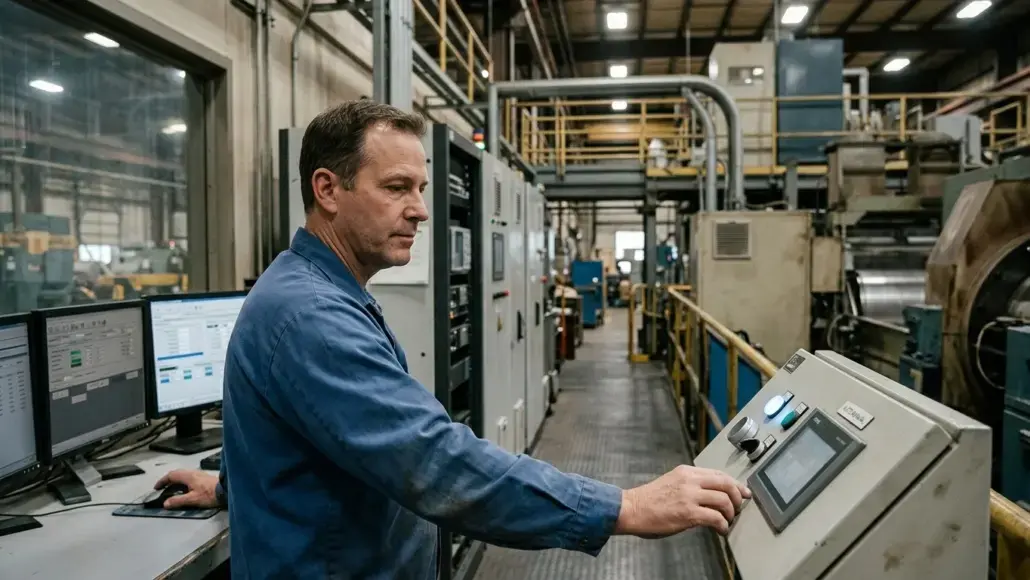


Over the past decade, industrial facilities have invested heavily in visibility. Sensors, data historians, and remote dashboards now make it possible to see what equipment is doing at almost any moment. That visibility was a genuine step forward. It is also, for many operations, where progress stalled. Monitoring tells a team what has happened or what is happening right now, but seeing a problem and resolving it are two different things, separated by however long it takes a person to notice, interpret, and act.
The more valuable transition, and the harder one, is the move from monitoring that informs to control that acts. Understanding that path, and what changes at each step, matters for any facility trying to get more out of the data it already collects.
Monitoring Tells You What Happened
The first wave of industrial digitization was about measurement. Instrumenting equipment with sensors and collecting the resulting data gave operators a picture of conditions they previously had to infer. NIST’s framework for sensing, monitoring, and process control treats this measurement layer as foundational to smart manufacturing, because nothing downstream is possible without reliable data about what equipment is actually doing.
Monitoring delivers real value on its own. It surfaces problems that would otherwise stay hidden, and it gives teams a shared view of operations. Its limitation is built into its nature: monitoring is passive. It reports a condition and then waits for a human to decide what to do about it.
The Limits of Watching Without Acting
In a facility with one system and an attentive operator standing beside it, the gap between seeing and acting is short. Across a portfolio of facilities, on a night shift, or during fast-moving conditions, that gap widens. A dashboard can show that a temperature is drifting or a compressor is drawing too much power, but the response still depends on someone seeing the alert, understanding it, and intervening in time.
That human loop is where delay, inconsistency, and cost accumulate. Measurement-science research on industrial control systems emphasizes that modern industrial operations increasingly need systems that respond in real time to changing conditions, rather than waiting on manual intervention at every step. The faster a facility needs to react, and the more sites it runs, the less a purely manual response can keep up.
From Visibility to Closed-Loop Action
The step that resolves this is closing the loop between measurement and action. Rather than reporting a condition and waiting, the system uses the measurement to act on its own. This is the defining feature of closed loop control systems: a controller continuously compares actual conditions against a target, then adjusts the process automatically to close any gap, without requiring an operator to notice and respond first.
The principle is not new in engineering, but applying it broadly across industrial facilities has become far more practical. The Department of Energy’s work on real-time process control describes how real-time data acquisition and analysis now enable automated control of production processes, turning streams of sensor data into continuous, self-correcting action. The data that monitoring already produces becomes the input to a system that acts on it directly.
Why Automated Control Pays Off in Industrial Facilities
For industrial facilities, the benefits of closing that loop are concrete. Automated control responds in seconds rather than waiting for a shift change or a callback. It holds conditions consistently instead of letting them drift between manual adjustments. It frees skilled operators from routine babysitting so they can focus on genuine exceptions. And it tends to save energy, because a system tuned to act continuously wastes less than one corrected only when someone gets around to it.
The efficiency case is significant. A federal smart manufacturing initiative targeting energy efficiency set a goal of improving energy efficiency by at least 15 percent and energy productivity by at least 50 percent through advanced sensors, controls, platforms, and modeling. Those gains come largely from doing what manual operation cannot: adjusting continuously and precisely, around the clock.
Key insight: Monitoring answers the question “what is happening?” Automated control answers the question “what should the system do about it, right now?” The value of industrial data rises sharply once it stops ending at a dashboard and starts driving action. Source: U.S. Department of Energy
Making the Transition
Moving from monitoring to automated control is a progression, not a single leap. Facilities that make the move successfully tend to follow a recognizable sequence:
- Establish reliable measurement first. Automated control is only as good as the data feeding it, so trustworthy sensing comes before automation.
- Define clear targets and guardrails. The system needs explicit setpoints to control toward and safety limits it must never cross.
- Automate routine responses before complex ones. The repetitive, well-understood adjustments are the safest and highest-value place to start.
- Keep people in a supervisory role. Operators move from making every adjustment to overseeing the system and handling exceptions.
- Standardize across sites. Once a control approach works at one facility, applying it consistently across others multiplies the benefit.
Built on the Data You Already Have
The encouraging part of this path is that it builds on investments most facilities have already made. The sensors and data that power monitoring are the same inputs an automated control system needs. Most of what the transition requires is already in place; the work is connecting existing measurement to action.
The Direction of Travel
Industrial facilities are steadily moving along a maturity curve that runs from manual operation, through monitoring, toward automated control. Each step adds value, but the largest gains come at the end, when a facility stops merely watching its operations and starts letting well-governed systems act on what they observe. For operators weighing where to invest next, the data already flowing into a dashboard is often the clearest signal of how much more that data could be doing.