


























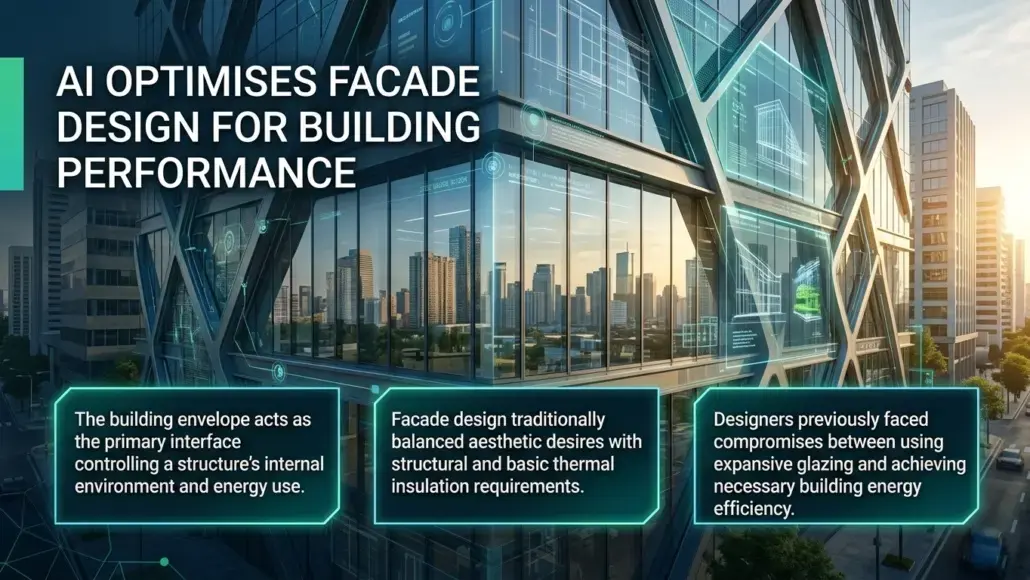


The building envelope is the primary interface between the internal environment and the external climate, serving as the most critical factor in the energy performance of a structure. Historically, the design of a facade has been a balancing act between aesthetic vision, structural requirements, and basic thermal insulation. Architects and engineers often faced a choice between expansive glazing and energy efficiency, frequently relying on standard solutions that did not account for the micro-climatic nuances of a specific site. The emergence of machine learning is resolving these tensions, and it is becoming evident that AI optimises facade design by processing thousands of variables to find the ideal equilibrium between form and function.
Modern commercial architecture requires a level of performance that traditional design methods struggle to deliver. With the increasing stringency of building regulations and the global push toward net-zero targets, every square meter of the facade must be justified by its contribution to the building’s thermal stability. Artificial intelligence allows for a more granular analysis of solar heat gain, daylighting requirements, and wind pressure. By simulating a vast array of geometric configurations and material choices, these tools can identify the specific patterns of shading and glazing that will result in the lowest possible energy demand over the lifecycle of the building.
Parametric Modeling and Performance Simulation
At the heart of this shift is the transition from static drafting to dynamic parametric modeling. When AI optimises facade design, it does so by treating the entire building envelope as a set of interconnected data points. Designers can set performance targets—such as a specific U-value or a target for natural daylight—and allow the algorithm to iterate through millions of possible solutions. This process can identify non-obvious configurations, such as the subtle angling of panels or the varied distribution of insulation, that provide superior performance compared to a uniform design. This level of optimization ensures that the building envelope is tailored to its orientation and the specific patterns of sunlight it will receive throughout the year.
The ability to simulate real-world conditions with high accuracy is a fundamental requirement for modern structural engineering. Artificial intelligence can account for the reflection of sunlight from neighboring buildings or the specific turbulence caused by local terrain. This ensures that the facade is not just an abstract shell, but a responsive layer that mitigates the specific challenges of its environment. For building owners, this translates into lower cooling and heating loads, which are the primary drivers of operational costs. The use of AI to refine these designs before a single panel is fabricated reduces the risk of expensive post-construction retrofits to address glare or overheating.
Material Selection and Lifecycle Analysis
The choice of materials for a high-performance facade is increasingly complex, involving a trade-off between embodied carbon, durability, and thermal properties. AI optimises facade design by conducting comprehensive lifecycle analyses across hundreds of different material combinations. For instance, the system might compare the long-term energy savings of a high-performance triple-glazing system against the carbon cost of its manufacturing and transport. This data-driven approach allows architects to make informed decisions that align with both their environmental goals and their budget constraints. The intelligence can also suggest innovative materials, such as bio-based composites or advanced aerogels, that might have been overlooked in a traditional specification process.
Furthermore, artificial intelligence can optimize the fabrication process itself. By analyzing the geometric complexity of the design, the system can suggest ways to standardize components without sacrificing the overall aesthetic. This reduces material waste during manufacturing and simplifies the logistics of onsite installation. When a facade is designed with its eventual construction and maintenance in mind, the total cost of ownership is significantly reduced. This focus on the “manufacturability” of the building envelope is a key characteristic of the modern move toward more integrated and efficient architectural practices.
Improving Occupant Comfort and Indoor Quality
The performance of a building is ultimately measured by the comfort and productivity of the people inside. A poorly designed facade can lead to issues with glare, localized cold spots, or a lack of connection to the outside world. When AI optimises facade design, it prioritizes the human experience by balancing thermal protection with visual transparency. Advanced algorithms can predict the distribution of light within a room at different times of the day and year, ensuring that occupants have access to natural light without the discomfort of direct solar glare. This level of precision is essential for modern office environments, where the quality of the workspace is a key factor in employee well-being.
The integration of smart systems within the facade—such as automated shading or electrochromic glass—is also enhanced by artificial intelligence. The AI can manage these dynamic elements in real-time, responding to cloud cover or temperature spikes to maintain a stable internal environment. This proactive management reduces the reliance on traditional HVAC systems, leading to a more pleasant and quieter indoor atmosphere. By treating the facade as an active participant in the building’s climate control, designers can achieve a level of comfort that was previously unattainable. The building envelope becomes a living skin that breathes and adapts, rather than a static wall.
Future Horizons in Building Envelope Innovation
The continued evolution of artificial intelligence will likely lead to facades that are even more responsive and intelligent. We are already seeing the development of 3D-printed building envelopes that utilize complex internal geometries for passive heating and cooling. AI is the only tool capable of managing the design complexity of these systems, ensuring that every internal void and surface is optimized for its specific thermal role. This move toward “functional complexity” represents the next frontier in sustainable architecture. As the technology becomes more accessible, the standard for building performance will continue to rise, making high-performance design the norm rather than the exception.
In the long term, the data collected from AI-designed facades will inform the next generation of urban planning. By understanding how different building envelopes interact with each other and the city at large, we can create more resilient and energy-efficient urban environments. The way AI optimises facade design today is setting the foundation for the cities of the future. Architects and engineers who embrace these tools are not just improving individual buildings; they are contributing to a more sustainable and intelligent built environment. The shift toward data-driven design is a fundamental reorganization of how we conceive and construct the world around us.
The transition to AI-enabled design is a natural progression for an industry that is increasingly defined by its technical requirements. By providing the tools to manage complexity and verify performance, artificial intelligence is enabling a new era of architectural excellence. It is clear that the building envelope of the future will be a product of both human creativity and machine intelligence, working together to achieve levels of performance that were once the stuff of science fiction.
As we move forward, the focus will remain on the integration of these tools into every stage of the project lifecycle. From the initial concept to the final installation and beyond, artificial intelligence will provide the continuity and the data necessary to ensure that buildings perform as intended. The ability to design for actual building performance, rather than just compliance with minimum standards, will be the defining characteristic of the successful architectural firms of the future.