






















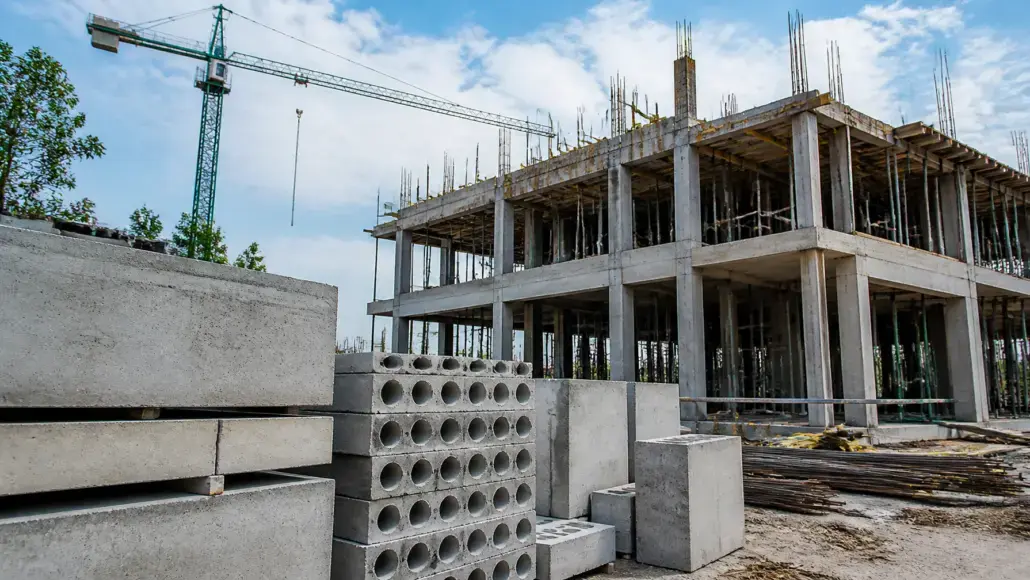

Geopolymer concrete applications are moving from laboratory programmes into working specifications as contractors and building owners come under sustained pressure to reduce the embodied carbon of structural frames. Ordinary Portland cement remains the default binder for most cast-in-place and precast work, yet its production accounts for a substantial share of global industrial carbon dioxide emissions. Binder substitution, rather than redesign of the structure itself, has therefore become the most direct route to lower-carbon buildings, and geopolymer concrete is the most commercially advanced of the available substitutes.
Binder Substitution as a Structural Question
The scale of the opportunity rests on a simple proportion. Cement typically contributes between eighty and ninety per cent of the embodied carbon of a conventional concrete mix, with aggregates, water and reinforcement accounting for the remainder. Any technology that removes Portland cement clinker from the binder therefore attacks the largest single source of emissions in a building’s structure without altering the architecture, the grid layout or the floor plates.
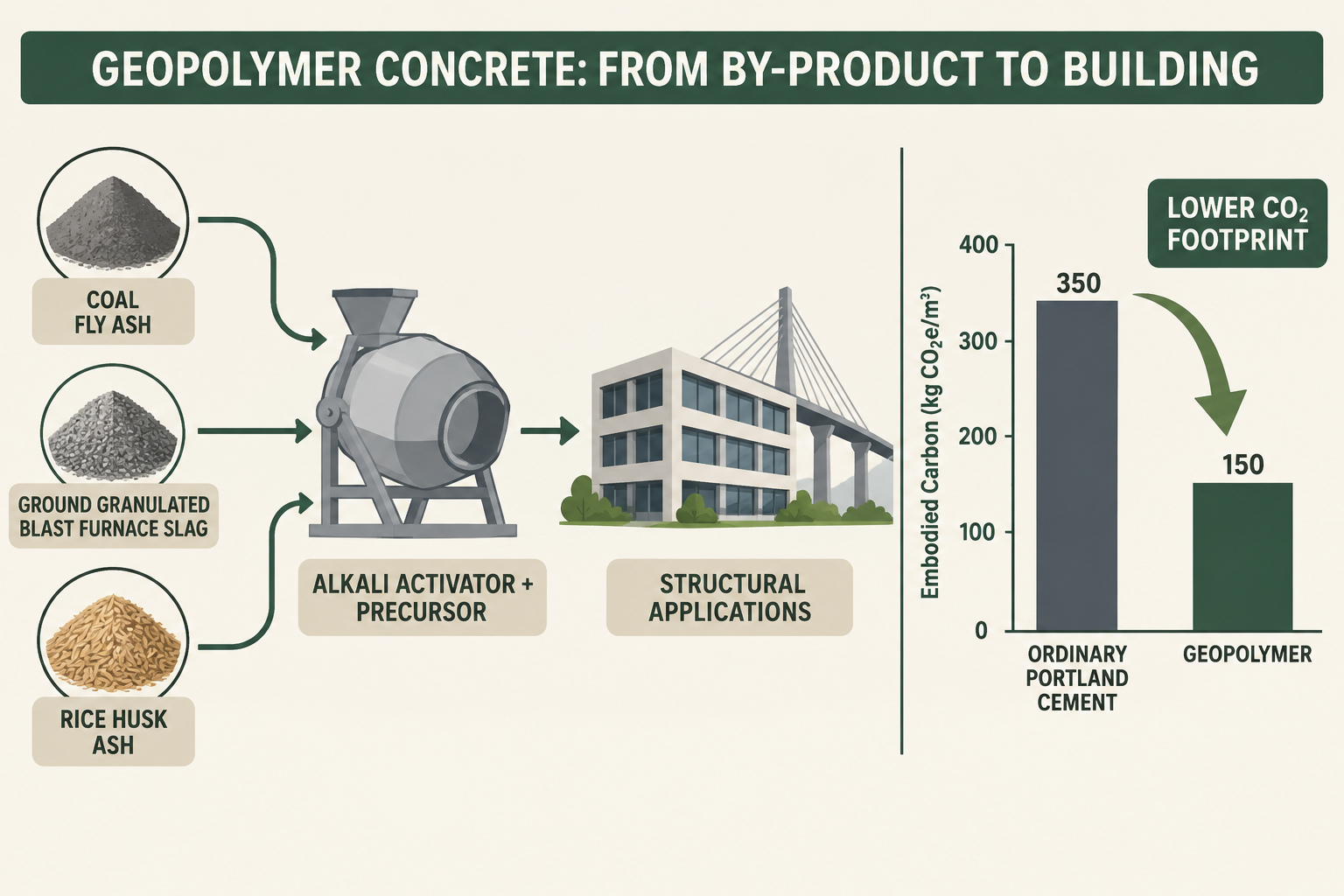
Geopolymer concrete achieves this substitution by replacing clinker with aluminosilicate-rich industrial by-products, principally fly ash from thermal power stations and ground granulated blast furnace slag from ironmaking. An alkaline activator, usually a combination of sodium hydroxide and sodium silicate solution, dissolves the reactive glassy phases in these precursors and reassembles them into a three-dimensional aluminosilicate gel that binds aggregates in the same way calcium silicate hydrate binds a Portland cement matrix. The result is a concrete that can be proportioned, placed, finished and tested with familiar equipment, but whose binder has never passed through a kiln.
Reported embodied carbon reductions vary with activator dosage and transport distances, but peer-reviewed assessments and environmental product declarations consistently place the saving in a wide range below conventional mixes, frequently between forty and eighty per cent for the binder fraction. The spread matters commercially: it means a project team cannot claim a fixed percentage credit, and it explains why early adopters have concentrated on supplementary documentation, verified product declarations and third-party verified mix designs rather than generic claims.
Performance Characteristics That Win Specifications
Laboratory work over the past two decades has established a performance envelope that is now being confirmed on real structures. Properly proportioned geopolymer mixes routinely achieve compressive strengths in the range of thirty to over one hundred megapascals, which covers most commercial building applications from footings to high-strength columns. Early-age strength gain can be slower than a rapid-set Portland mix in room-cured fly ash systems, a point that programme planners must respect, although slag-rich blends cure at ambient temperatures with credible early strengths.
Durability is the argument that converts sceptical structural engineers. The geopolymer gel matrix is markedly less permeable to chloride ions than Portland cement concrete, which matters directly for coastal structures, bridge substructures in marine exposure and car parks where de-icing salts are used. Reduced calcium content also removes much of the raw material for sulfate attack and thaumasite formation. Several published field trials on highway structures and marine piles have reported stable performance across multi-year exposure periods, and long-term monitoring datasets are steadily extending.
Fire and chemical resistance add further weight. The aluminosilicate binder does not decompose into calcium hydroxide at elevated temperature, so spalling behaviour differs from Portland concrete and residual strength after fire exposure has been reported at comparable or higher levels in furnace testing. Acid resistance, historically a weakness of Portland binders, is substantially improved, which is relevant to industrial floors, agricultural structures and wastewater infrastructure within the building sector.
Placement and finishing practice stays close to conventional concrete craft, which eases site adoption. Geopolymer mixes respond well to vibration, standard screeding and power floating, and experienced finishing crews generally need no new techniques, only familiarisation with the mix’s different setting indications. Pumping has been demonstrated successfully on commercial projects, though longer lines and high ambient temperatures can shorten workable open time, so pour planning deserves the same scrutiny it receives for hot-weather Portland placements. Trial panels remain the most reliable way to calibrate finishing timing for a specific mix and weather window, and most suppliers now include trial panel support in their project onboarding.
Where Geopolymer Concrete Applications Deliver Most Value
Project experience to date suggests value is not evenly distributed across all construction tasks. Teams evaluating the technology tend to screen opportunities against three practical criteria: volume of binder, exposure severity and tolerance for mix learning curves. The applications below consistently emerge as priority candidates.
- Mass concrete elements such as deep foundations, rafts and retaining walls, where high binder volumes make carbon savings per element large and where slower heat of hydration in geopolymer mixes reduces thermal cracking risk.
- Precast elements including wall panels, stair cores, beams and bridge segments, where factory curing control offsets early-strength uncertainty and where repeat production runs amortise mix development cost across many units.
- Marine and ground-exposed structures such as basements, pile caps and seafront components, where chloride resistance converts directly into longer service life and lower maintenance liability.
- Fit-out and hard landscaping elements, including pavers, kerbs and drainage units, which allow low-risk specification trials before structural adoption.
The precast route deserves particular attention because factory conditions compress the risks that worry site engineers. Quality control laboratory space, controlled temperature curing and repetitive moulds make it far easier to demonstrate consistent strength than on a congested city site. Readers evaluating this pathway will find a natural next step in precast geopolymer concrete components for modern infrastructure development, where factory production and repeat unit economics are examined in detail.
Standards, Testing and the Specification Gap
The principal obstacle to wider adoption is not technical performance but the absence of harmonised standards. Most national concrete codes are calibrated around Portland cement chemistry, and prescriptive clauses on minimum cement content, water-cement ratio and curing regime can exclude geopolymer mixes by definition rather than by performance. Australia’s experimental specification for construction with alkali-activated binders, along with emerging European standardisation work under CEN committees, signals movement, but structural engineers in many jurisdictions still need project-specific approvals, performance-based specifications or derogations to proceed.
Testing practice therefore carries extra weight on early projects. Compressive strength testing transfers directly from conventional practice, but elastic modulus, shrinkage, creep and bond to reinforcement need project verification because the gel chemistry differs. Activator handling raises occupational health questions that site method statements must address, since sodium hydroxide solutions are caustic before mixing. None of these issues is unusual by the standards of new material adoption, yet together they add cost and time that smaller contractors cannot always absorb, which partly explains why adoption has concentrated among large contractors and public clients with technical review capacity.
Life cycle documentation has become the practical bridge. Rather than waiting for code revision, leading suppliers now supply environmental product declarations modelled to EN 15804, allowing design teams to credit carbon savings directly in whole-building assessments such as BREEAM and LEED. Where a specification cannot name a material, a performance clause referencing verified declaration data can often do the work instead.
Commercial Pathways and the Procurement Outlook
Supply chain development is following the pattern established by other low-carbon construction products: regional precursor availability determines commercial viability. Where coal power stations remain in operation, fly ash is available at scale and at moderate cost, although declining coal generation is already tightening supply in parts of Europe and pushing mix designers toward slag blends and calcined clays. Iron and steel producing regions hold durable slag reserves. Concrete producers in precursor-poor markets face activator logistics as the dominant cost, since sodium silicate manufacture is itself energy intensive.
Procurement models are adapting in parallel. Early projects were driven by research partnerships between universities, contractors and material suppliers, often supported by public innovation funding. The current wave is more commercially routine: specialist low-carbon concrete suppliers now offer geopolymer products alongside cement-reduced Portland blends, and general contractors are including them in tender options alongside carbon budget reporting. Public clients, particularly infrastructure agencies with published net zero commitments, have provided the anchor demand that gives suppliers the volume confidence to invest in batching and quality systems.
The economics remain finely balanced. Activator costs currently offset much of the saving from avoided clinker, so delivered price parity depends on precursor logistics, carbon pricing and the value a client places on verified emissions reduction. As carbon reporting obligations tighten across major construction markets and green procurement rules mature, that balance is expected to tilt further toward binder substitution. For building project teams, the practical conclusion is to begin screening suitable geopolymer concrete applications now, build supplier relationships through trial panels, and treat the technology as a staged specification decision rather than an all-or-nothing conversion.
Geopolymer concrete has crossed the threshold from research material to specification-ready option for a defined and growing set of building applications. The chemistry is proven, the durability case is strengthening with each field trial cycle, and the carbon arithmetic is compelling wherever precursor supply is dependable. What remains scarce is institutional experience: engineers who have certified it, contractors who have placed it and clients who have accepted it. Projects that build that experience now, on well-chosen elements with thorough testing documentation, will hold a meaningful advantage as low-carbon procurement moves from preference to requirement across the construction sector.