























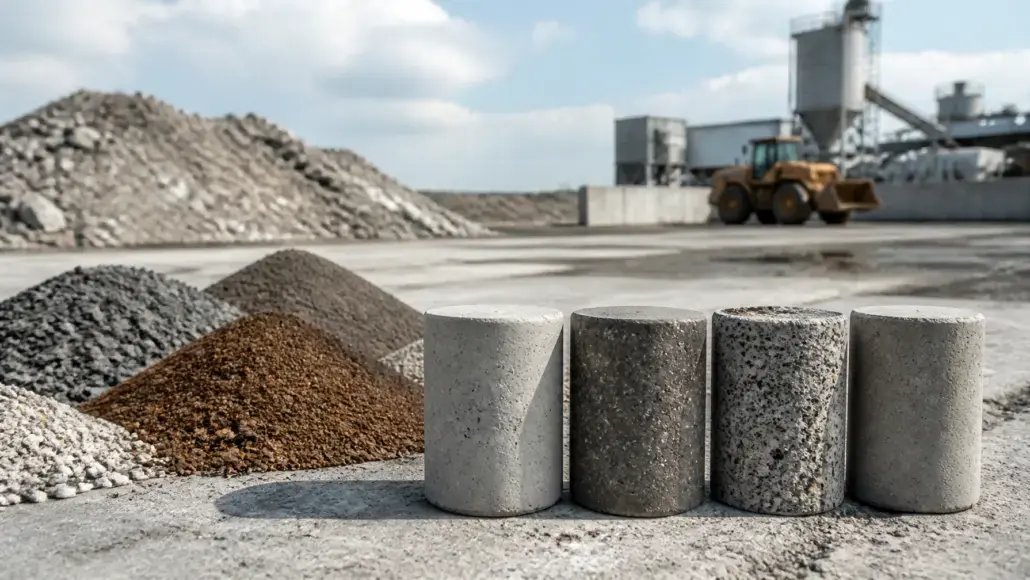

Recycled industrial materials form the material backbone of geopolymer concrete, and their sourcing economics increasingly determine where low-carbon infrastructure can be built affordably. The technology’s central proposition, replacing Portland cement with alkali-activated aluminosilicates, depends entirely on a dependable supply of reactive by-products: combustion ashes, metallurgical slags, mining residues and processed demolition fines. As infrastructure clients embed circular economy targets into procurement alongside carbon budgets, the question facing material engineers has shifted from whether geopolymer binders work to how regional waste streams can be matched to construction demand at industrial scale.
The By-Product Streams That Power Geopolymer Binders
Fly ash remains the most widely used geopolymer precursor, and its chemistry explains why. The glassy aluminosilicate particles formed during coal combustion dissolve readily in alkaline solution and polymerise into the binding gel, with low-calcium Class F ash offering the most predictable structural performance. Global ash generation remains in the hundreds of millions of tonnes annually, though the energy transition is reshaping its geography: where coal generation retires, fresh ash supply contracts and producers turn to stockpiled ash with processing and quality control, or to alternative precursors entirely.
Ground granulated blast furnace slag carries the other half of commercial geopolymer production. The rapid water quenching of ironmaking slag produces an amorphous, calcium-rich material that reacts strongly with alkaline activators and, blended with fly ash, enables ambient-temperature curing without heat treatment. Slag-blended geopolymer mixes dominate structural applications precisely because they combine one precursor that delivers reactivity with another that delivers calcium for setting behaviour. Slag reserves track steel production, which persists at global scale, but regional allocation between cement blending, geopolymer production and other uses is tightening as carbon accounting puts a price on every tonne of clinker displaced.
Several by-product streams now feed commercial and research geopolymer production:
- Fly ash from thermal power stations, supplying the reactive aluminosilicate glass at the core of most structural mix designs.
- Ground granulated blast furnace slag from ironmaking, providing calcium-rich reactivity that enables ambient-cure structural concretes.
- Ceramic, tile and sanitaryware residues, contributing reactive silica as both precursor supplement and crushed aggregate.
- Demolition fines, including crushed brick and returned concrete, extending the aggregate supply base under circular economy procurement rules.
Beyond these primary streams, a wide set of secondary materials is entering geopolymer research and early commercial use. Calcined clays, activated by heating rather than being industrial wastes in the strict sense, provide the scalable fallback as ash supplies tighten. Red mud from alumina refining, waste glass powder, ceramic and sanitaryware processing residues, rice husk ash, palm oil fuel ash and copper mine tailings have all demonstrated reactive potential in published work, generally as partial substitutes within blended precursor systems rather than standalone binders. Construction and demolition fines, particularly crushed brick and tile, contribute reactive silica and serve effectively as supplementary precursor or as recycled aggregate.
Closing the Loop on Aggregates
Geopolymer chemistry also changes the calculus for recycled aggregates, a less discussed but commercially significant connection. Returned concrete recycling, where fresh surplus is processed back into usable aggregate, fits naturally alongside geopolymer production at batching facilities operating both material streams. Recycled concrete aggregate has long suffered a market penalty in Portland concrete: the adhered cement mortar on recycled particles raises water demand, weakens bond and limits replacement rates in structural grades. Geopolymer binder systems, with their different paste chemistry and often higher paste volumes in printable and precast applications, have demonstrated higher recycled aggregate acceptance in published studies, with some structural-grade mixes carrying substantial replacement fractions while meeting strength and durability requirements.
Ceramic and brick waste occupies a distinctive position because it can serve both roles. Crushed ceramic sanitaryware and tile waste contribute reactive silica to the binder system while simultaneously functioning as aggregate, and waste streams from tile manufacturing regions have supplied both components to geopolymer production trials. Foundry sands, waste foundry sand research and glass fines extend the aggregate substitution picture further into industrial by-product streams that currently carry disposal costs.
Activator supply deserves the same sourcing scrutiny as precursors. Sodium silicate manufacture concentrates among a small number of chemical producers, and its energy intensity means prices respond to industrial energy markets rather than construction demand cycles. Regional blending facilities that dilute and formulate activator solutions close to batching plants reduce transport emissions and handling risk, and some producers now offer premixed activator systems with quality certification, mirroring the ready-to-use admixture model familiar to site engineers. Potassium-based activators, which support certain mix chemistries, carry higher costs and narrower supply, reinforcing the dominance of sodium systems in commercial work. Infrastructure programmes planning multi-year geopolymer supply should secure activator framework agreements alongside precursor contracts.
The infrastructure applications where this matters most are the high-volume, quality-tolerant ones: sub-base and pavement layers, lean concrete, pipe bedding, flowable fills and mass fills, which together consume the majority of construction aggregate. Geopolymer-bound recycled materials are being trialled in precisely these layers, where binder content is modest, exposure is protected and specification regimes are updating to accept recycled content. Moving upward from fills into precast products and structural elements follows the same staged qualification path that governs any new material acceptance.
Regional Supply Chains Determine Viability
Unlike Portland cement, which is manufactured to specification anywhere, geopolymer concrete inherits the waste geography of its region. A construction market near lignite power stations and integrated steelworks holds abundant precursor supply at competitive cost; a market with retired coal plants, no primary steelmaking and strict waste export rules faces activator logistics and imported precursor costs instead. Infrastructure carbon strategies therefore need regional material audits before they need mix designs, an inversion of conventional practice that many client engineering teams are still absorbing.
Processing and quality assurance requirements differ sharply between waste streams. Fresh power station ash arrives classified and consistent; stockpiled ash varies in loss on ignition, fineness and moisture and requires drying, milling and batch testing before structural use. Slag arrives ground to cement fineness or requires grinding contracts. Demolition fines require crushing, screening, contaminant removal and, critically, consistent sourcing, since building stock varies with every structure demolished. The commercial winners in geopolymer supply have generally been firms that industrialised this processing step, holding consistent precursor inventories rather than chasing variable waste arisings.
Carbon accounting completes the regional picture. Haulage distances for by-products, activator manufacture and aggregates feed into every verified environmental product declaration, and a geopolymer mix using distant precursors can lose its carbon advantage over a locally produced low-clinker Portland blend. Procurement frameworks that reward verified declarations rather than generic technology labels have forced the market toward honest regional accounting. For teams mapping the wider technology context, the analysis of precast geopolymer concrete components for modern infrastructure development shows how factory production consolidates precursor demand and quality control into a controlled industrial setting.
Standards, Policy and the Market Outlook
Policy frameworks increasingly pull in geopolymer’s direction. Circular economy action plans across major markets set recycling and material efficiency targets for construction, landfill diversion rules raise disposal costs for the very ashes and slags geopolymer binders consume, and green public procurement criteria award carbon savings verified through declarations. End-of-waste classifications for processed by-products remain a friction point in some jurisdictions, and producers have invested in certification schemes to give processed ashes and slags the regulatory status of products rather than wastes.
Standardisation of geopolymer binders is progressing through the same committees addressing low-carbon concrete generally, with performance-based durability provisions offering the practical specification route while prescriptive cement-centred clauses remain. Testing protocols for blended and processed precursors are being formalised alongside, giving quality assurance laboratories the methods they need to certify recycled feedstocks. The trajectory resembles the acceptance path recycled aggregates followed two decades earlier: demonstrator projects, then framework prequalification, then routine specification.
The commercial outlook rests on matching three curves: declining fresh ash availability, growing clinker substitution demand and expanding recycled aggregate acceptance. Blended precursor systems, combining whatever reactive wastes a region holds with small doses of processed natural materials, appear the durable answer, keeping geopolymer production viable as any single waste stream fluctuates. Infrastructure owners that audit regional by-product reserves, qualify local suppliers and specify verified declarations will find their low-carbon concrete supply chain secured years ahead of competitors constrained to conventional sources.
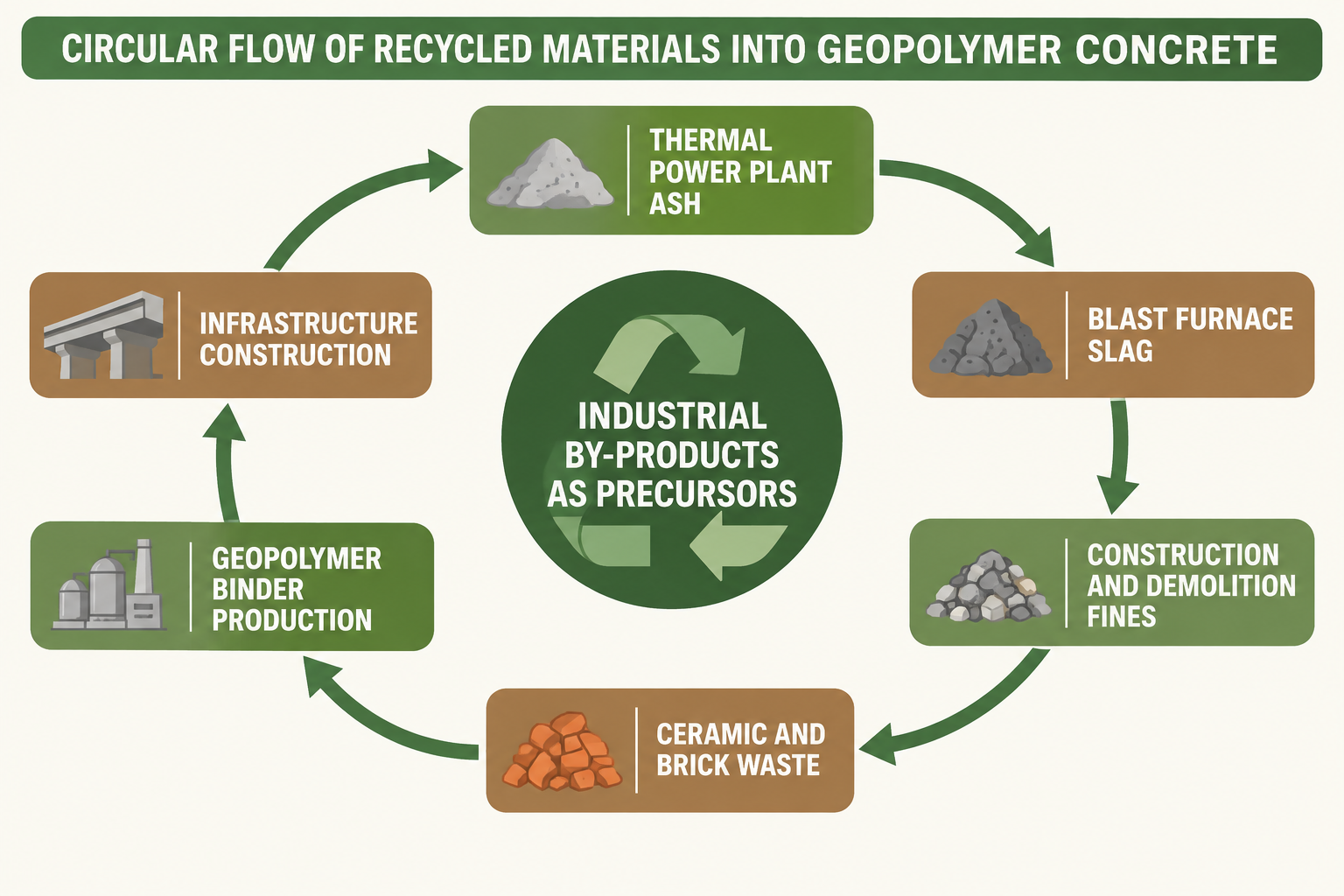
Recycled industrial materials convert geopolymer concrete from a chemistry demonstration into an infrastructure supply strategy. Ash, slag, ceramic waste and demolition fines provide the reactive precursors and aggregates that clinker-free binders require, and regional processing capacity turns variable waste arisings into consistent, certifiable products. The technology aligns directly with circular economy procurement, landfill diversion policy and verified carbon reporting, giving infrastructure owners a coherent basis for adoption. As standardisation completes and end-of-waste frameworks mature, the markets that industrialised their by-product processing first will hold both the material supply and the institutional experience that sustainable infrastructure will increasingly demand.