





















Fly ash geopolymer concrete has become the most extensively studied low-carbon structural binder in civil engineering, and it is now moving into structural applications on the strength of a two-decade research record. Coal combustion ash, an industrial by-product generated in the hundreds of millions of tonnes annually worldwide, supplies the reactive aluminosilicate material that replaces Portland cement clinker entirely. For structural engineers facing carbon reduction targets on every new project, the prospect of a binder built from a material the power sector currently manages as waste carries obvious strategic weight, and the technical questions that once limited adoption have been answered with increasing confidence.
The Chemistry That Replaces Clinker
Fly ash is rich in reactive silica and alumina held in a glassy phase formed during coal combustion. When an alkaline solution, typically sodium hydroxide combined with sodium silicate, contacts that glass, it dissolves the reactive species and polymerises them into a three-dimensional network of alumino-silicate gel. The term geopolymer describes this polymer-like gel structure, which performs the same binding function as the calcium silicate hydrate in Portland concrete but forms without any kiln firing or limestone calcination.
The consequences for embodied carbon follow directly. Portland cement manufacture emits carbon dioxide both from fuel-fired kilns and from the calcination of limestone itself, and that chemical process emission cannot be abated by fuel switching. The geopolymer binder eliminates the calcination step entirely and inherits a material that has already been produced. Independent life cycle assessments consistently report large reductions in binder embodied carbon compared with Portland cement concrete, with the exact figure depending on activator dosage, transport distances and the ash classification. This variability is why verified project-specific declarations, rather than generic claims, have become the standard evidence in structural submissions.
Not all fly ash performs equally. Class F low-calcium ash, common from bituminous coal combustion, is the preferred precursor for structural geopolymer because it delivers stable, predictable setting behaviour. Class C high-calcium ash sets faster and introduces calcium into the gel chemistry, which can be exploited in ambient-cure mixes but requires closer control. Ash fineness and unburnt carbon content, measured by loss on ignition, both influence reactivity, which places ash quality assurance at the front of every mix design programme.
Structural Performance the Evidence Supports
Compressive strength data now spans the full range of ordinary structural work. Well-proportioned heat-cured fly ash systems achieve strengths from around forty to beyond ninety megapascals, and ambient-cured blends incorporating slag reach comparable values without oven treatment. Elastic modulus typically runs somewhat lower than a Portland mix of equal cylinder strength, a parameter structural engineers must account for in deflection and buckling calculations rather than assume equivalence.
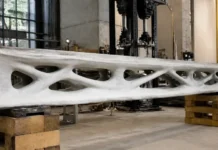
Reinforcement bond behaviour has been verified through pull-out and beam testing across multiple research programmes, with geopolymer concrete generally showing bond strengths comparable to Portland concrete of equivalent grade. Flexural behaviour of reinforced geopolymer beams follows standard reinforced concrete mechanics, and published tests confirm that existing design methods for bending, shear and crack control transfer with appropriate material parameters. Several full-scale structural demonstrations, including footings, columns and complete beam assemblies cast in research facilities and on live projects, have validated the translation from coupon testing to real members.
Durability is where geopolymer chemistry earns structural specifications in aggressive environments. The refined pore network of the geopolymer gel restricts chloride ingress substantially compared with Portland concrete, which extends the design service life of marine-exposed and ground-contact elements.
Sulfate, acid and chemical attack resistance follows from the same mineralogical differences, and long-term exposure testing on geopolymer concrete in aggressive ground and industrial environments has shown low deterioration rates in published programmes. Structural engineers should nevertheless insist on project-specific exposure testing where unusual chemicals are present, since geopolymer performance depends on precursor chemistry and activator formulation, both of which vary between suppliers. Test regimes drawn from ASTM and EN durability standards, adapted where necessary for the binder system, provide recognised formats that approving authorities can review without bespoke frameworks. Chloride binding capacity of the aluminosilicate gel, measured across multiple studies, adds a further margin where de-icing salts or marine aerosols govern the exposure class. Reduced calcium content removes the vulnerable portlandite phase, improving resistance to sulfate attack and acid exposure. Drying shrinkage of heat-cured fly ash systems is typically lower than Portland concrete, benefiting crack control in restrained members, while creep behaviour remains an area where element-specific testing is prudent.
Fire performance rounds out the structural case. Furnace testing has shown the binder retaining a higher proportion of its compressive strength after elevated temperature exposure than Portland concrete, with comparatively stable behaviour through the temperature range where calcium hydroxide decomposition weakens conventional matrices. For fire-rated structural frames, that evidence supports standard fire design submissions.
Mix Design Practice and Curing Strategy
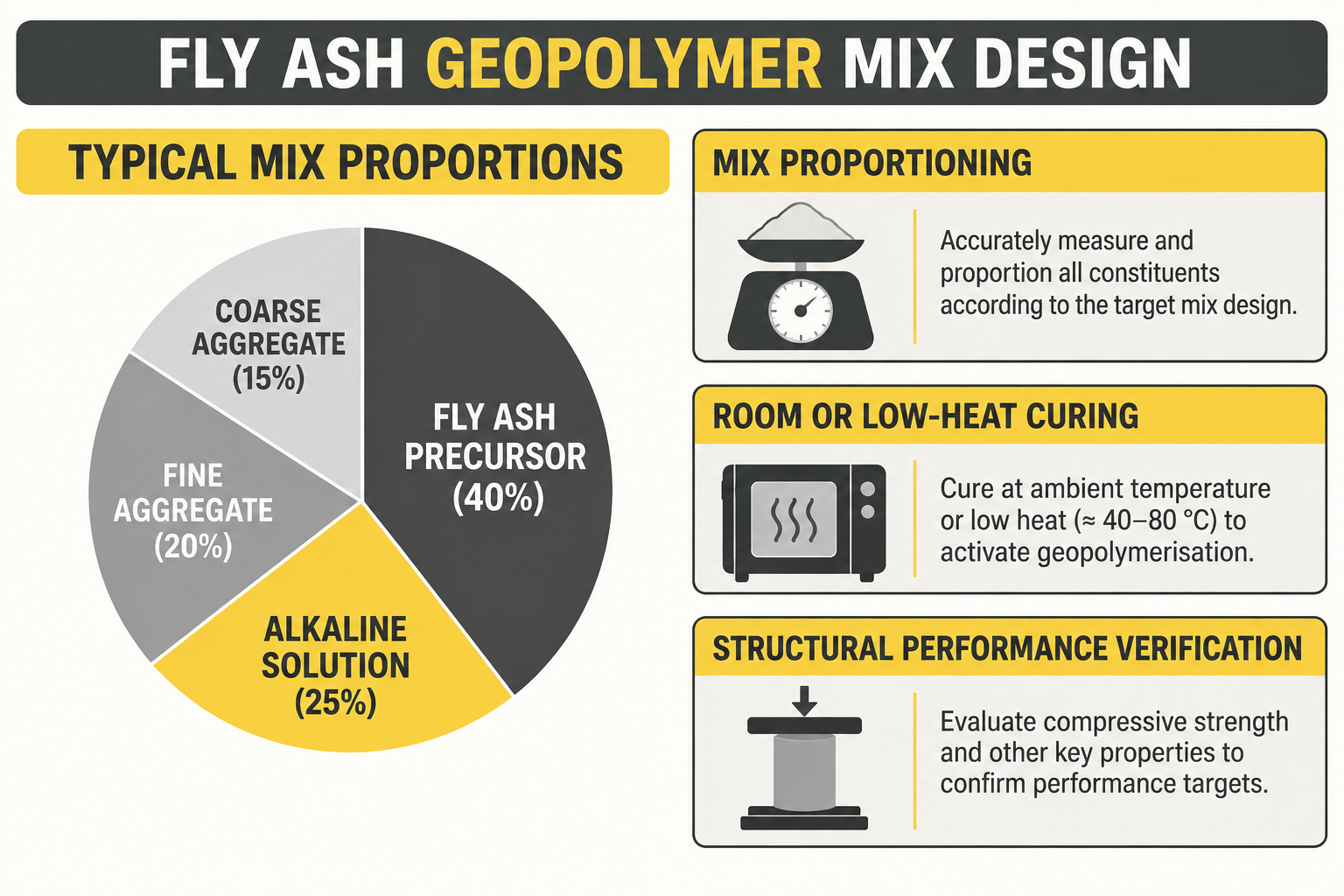
Mix proportioning for fly ash geopolymer differs from Portland practice in one central respect: the activator. Sodium hydroxide concentration, usually between eight and sixteen molar, and the ratio of sodium silicate to hydroxide solution govern reactivity, workability and strength development together. Increasing silicate dosage generally raises strength but also cost and viscosity, so mix designers work within a practical window rather than optimising a single variable. Aggregates, water content and admixtures follow conventional proportioning logic, though naphthalene-based superplasticisers have shown more reliable performance with geopolymer pastes than some polycarboxylate formulations. The activator variables that mix designers control sit within a defined practical window:
- Sodium hydroxide concentration between eight and sixteen molar, which sets the alkalinity driving dissolution of the glassy ash phase.
- Sodium silicate to hydroxide ratio, which raises strength and viscosity together and acts as the principal cost lever in the mix.
- Slag substitution level, which accelerates ambient-cure setting behaviour and reduces dependence on elevated-temperature curing.
- Water content and admixture selection, which govern workability and pumpability without diluting the alkaline activation system.
Curing strategy defines the commercial shape of any application. Open time for finishing and joint preparation is typically longer than a rapid-set Portland mix, which crews often find easier to manage on hot days. Heat curing between sixty and ninety degrees Celsius for several hours accelerates geopolymerisation dramatically and produces the highest, most repeatable strengths, which is why precast production and factory products adopted the technology first. Ambient-cured structural concrete relies either on Class C ash, on slag blending or on chemical activator adjustments to achieve practical setting times on site. Each route trades some strength development rate for operational simplicity, and project teams should match the curing route to the element and programme rather than expecting one mix to serve all situations.
Quality control practice extends naturally from conventional concrete testing. Slump or flow testing, cube or cylinder sampling and standard curing-room testing all transfer directly, with the addition of activator solution batching verification and, on heat-cured work, temperature logging of the curing cycle. Contractors familiar with temperature-matched curing on mass pours will recognise the discipline immediately.
Standards, Demonstrators and the Adoption Pathway
Standardisation remains the gating factor for routine structural use. Prescriptive national codes written around Portland chemistry can exclude alkali-activated binders by clause rather than by performance, so early structural projects have proceeded through performance-based specifications, engineering derogations or project-specific approvals. Australian standardisation work and European pre-normative research programmes are steadily building the documentation base that code committees need, and performance requirements for alkali-activated concrete are appearing in draft form across several jurisdictions.
Full-scale demonstrators have played a decisive role in building institutional confidence. Airport aprons, department store slabs, pedestrian bridges and public building elements cast in fly ash geopolymer concrete across Australia and Europe have provided multi-year service records, monitoring data and, critically, reference projects that approving authorities can inspect. Where those demonstrators are local, adoption accelerates; structural engineers weight proximate, comparable evidence heavily when certifying unfamiliar materials. Teams mapping the wider adoption picture across by-product streams will find the related analysis of recycled industrial materials in geopolymer concrete for sustainable infrastructure useful for understanding how ash supply interacts with other precursor sources.
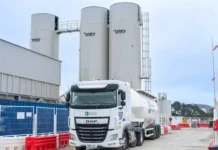
Supply considerations deserve equal attention in feasibility work. Fresh ash availability tracks coal generation, which is declining across many markets, so structural projects should verify ash sourcing, classification testing and reserve arrangements early. Stockpiled and processed ash can substitute with additional quality control, and blends with slag or calcined clay widen the sourcing base. These logistics, rather than the structural engineering itself, now determine where geopolymer concrete can be specified economically.
Fly ash geopolymer concrete offers structural engineering a binder that converts a managed waste stream into a verified, durable and substantially lower-carbon structural material. Strength, bond, durability and fire evidence now cover the ordinary range of structural work, and the remaining barriers are institutional: standards completion, ash supply planning and the accumulation of certified project experience. Firms that engage with trial elements, performance-based specifications and verified declarations now will be positioned to specify this binder routinely as codes and carbon procurement rules complete their transition over the coming decade.