



























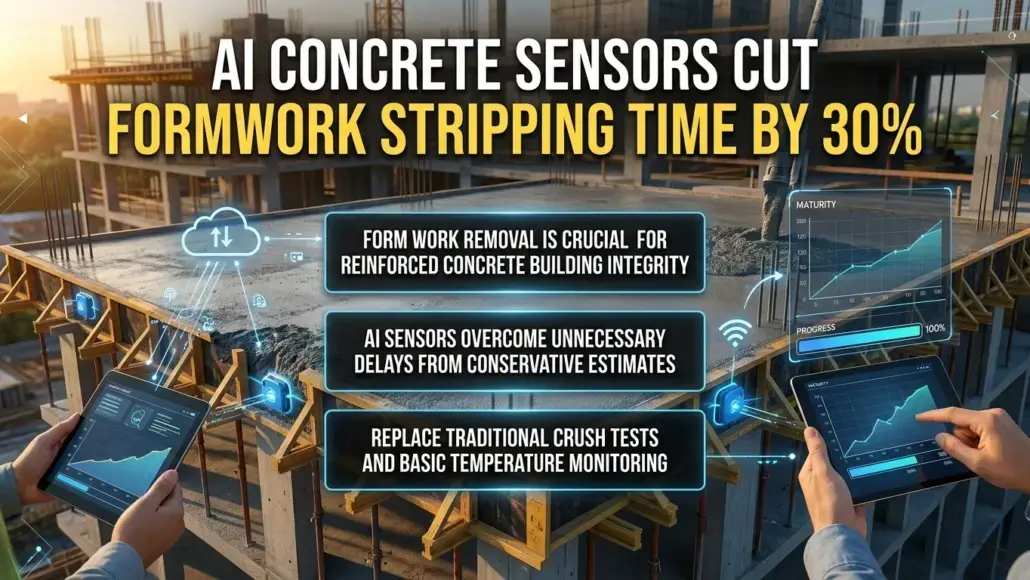


The structural integrity of any reinforced concrete building depends on the precise timing of formwork removal. For decades, site managers have relied on conservative estimates, traditional crush tests, or basic temperature monitoring to decide when a slab has reached sufficient strength to support its own weight. This conservative approach often leads to unnecessary delays, as crews wait for a safety margin that may have already been surpassed. The introduction of AI concrete sensors is changing this dynamic by providing a data-driven window into the hydration process, allowing teams to act with confidence based on the actual state of the material rather than a predetermined schedule.
Early formwork removal is not just a matter of convenience; it is a critical component of project velocity. In high-rise construction, the speed at which a cycle can be completed often dictates the overall profitability of the project. By using AI concrete sensors, contractors can identify the exact moment that structural requirements are met, often cutting days from a typical pour-to-strip cycle. This acceleration is achieved through a more accurate application of the maturity method, where artificial intelligence analyzes temperature and humidity fluctuations to predict compressive strength with a degree of precision that manual methods cannot replicate.
Real-Time Hydration Monitoring and Data Accuracy
Traditional methods of measuring concrete strength often involve the use of field-cured cylinders, which are meant to represent the condition of the poured slab. However, these cylinders are subject to different environmental variables than the massive volume of concrete in the actual structure, leading to discrepancies that can cause either premature stripping or excessive waiting. AI concrete sensors are embedded directly within the formwork, capturing data from the core of the pour. This ensures that the information received by the project team reflects the true thermal signature and chemical progression of the material in its specific environmental context.
The intelligence behind these sensors goes beyond simple data collection. Machine learning algorithms process the incoming streams of temperature and moisture data, comparing them against vast datasets of various mix designs under different climatic conditions. This allows the system to provide a predictive forecast of when the concrete will reach its target strength. Instead of reacting to a lab report that may be several hours old, site supervisors can monitor progress through a digital interface, receiving alerts the moment the concrete is ready for the next phase. This continuous feedback loop is what enables the documented thirty percent reduction in stripping time.
Operational Efficiency and Labor Coordination
The impact of this technology extends into the logistical management of the job site. When the stripping time is predictable and verified, the coordination of following trades becomes significantly more efficient. Scaffolding teams, rebar fixers, and MEP contractors can be scheduled with greater certainty, reducing the idle time that often plagues large-scale builds. Because AI concrete sensors provide a reliable timeline, the risk of a “stop-start” workflow is minimized. The ability to plan labor around verified data points rather than best-guess estimates ensures that the human capital on site is utilized to its maximum potential.
Furthermore, the reduction in formwork dwell time means that the equipment itself can be cycled more frequently. For a contractor, this reduces the total amount of formwork inventory required on site, leading to lower rental costs and a smaller physical footprint for material storage. In an industry where margins are thin and space is at a premium, the ability to do more with less equipment is a vital competitive advantage. The data provided by the sensors also serves as a permanent digital record of the structural curing process, which is invaluable for quality assurance and long-term liability management.
Mitigating Risk and Ensuring Structural Quality
While the speed of construction is a primary benefit, the use of AI concrete sensors is equally focused on safety and quality. Stripping formwork too early can lead to structural sagging or, in extreme cases, catastrophic failure. By providing a verified strength reading, the sensors remove the human element of guesswork from the decision-making process. The artificial intelligence can identify anomalies in the curing process—such as unexpected temperature drops or moisture loss—that might indicate a problem with the mix or the environment. This early warning system allows for immediate remedial action, such as adjusting heating or curing blankets, before the integrity of the slab is compromised.
The consistency of the results achieved through automated monitoring also leads to better surface finishes and fewer structural cracks. Concrete that is allowed to cure under optimal, monitored conditions is less likely to suffer from the internal stresses caused by rapid or uneven temperature changes. For structural engineers, the availability of high-fidelity data regarding the early-life performance of the concrete provides greater confidence in the as-built quality of the building. This shift toward empirical verification is a hallmark of the modern move toward more professionalized and accountable construction practices.
Environmental Sustainability and Resource Management
The construction industry is under increasing pressure to reduce its environmental impact, and the curing process is an area where significant gains can be made. By optimizing the use of heating equipment during the winter months, AI concrete sensors help to reduce the energy consumption of a project. Instead of running heaters on a continuous cycle, they can be used only when the data indicates they are necessary to maintain the target hydration rate. This targeted approach reduces the carbon footprint of the build and lowers the operational costs for the contractor.
In the long term, the move toward data-driven concrete management supports the industry’s transition to more sustainable mix designs. Low-carbon concrete mixes often have different curing characteristics than traditional Portland cement, and the use of AI concrete sensors allows teams to master these new materials without increasing project risk. By providing a reliable way to monitor the performance of innovative materials in the field, artificial intelligence is enabling the construction sector to adopt greener practices with greater speed. The combination of improved project velocity and reduced environmental impact makes the adoption of this technology a logical step for forward-thinking firms.
The integration of artificial intelligence into the most fundamental aspects of building is a clear indication of where the sector is headed. By replacing traditional, conservative estimates with real-time, verified data, contractors can achieve levels of efficiency that were previously considered impossible. The thirty percent reduction in stripping time is a clear metric of success, but the broader benefits of safety, quality, and sustainability are equally important for the future of the industry.
As project timelines continue to compress and the complexity of builds increases, the reliance on digital monitoring will only grow. The ability to see inside a curing slab and understand its exact state is a powerful tool that changes the way we think about the construction schedule. Firms that embrace these digital tools will find themselves better equipped to handle the challenges of the modern built environment, delivering high-quality structures with greater speed and precision.