




















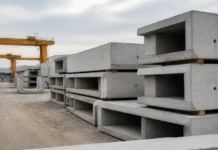



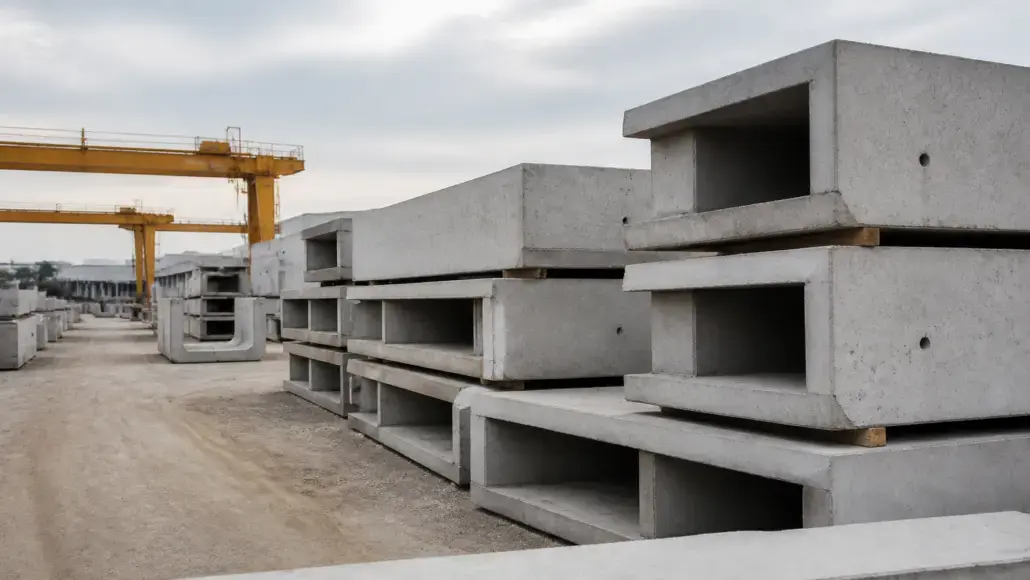

Precast geopolymer concrete components are entering mainstream infrastructure procurement as transport agencies, water utilities and building contractors search for verified ways to cut embodied carbon without stretching construction programmes. The combination answers two pressures at once: precast manufacturing already offers the process control that novel binders need, and infrastructure clients now carry carbon budgets that make clinker replacement a tender criterion rather than a research curiosity. Factories in Australia, Europe and parts of Asia have moved geopolymer elements from trial pours into commercial production runs, supplying beams, panels, segments and pipes into live projects.
Why the Factory Suits a New Binder
Curing discipline explains much of the appeal. Many fly ash-led geopolymer mixes need elevated temperature curing, typically between forty and ninety degrees Celsius for sustained periods, to develop reliable early strength. A precast plant can deliver that regime in curing chambers with consistent temperature and humidity, whereas on-site curing depends on weather, insulation and programme pressure. Slag-rich geopolymer blends relax the curing requirement considerably, yet factory control still delivers tighter strength variability, and that variability is precisely what design engineers need before they will trust a new binder in a structural element.
Repeat production compounds the advantage. A bridge project may cast forty identical deck segments; a residential programme may produce thousands of identical stair units. The first units carry the learning cost of mix tuning, flowability adjustment and demoulding trials, and every subsequent unit inherits that optimisation at marginal cost. On a one-off site pour, the learning cost lands on a single element and the economics rarely work. Precast production turns binder innovation from a project risk into a line-item that amortises.
Quality assurance infrastructure matters as much as curing. Precast factories maintain in-house laboratories, cube or cylinder testing regimes, weigh-batching accuracy and trained sampling staff, so every batch of geopolymer elements can carry documented strength evidence. When a structural engineer reviews a submission for an unfamiliar binder, that documentation trail, rather than the chemistry itself, is usually what secures approval.
Component Types Where Precast Geopolymer Concrete Leads
Commercial production has concentrated on element families where the binder’s strengths align with the product’s exposure and where repeat volumes justify mix development. Several categories now have meaningful production track records.
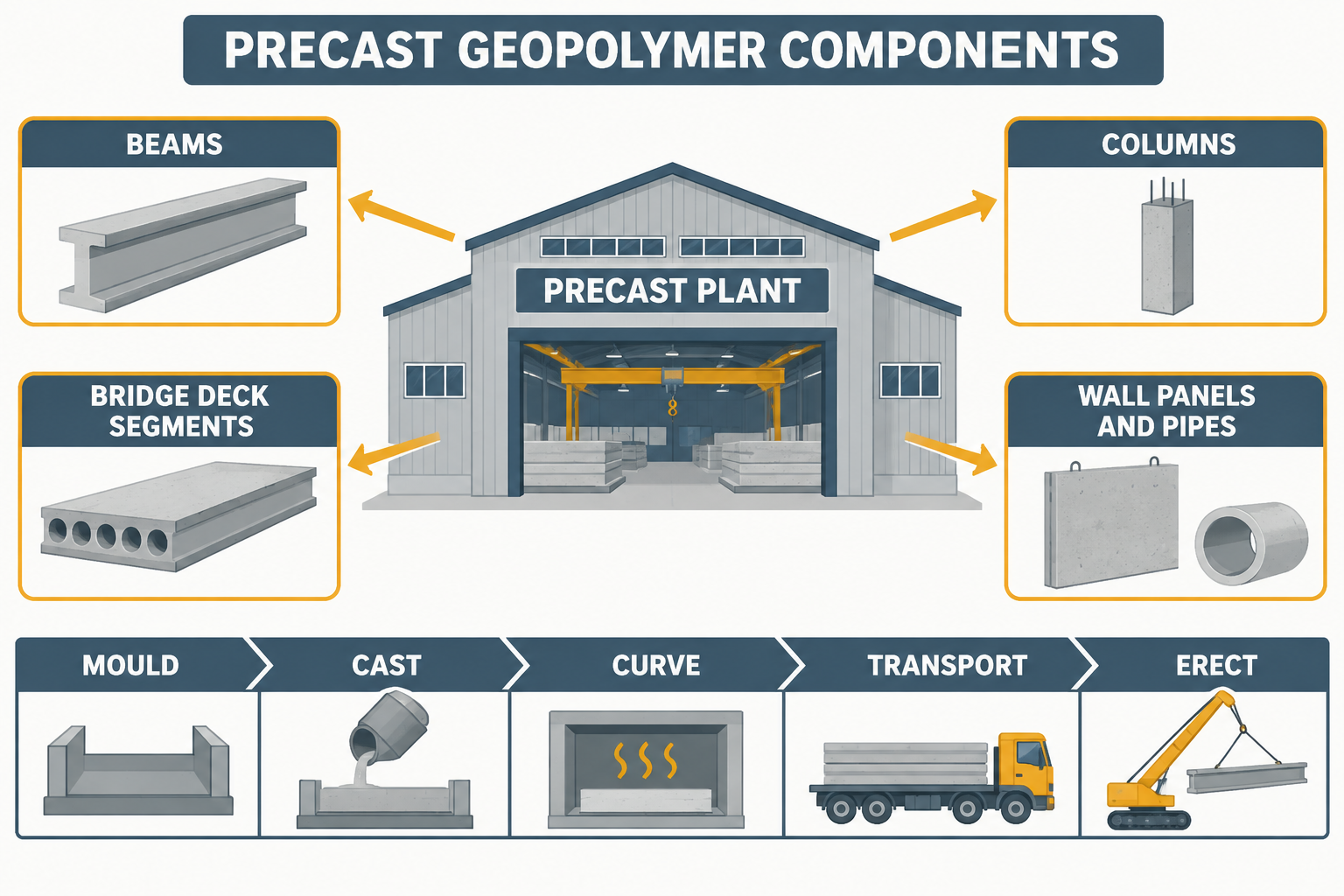
- Bridge deck segments and parapets, where low chloride permeability directly extends service life in marine or de-icing salt environments and where segmental construction suits factory repetition.
- Wall panels and facade units for commercial and residential buildings, where stable dimensional control and reduced carbon content support both structural frames and green building certification.
- Pipes, culverts and drainage units, where sulfate and acid resistance in aggressive ground conditions reduces the maintenance liability water utilities carry across decades of service.
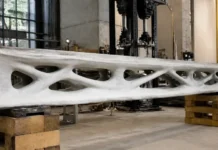
- Beams, columns, stair cores and other primary frame elements, produced in slag-blended mixes that cure at ambient plant temperatures and meet standard structural strength classes.
- Rail and pavement products, including sleepers and kerb units, where high-volume repeat production has justified dedicated geopolymer mix development programmes.
Across these categories, the common commercial logic is that the client buys a finished, tested element rather than a raw material. The binder innovation is embedded inside a familiar procurement shape: a product specification, a factory audit and a delivery schedule. That shapes approval conversations far more smoothly than a novel site-mixed material would.
Durability Evidence From Service Environments
The durability record is accumulating from real infrastructure rather than laboratory coupons alone. Geopolymer binders show markedly reduced chloride diffusion coefficients compared with Portland cement concrete in most published testing, a consequence of the refined pore structure and the absence of calcium hydroxide phases that chlorides can react with. For bridge elements exposed to marine aerosols and for drainage products buried in sulfate-bearing soils, that property converts into design service life calculations that are easier to defend.
Sulfate resistance deserves particular note for utilities. Conventional buried concrete in aggressive ground relies on sulfate-resisting Portland cement, surcharge quality control and sometimes protective coatings. Geopolymer pipes and culverts have been trialled in ground conditions that would demand such measures with Portland binders, and reported performance across multi-year exposure has been stable. Acid resistance follows the same direction: the aluminosilicate gel neutralises acid attack differently from calcareous Portland paste, which is relevant to sewer networks where biogenic acid attack is a persistent maintenance cost.
Fire performance rounds out the case for structural elements. Furnace testing of geopolymer concrete has generally shown comparable or improved residual compressive strength relative to Portland concrete, with different spalling behaviour linked to the absence of bound calcium hydroxide. For precast components in tunnels, car parks and industrial buildings, that evidence supports fire design submissions without exceptional measures.
Freeze-thaw and abrasion performance, where relevant to regional markets, follows the same evidence-building pattern. Air entrainment in geopolymer systems has required admixture reformulation rather than direct transfer of Portland practice, and published frost resistance testing shows satisfactory performance once a stable air void system is achieved. Abrasion resistance of slag-blended geopolymer floors and paving products has compared favourably with Portland equivalents in laboratory studies, supporting the product families listed above in demanding service environments. Producers serving cold climates should request frost resistance data specific to their mix rather than relying on transfer assumptions from conventional concrete.
Shrinkage and creep remain the areas requiring careful element-specific verification. Drying shrinkage of heat-cured fly ash geopolymer is typically lower than Portland concrete, which benefits panel dimensional stability, while creep data is thinner and stiffness values can differ from Portland mixes of equal strength. Responsible precast producers publish element-specific test data and design parameters rather than assuming equivalence, and that practice should be treated as a selection criterion when choosing suppliers.
Production Economics and Supply Chain Realities
Cost structure determines how quickly these components spread through infrastructure programmes. Geopolymer binder systems trade avoided clinker for alkaline activators, and sodium silicate remains the expensive component. At current prices, delivered element cost parity depends on precursor logistics, activator sourcing and the carbon value assigned by the client. Producers located near fly ash sources or slag supplies hold a structural advantage, and several have built their business models around those feedstock corridors.
Coal transition is reshaping the fly ash half of the equation. As thermal power stations retire, fresh fly ash supply is tightening in some markets and stockpiled ash quality varies. Producers are responding in three directions: slag-blended designs, acceptance of processed stockpile ash with quality control, and development of calcined clay precursors. Each direction preserves the precast business case, but mix designs and activator dosages shift, which clients should expect to see reflected in evolving product declarations.
Carbon accounting is the commercial lever pulling demand forward. Environmental product declarations modelled to EN 15804 now accompany commercial geopolymer element ranges, allowing infrastructure clients to book verified embodied carbon savings directly against project carbon budgets under frameworks such as PAS 2080. Where public tenders include carbon pricing or carbon reduction requirements, precast geopolymer elements compete on a playing field that conventional elements must answer with cement substitutions of their own. Procurement teams evaluating the wider field of binder substitution will find the broader context set out in geopolymer concrete applications for sustainable building construction, which maps where the technology delivers most value across project types.
Specification Pathway for Project Teams
Engineers specifying precast geopolymer components for the first time face a sequence that is now reasonably well trodden. Performance-based specification, stating required strength class, durability exposure class and verified declaration data rather than prescribing binder chemistry, avoids the trap of prescriptive clauses written for Portland cement. Supplier qualification should review mix design documentation, factory test records, activator handling procedures and any third-party certifications or code derogations secured in comparable jurisdictions.
Connection design and site assembly follow conventional precast practice, since reinforcement detailing, lifting inserts and joint grouting operate identically regardless of binder. The main programme consideration is early-strength verification: heat-cured fly ash elements typically reach demoulding strength within the factory’s normal cycle, while ambient-cured slag blends may need modest cycle adjustments. Early coordination between the precaster and the design engineer on these parameters prevents surprises late in production.
Trial element programmes remain the fastest de-risking route. Casting a small production batch, testing it through the factory’s standard regime and inspecting the elements under the project engineer’s review converts an unfamiliar binder into a documented product with project-specific evidence. Several public infrastructure agencies have adopted exactly this pathway, running trial units through pilot packages before admitting geopolymer elements into full supply frameworks.
Precast geopolymer concrete components have moved past the demonstration stage and into commercial infrastructure supply, carried by the natural fit between factory process control and the curing, testing and documentation needs of a new binder. Durability performance in aggressive environments gives the technology a service life argument that goes beyond carbon, and repeat production economics give suppliers a route to sustainable margins. As standards committees complete the work of writing performance clauses for alkali-activated binders, the gap between early adopters and the wider market will narrow. Project teams that establish supplier relationships and trial-element experience now will find the transition straightforward when carbon requirements make that transition mandatory.