






















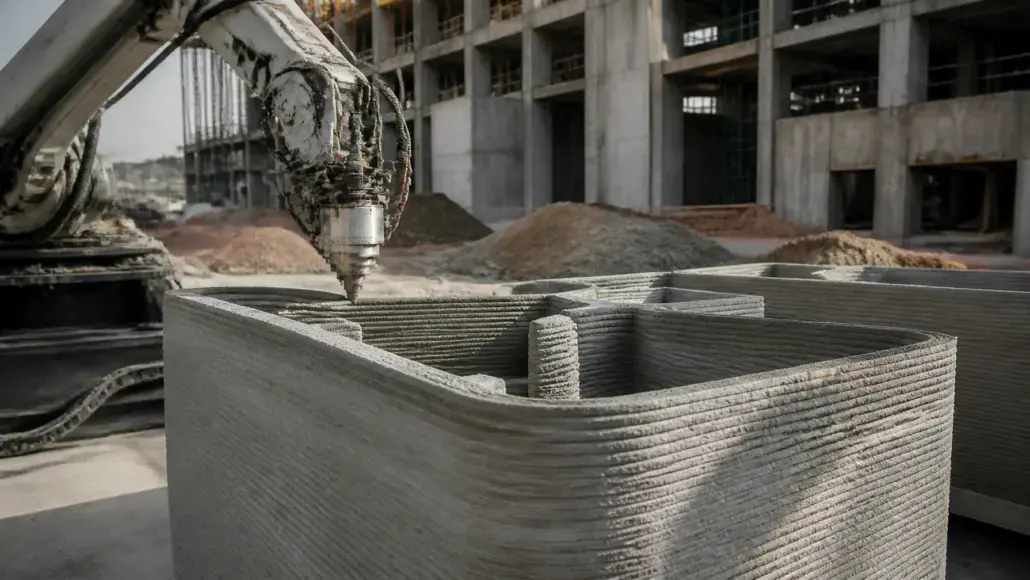

Geopolymer 3D printing is emerging as the most significant intersection of construction automation and low-carbon materials science. Extrusion-based concrete printing removes formwork from wall and element production, cutting one of the largest waste streams on conventional sites, while geopolymer binders remove Portland cement clinker from the mix. Combining the two produces buildings and components with both a smaller material footprint and a radically different production process. Research groups and commercial ventures across Europe, Asia and Australia have demonstrated printed geopolymer walls, columns, furniture-scale elements and complete small structures, and the technology is now being assessed seriously by contractors evaluating automated production methods.
What Makes a Concrete Printable
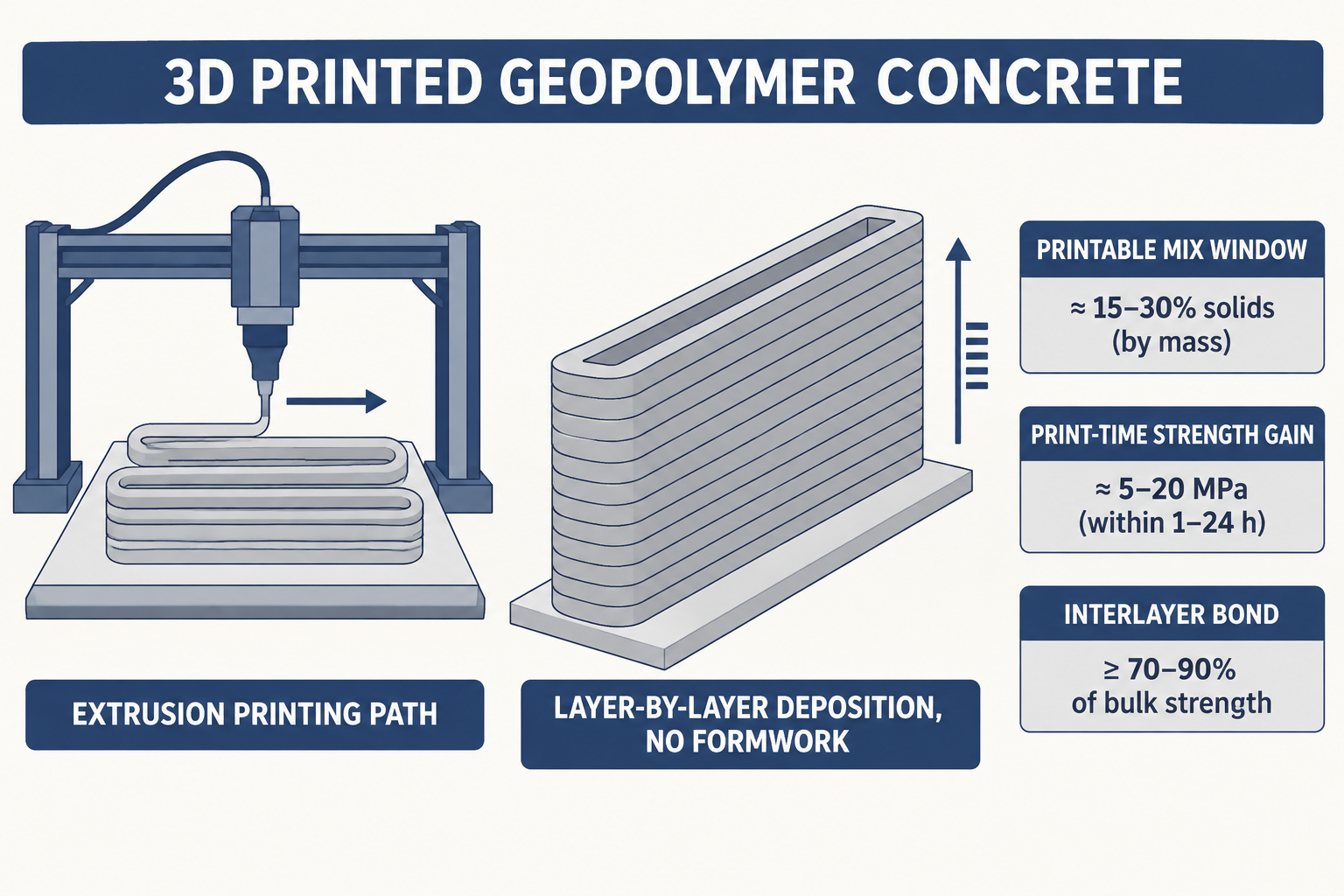
Printable concrete must satisfy requirements that conventional mixes never face. The material must pump through hoses under pressure, extrude through a nozzle as a continuous filament, hold its deposited shape under the weight of subsequent layers, build interlayer bond with the layer beneath and gain strength quickly enough to support progressive construction. Engineers summarise this as a balance between flowability and buildability: the mix must be fluid enough to pump and extrude, yet stiff enough to stack. Meeting both requirements simultaneously, while maintaining final structural strength, defines the printable mix window.
Geopolymer binders adapt to this challenge with distinct advantages. Setting and hardening behaviour in alkali-activated systems is governed by activator chemistry rather than cement hydration kinetics, giving mix designers an independent control lever: adjusting sodium hydroxide concentration, silicate modulus and slag blending changes open time and strength gain without adding cement. Thixotropy, the reversible thinning of the mix under shear and its recovery at rest, can be tuned through activator design and admixture selection, which is exactly the property extrusion printing requires. Published printable geopolymer mixes have demonstrated compressive strengths well above fifty megapascals in printed and properly cured specimens, sufficient for structural framing in low and mid-rise applications.
Interlayer bond remains the defining quality issue. Because each layer meets the previous one after a delay, weak interfaces can form where fresh material does not fully merge with partially set material below. Research on geopolymer printing has attacked the problem through mix thixotropy tuning, surface moisture management, time interval control and post-tensioning or combined reinforcement strategies. Printed geopolymer flexural testing consistently shows anisotropy, with weaker interlayer directions, and responsible design practice treats printed elements as orthotropic members until test data demonstrates otherwise.
Printing Systems and Building Applications
Concrete printing hardware falls into two main families, and both have been demonstrated with geopolymer materials. Commercial and research systems now span a wider set of recognised configurations:
- Gantry systems, which mount the extrusion head on a rigid frame for high-accuracy factory production of printed panel and element ranges.
- Robotic arm systems, which carry the extruder on a six-axis arm for on-site printing where mobility and reach matter most.
- Delta and cable-driven systems, which offer large build volumes at lower capital cost for experimental and mid-scale production work.
- Hybrid stations, which combine printing with automated reinforcement placement for manufacture of reinforced structural elements. Gantry systems mount the extrusion head on a frame that moves in three axes, offering high positional accuracy and payload, suited to factory production of precast-style printed elements. Robotic arm systems mount the extruder on a six-axis arm, offering reach, mobility and the ability to print on irregular sites, which has made them the choice for on-site demonstration buildings. Continuous delivery from batching plant to print head through progressive cavity pumps sustains the uninterrupted filament that quality printing requires.
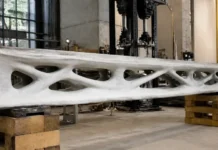
Building applications have progressed in a consistent sequence. Non-structural printed elements came first: urban furniture, facade features and landscaping products produced in factories where geometry advantages justify automation. Wall panels followed, with printed geopolymer panels tested as cladding, partition and insulated sandwich wall systems in several European housing research programmes. Complete printed buildings, printed on site or printed as modules and assembled, have been demonstrated for residential and relief housing contexts. Column and beam printing, including curved elements impossible to form conventionally at reasonable cost, extends the technology toward full structural framing.
The geometry argument deserves emphasis in commercial assessment. Formwork typically represents a large share of the cost of non-standard concrete elements, and its elimination changes the economics of curved, tapered and organic geometries from prohibitive to routine. For standard rectangular elements, printed production competes instead on speed, labour reduction and waste elimination. Design teams evaluating where geopolymer 3D printing adds value should therefore look first at elements whose geometry conventional forming struggles with, then at volume repetition where automation pays back fastest.
Sustainability Arithmetic of Printed Geopolymer Construction
The carbon case stacks three effects. Binder substitution removes clinker-related emissions, typically the largest component of concrete embodied carbon, and geopolymer mixes for printing have been formulated with fly ash, slag and calcined clay precursors. Formwork elimination removes timber and steel form materials, their transport, their cleaning chemicals and the waste stream of single-use forming, which on complex elements can exceed the concrete volume itself in material terms. Material efficiency adds the third effect: extrusion deposits concrete only where geometry requires it, and topology-optimised printed designs demonstrate material reductions that conventional forming cannot achieve economically.
Water use differs from conventional practice in ways that matter on constrained sites. Printable geopolymer mixes generally run at lower free water content than conventional pumped concrete, reducing bleeding and improving green strength, and printing produces little of the washout waste that conventional concrete operations generate. For urban infill projects and sites with strict environmental controls, these operational differences carry permitting and neighbourhood relation benefits beyond the headline carbon figures.
Life cycle assessment of printed geopolymer buildings remains an active research area, and honest reporting shows nuance: activator production carries its own footprint, printing equipment requires energy, and interlayer weakness can demand additional reinforcement that offsets some savings. Verified project-specific declarations are as essential here as in any other geopolymer application. Project teams weighing the wider case for binder substitution will find the broader context in geopolymer concrete applications for sustainable building construction, which maps where the technology delivers most value across building types.
Reinforcement, Standards and the Commercial Outlook
Reinforcement is the central unsolved design question for printed structural concrete. Conventional rebar cages cannot be cast around extruded layers, so printed construction relies on alternative strategies: cable and mesh integration between layers, short fibre addition to the printable mix, post-installed bars in drilled channels, and combined printing of permanent formwork with conventional reinforced cores. Each strategy has published structural testing behind it, and hybrid systems combining printed geopolymer shells with cast reinforced cores have emerged as the most practical route for multi-storey framing. Fire and acoustic performance of printed wall build-ups, with their natural voids and layer texture, are being characterised in parallel.
Digital workflow integration, from building information models directly to print path files, is progressing through commercial software partnerships and will define procurement workflows as adoption spreads.
Curing and post-processing of printed elements follow factory logic even when printing happens on site. Printable geopolymer mixes gain green strength quickly, but full strength development still benefits from moisture retention and, for slag-lean fly ash designs, modest temperature support such as insulated enclosures during early age. Surface texture, an inherent feature of layered deposition, can serve as an architectural finish, be spray-coated for sealing or be milled flat where tolerance demands. Dimensional accuracy on well-calibrated gantry systems has reached tolerances comparable to precast production, while site-based robotic printing carries greater variability that design details should absorb. Geometry-dependent strength variation between printed and cast specimens of the same mix is now routinely reported in supplier data, and structural submissions should reference printed-specimen testing rather than mould-cast results alone.
Standards development is beginning to address printing specifically, with work underway on printed concrete specification, layer bond testing methods and digital model acceptance criteria. Until harmonised provisions mature, printed geopolymer projects proceed through performance-based specification and project-specific approval, supported by extensive test sampling of printed elements rather than mould-cast coupons, since printed material properties differ directionally from cast material of the same mix. Procurement teams should expect that testing scope, and budget for it.
Commercial momentum is building through housing programmes rather than prestige structures. Printed geopolymer wall production addresses labour shortages, construction waste regulations and carbon reporting requirements simultaneously, and social housing agencies in several countries have commissioned printed demonstrator units as procurement learning exercises. Material suppliers have responded with commercial printable geopolymer product lines, shortening the mix development path for new entrants.
The realistic assessment is that geopolymer 3D printing will first own the niche where its advantages are structural rather than incremental: geometrically complex elements, factory panel production at volume and projects where waste, labour and carbon constraints bite hardest. As layer bond research, reinforcement integration and standards mature, the technology will move outward from that niche into mainstream framing. Contractors and developers that build printing capability now, through pilot elements and supplier partnerships, will hold the production experience that competitors will later need to buy.