


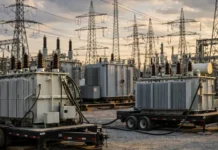

















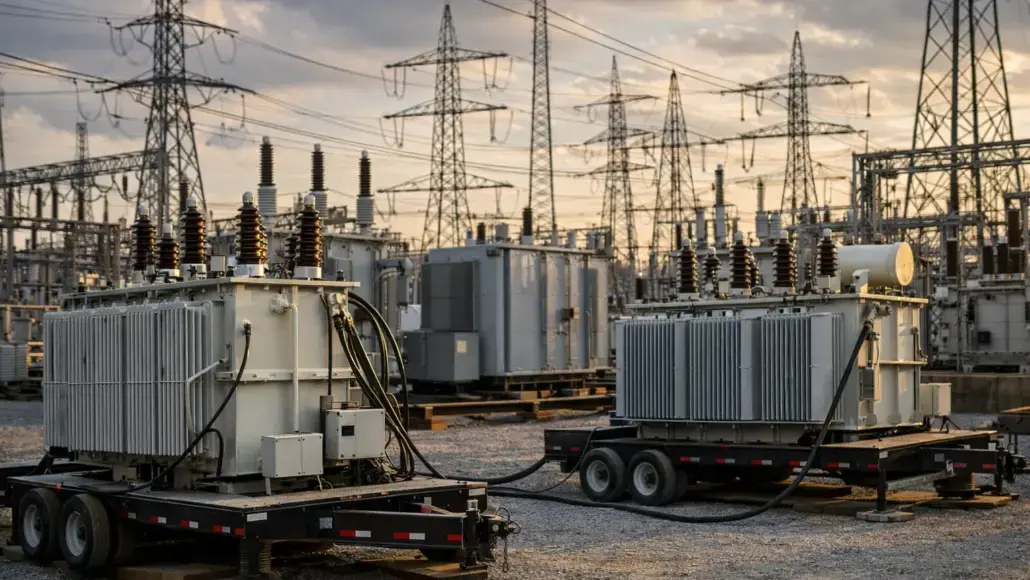


Electric utilities cannot wait two years for new transformers. Global demand has created a massive backlog, and manufacturing capacity simply isn’t keeping up with grid modernization needs. Rental transformers have become the go-to solution, giving operators immediate access to critical infrastructure while permanent equipment works its way through production pipelines.
Industry Strategies for the Supply Backlog
The global supply backlog exceeded 1,000 gigavolt-amperes (GVA) in 2024 and could reach roughly 1,690 GVA by 2030. Federal investment has helped, but the Infrastructure Investment and Jobs Act’s $73 billion allocation through 2026 still leaves a $578 billion investment gap for grid modernization. While long-term capacity builds, operators need strategies that work right now.
Multiple approaches have emerged to stretch existing resources and accelerate procurement:
- Asset life extension: Sensors detect insulation degradation early through partial-discharge monitoring, enabling utilities to schedule replacements strategically rather than face unexpected failures.
- Fleet standardization: When utilities order fewer unique configurations, manufacturers can dedicate production capacity to commonly specified units. Limiting custom specifications streamlines procurement across standard voltage classes and can significantly shorten ordering cycles.
- Reconditioning: Reconditioned transformers can often be ready in months instead of years, providing an alternative to waiting for new manufacturing. Units undergo thorough inspection and testing to meet performance standards.
- Advance pooling: Pooling arrangements help smaller operators gain access to backup inventory they couldn’t justify maintaining independently through regional collaboration. Shared stockpiles reduce individual capital requirements while improving emergency response capabilities.
These strategies buy valuable time. However, they don’t solve the immediate problem when a transformer fails or a new substation comes online, which is where temporary power fills the gap.
Temporary Power Equipment as the Immediate Solution
A substation expansion project scheduled for completion in six months loses value if the transformer does not arrive within 24 months. Operators cannot afford to wait years for new manufacturing when grid demands are immediate.
Short-term rentals provide stopgap power during equipment failures, while long-term arrangements support planned infrastructure projects that would otherwise stall. Rental transformers keep substations energized, construction sites operational and service areas protected from outages that could stretch for months.
Rental equipment offers the flexibility that permanent installations can’t match. Load growth projections change, and rental arrangements adapt to those shifts. When demand patterns remain unclear, operators can energize a new development with rental transformers while usage data accumulates.
Once actual requirements become clear, they can specify permanent equipment with confidence and return the rental unit. This strategy prevents both underbuilding and overbuilding costly permanent infrastructure.
Are There Companies That Deliver and Install Rental Transformers?
Comprehensive rental and service providers equipped to handle utility-scale demands have stepped up to meet the crisis. Three companies stand out for maintaining substantial inventories of distribution equipment, while offering the logistics support needed to get transformers into service quickly.
1. Sunbelt Solomon
Sunbelt Solomon offers a complete life cycle of power solutions for utility, commercial and industrial customers. Reconditioned units arrive much faster than new units, and its three-year warranty outpaces the standard one-year warranty on new units. Users get better protection and faster delivery.
Speed matters during a supply crisis, and Sunbelt Solomon’s emergency rental service responds to urgent needs with 24/7 availability and rapid deployment capabilities. Its inventory spans both low- and high-voltage transformer options to match equipment specifications to exact requirements without delays. It also provides maintenance and repair services for both rental and owned assets. This all-in service means clients work with one provider across an item’s entire life cycle.
2. United Rentals
https://www.unitedrentals.com/
United Rentals maintains a widely available fleet of temporary power equipment across numerous locations. Standardized step-up and step-down transformer configurations suit a range of distribution applications, and an established logistics network supports deployment to various project sites.
A national footprint gives United Rentals reach into most major markets. Equipment stock includes common voltage classes that cover typical distribution needs, helping utilities operating across multiple service territories access consistent equipment specifications regardless of location. The company’s Total Control online platform allows utilities to manage rental accounts and track equipment digitally.
3. Texas First Rentals
Texas First Rentals provides reliable transformer solutions with particular strength in regional power applications. Bundling transformers with other temporary power distribution equipment is a core part of its approach, particularly for customers who need integrated systems.
When a project requires switchgear, cable and transformers working together, sourcing each component separately from different vendors adds complexity. Texas First Rentals addresses this through bundled solutions that keep multiple components coordinated under a single agreement. Site assessments and professional installation services come standard, with experienced technicians handling planning and equipment removal.
Frequently Asked Questions About Temporary Power Equipment
Operators considering rental solutions often have similar concerns about capabilities and logistics.
How long can utilities rent transformers?
Rental periods range from days to years, depending on the application. Short-term rentals cover emergency outages and temporary construction power needs, while long-term arrangements support extended projects or bridge the gap until permanent equipment arrives. Some utilities maintain rental agreements for 18 months or longer during major infrastructure upgrades.
What voltage ratings are available in rental fleets?
Rental providers stock both low-voltage distribution transformers and high-voltage units for substation applications. Voltage classes typically range from 480V distribution equipment up to transmission-class transformers rated for 69kV and higher. Availability varies by provider and region.
Do rental agreements include installation and removal?
Most comprehensive providers handle pickup and placement as part of the rental service. This logistics support reduces coordination burden on utility crews and accelerates deployment timelines during critical situations. Some providers also offer connection services and testing.
Can rented transformers match custom specifications?
Standard ratings dominate rental inventories because they serve the broadest range of applications. Custom specifications may require longer lead times, but reconditioned units can sometimes be modified to meet specific requirements faster than ordering new equipment. Providers typically maintain communication about upcoming inventory additions.
How does rental pricing compare to purchasing?
Rental costs depend on equipment size, rental duration and required services. For short-term needs or uncertain timelines, expenses typically remain lower than capital purchases. Extended rentals may approach purchase costs, but they preserve capital budgets and provide the flexibility to return equipment when permanent solutions are in place.
Secure Reliable Power for Grid Resilience
The transformer supply crisis won’t resolve overnight. Flexible rental solutions keep utilities operational while the industry rebuilds manufacturing capacity. Operators who establish relationships with responsive rental providers gain the speed and inventory access needed to maintain grid reliability despite unprecedented lead times. Energizing a substation now with rental equipment beats waiting two years for new manufacturing. Rental transformers bridge the gap between immediate needs and long-term solutions.