






















Sika has developed SikaBiresin® MC 90, a two-component polyurethane paste material that enables high-throughput additive manufacturing of complex geometries and three-dimensional structures. Combining rapid strength development with thermal performance and dimensional stability, the material can reduce the need for support materials and energy-intensive post-curing during manufacturing.
The technology has potential applications in architecture, construction and design, where spatial printing offers new ways to produce curved elements, cantilevers and complex structures. Sika recently explored these possibilities through a collaboration with Digital Building Technologies (DBT) at ETH Zurich, demonstrating how the material can be printed directly into three-dimensional space rather than being built layer by layer.
Originally developed for high-performance molds used in prepreg composite production, SikaBiresin® MC 90 combines room-temperature processing with performance comparable to post-cured high-glass-transition-temperature epoxy systems.
Spatial Printing Enables Complex Architectural Geometries
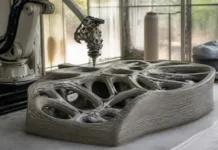
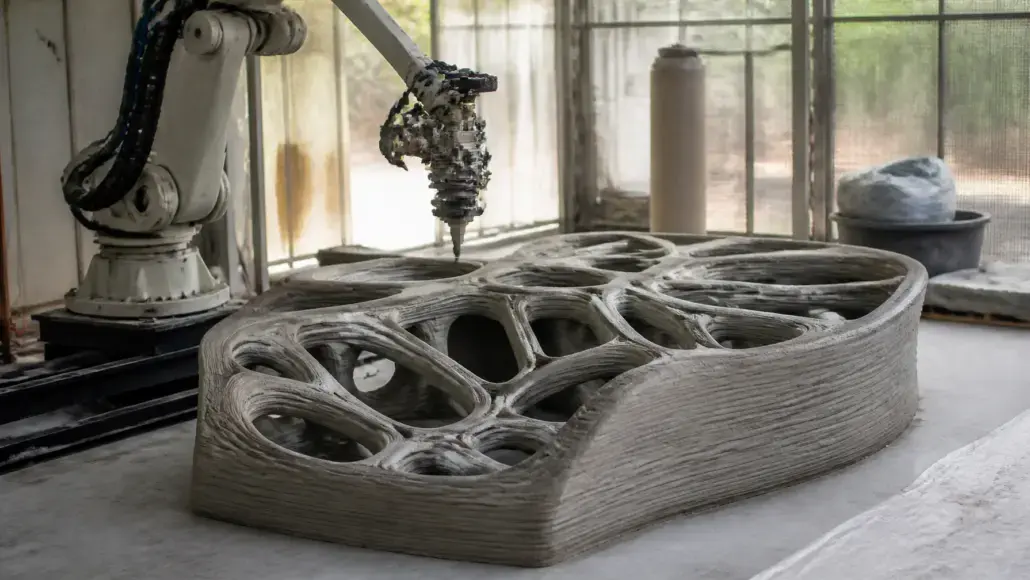
Spatial printing allows material to be deposited directly into three-dimensional space, enabling the creation of free-form geometries, curved elements, cantilevers and complex three-dimensional networks that can be difficult or impossible to manufacture using conventional methods.
In collaboration with DBT at ETH Zurich, Sika explored how SikaBiresin® MC 90 could be used in this printing process. The spatial 3D printing process was developed by DBT in collaboration with Sika.
The material’s rapid strength development enables printed strands to support themselves shortly after extrusion. This reduces the need for temporary formwork or additional support structures during printing, providing greater freedom to produce complex shapes.
For architecture and design, the technology offers opportunities to explore spatial structures and geometries beyond those typically produced through conventional manufacturing methods. Its application also demonstrates how material properties can influence the forms and structures achievable through additive manufacturing.
Material Properties Support Efficient Fabrication
SikaBiresin® MC 90 uses a two-component polyurethane chemistry that enables controlled curing and rapid strength development immediately after extrusion. These characteristics support the printing of complex geometries, large overhangs and hollow structures at high throughput.
The material was initially developed for high-performance molds used in prepreg composite production. Prepreg composites are carbon- or glass-fibre-reinforced materials pre-impregnated with resin and cured under heat and pressure to produce lightweight, high-performance components.
SikaBiresin® MC 90 combines room-temperature processing with thermal resistance and dimensional stability comparable to post-cured high-temperature epoxy systems. This allows the material to deliver the required performance for demanding tooling applications without the energy-intensive post-curing associated with conventional alternatives.
By reducing the need for support materials and post-curing, the technology can streamline production processes while reducing material consumption and waste.
Collaboration Explores Architecture and Construction Applications
The collaboration between Sika and DBT at ETH Zurich demonstrates how advanced material science and innovative printing methods can be combined to explore new possibilities in architecture and design.
The material’s ability to retain its shape shortly after extrusion supports the production of spatial structures without relying on conventional layer-by-layer fabrication. This opens opportunities to investigate complex geometries and customised forms for architectural and design applications.
Beyond composite tooling, SikaBiresin® MC 90 has potential applications in architecture, construction, design and customised components where geometric freedom and material efficiency are important.
The collaboration highlights the role of specialised materials in expanding the capabilities of additive manufacturing. By combining rapid curing with high printing throughput, SikaBiresin® MC 90 provides a material platform for exploring new fabrication approaches.
Additive Manufacturing Expands Design Possibilities
SikaBiresin® MC 90 brings together material performance and spatial printing capabilities to support the production of complex structures. Its rapid strength development enables printed strands to support themselves, while its thermal performance and dimensional stability support demanding tooling applications.
The work with DBT at ETH Zurich demonstrates how these characteristics can be applied to spatial printing and explored for architecture and design. The technology also offers potential for customised components and lightweight structures that benefit from geometric freedom and efficient material use.
By connecting advanced material development with spatial printing, Sika and ETH Zurich are exploring new possibilities for additive manufacturing across tooling, architecture, construction and design.