
























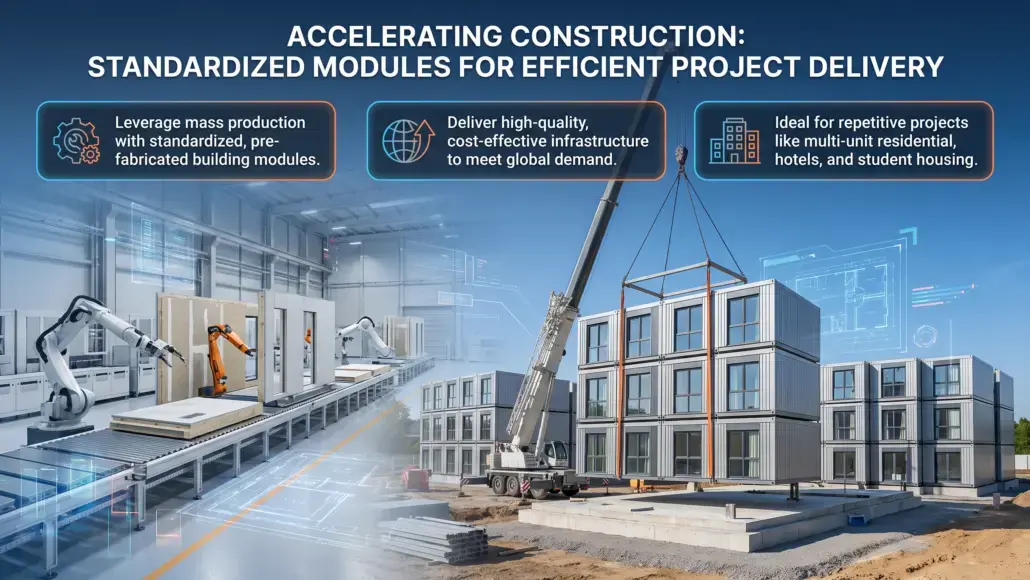


The implementation of standardized building modules has emerged as a critical strategy for addressing the global demand for high-quality, cost-effective infrastructure. By utilizing a common set of geometric and functional parameters, construction firms can utilize the benefits of mass production within the context of the built environment. This approach is particularly effective for repetitive project types, such as multi-unit residential developments, hotels, and student housing, where a high degree of uniformity is both desirable and efficient. The shift toward standardization allows for the optimization of the entire project lifecycle, from initial design through to long-term facility management. By reducing the number of bespoke components, developers can significantly lower the technical and financial risks associated with complex building projects, ensuring a more predictable and reliable delivery sequence.
The move toward standardized building modules does not necessitate a loss of architectural variety: rather, it provides a kit of parts that can be configured in numerous ways to meet specific site requirements. This flexibility is achieved by focusing on the standardization of internal systems and structural interfaces, while allowing for variation in external finishes and spatial arrangements. This balanced approach ensures that the benefits of industrialized production are maintained without sacrificing the aesthetic or functional diversity of the urban fabric. As the construction industry continues to grapple with rising material costs and labor shortages, the efficiency provided by standardized modular systems becomes an increasingly attractive proposition for both public and private sector clients who require rapid and scalable housing solutions.
Consistency in Multi Unit Residential Projects
In the realm of high-density housing, the use of standardized building modules provides a level of quality and consistency that is often difficult to achieve through traditional site-based methods. Every unit produced in a factory setting undergoes rigorous quality control checks, ensuring that insulation, acoustics, and structural connections meet or exceed the required standards. This uniformity is particularly beneficial for large-scale developments where the performance of each individual unit contributes to the overall efficiency of the building. By eliminating the variations inherent in manual labor and on-site assembly, developers can provide tenants and owners with a superior product that offers long-term durability and lower operational costs. The certainty of the final product also simplifies the handover process, as the likelihood of defects and snagging issues is significantly reduced.
The repeatability of the modular design also allows for the refinement of spatial layouts based on user feedback and performance data. Architects and engineers can analyze the performance of a standardized unit across multiple projects, making incremental improvements to its design to enhance occupant comfort and energy efficiency. This iterative process is a hallmark of product-based construction, where the building unit is treated as a piece of high-performance technology rather than a one-off structural assembly. The accumulation of knowledge over successive projects allows firms to continuously improve their modular offerings, creating a virtuous cycle of quality and performance that benefits all stakeholders. This focus on long-term value is a key driver for the adoption of standardized solutions in the residential sector.
Economic Advantages of Repetitive Component Production
The economic logic of using standardized building modules is rooted in the principles of economies of scale. When a manufacturer can produce a large volume of identical or nearly identical components, the cost per unit decreases significantly. This is due to the optimization of manufacturing processes, the reduction of setup times, and the ability to negotiate better pricing with material suppliers. For large-scale developers, these savings can be passed on to the end-user, making high-quality housing more accessible to a broader demographic. The financial predictability of the modular approach is also a major advantage, as the cost of the modules is established early in the project, reducing the risk of the budget overruns that are common in traditional construction.
Beyond direct manufacturing costs, the use of standardized modules also reduces the overhead associated with design and engineering. Once a modular system has been developed and certified, it can be deployed across multiple sites with minimal modification. This reuse of technical documentation saves time and money, allowing project teams to focus their resources on site-specific challenges like foundation design and surrounding site integration. The reduction in bespoke engineering also simplifies the regulatory approval process, as building officials become familiar with the performance characteristics of the standardized system. This streamlined path to project commencement is a vital factor for investors who need to minimize the time between capital allocation and project completion.
Supply Chain Stability through Standardization
Standardization plays a vital role in creating a more resilient and predictable supply chain for construction projects. By using a consistent set of materials and components across multiple projects, manufacturers can establish long-term relationships with suppliers, ensuring a steady flow of inputs even during periods of market volatility. The predictability of demand allows suppliers to optimize their own production schedules, leading to better lead times and reduced logistical costs. This level of supply chain integration is a key advantage of the modular model, as it minimizes the risk of the material shortages and price spikes that often disrupt traditional construction schedules. The ability to forecast material requirements with precision is an essential tool for managing the financial risks of large-scale developments.
The use of standardized building modules also facilitates the implementation of just-in-time delivery strategies. Because the manufacturing process is highly predictable, modules can be delivered to the site exactly when they are needed for assembly. This reduces the need for on-site storage and minimizes the risk of damage to completed units. The coordination between the factory and the site is simplified by the use of standardized transport and lifting protocols, ensuring that the movement of modules is handled with maximum efficiency. This logistical precision is particularly valuable in constrained urban environments where site access is limited and traffic congestion can pose a significant challenge. The ability to manage the entire supply chain through a lens of standardization is a fundamental driver of productivity.
Accelerating On-Site Assembly through Predictable Workflows
The primary benefit of standardized building modules during the assembly phase is the speed and predictability of the installation process. Because each module is designed to fit precisely with its neighbors, the on-site team can follow a repetitive and well-defined assembly sequence. This reduces the need for complex site-based coordination and allows for the use of smaller, more specialized assembly crews. The speed of installation is often several times faster than traditional methods, allowing buildings to be enclosed and made weather-tight in a fraction of the time. This accelerated schedule not only reduces the cost of site preliminaries but also allows owners to begin generating revenue from their assets much sooner.
The predictability of the assembly process also contributes to a safer working environment. Standardized modules are designed with integrated lifting points and safety features that minimize the risks associated with working at height. The reduction in the number of on-site trades also leads to less congestion and fewer opportunities for accidents. By moving the majority of high-risk work into the controlled environment of the factory, the modular industry has set a new benchmark for construction safety. The ability to plan every lift and connection in advance ensures that the assembly phase is executed with surgical precision, further reinforcing the reliability of the overall project delivery. This focus on operational excellence is a key differentiator for modular contractors.
Long Term Reliability and Performance Benchmarking
The long-term performance of standardized building modules is supported by the ability to conduct extensive testing and benchmarking on a single design. Unlike traditional buildings, where every structure is a unique prototype, modular systems can be subjected to rigorous laboratory testing to verify their structural, thermal, and acoustic properties. This data provides building owners and insurers with a high level of confidence in the long-term durability of the asset. The consistency of the manufacturing process ensures that the performance observed in the laboratory is replicated in every unit produced, providing a level of reliability that is difficult to match through site-based methods. This focus on verifiable performance is particularly important as building codes and environmental regulations become increasingly stringent.
The standardization of building components also simplifies the long-term maintenance and repair of the building. Because the modules are constructed using a common set of materials and assembly techniques, facility managers can develop standardized maintenance protocols that can be applied across their entire portfolio. If a component needs to be replaced, the replacement can be sourced with ease, as the specifications are already documented within the modular system. This ease of maintenance reduces the total cost of ownership and ensures that the building remains in peak condition throughout its lifecycle. The ability to manage buildings as high-performance products rather than one-off projects is a fundamental shift in the construction industry’s approach to asset management. This transition toward a more systematic and data-driven model is essential for creating a more sustainable and resilient built environment.