


















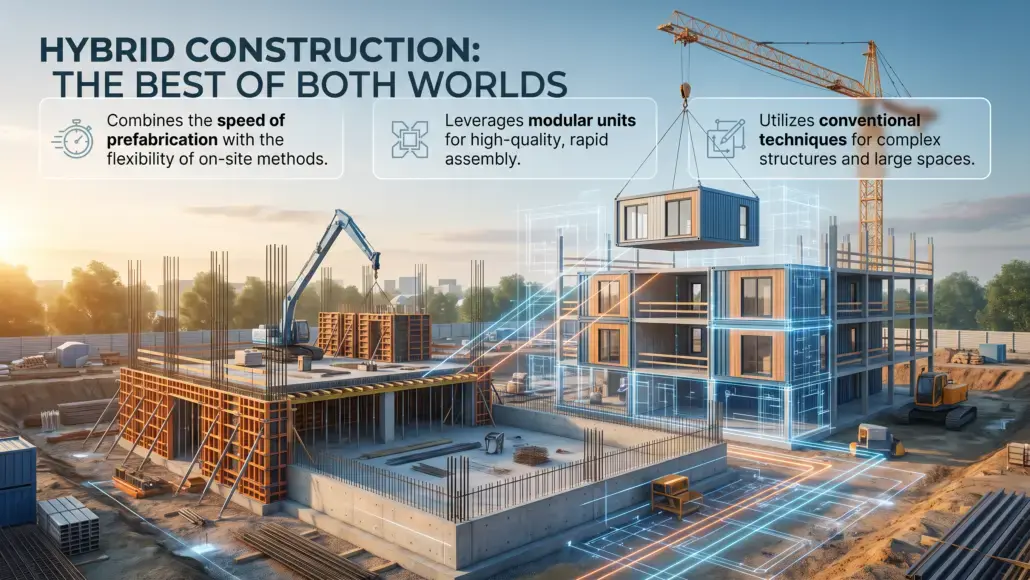


The evolution of modern construction has seen the emergence of hybrid modular systems as a pragmatic solution for projects that require both the speed of prefabrication and the flexibility of traditional site-based methods. This approach recognizes that while volumetric modular units offer significant advantages in terms of quality and speed, certain building components, such as long-span public spaces or complex foundation systems, are often better suited to conventional construction techniques. By integrating these two distinct workflows, project teams can optimize the structural and functional performance of the building while minimizing the overall delivery schedule. The hybrid model represents a sophisticated synthesis of industrialized manufacturing and bespoke engineering, providing a pathway for the broader adoption of off-site methods in a wider variety of building types.
The primary challenge in implementing hybrid modular systems lies in the coordination of the interface between the factory-produced units and the site-built elements. This requires a high degree of technical precision and a deep understanding of the tolerances associated with different construction materials. For instance, the connection between a modular unit and a site-cast concrete core must be carefully engineered to account for the slight variations that can occur in each system. Successful integration depends on the use of advanced digital modeling and a collaborative approach to project management that involves both the modular manufacturer and the site contractor from the earliest stages of the design process. When executed correctly, the hybrid approach provides a level of architectural freedom and structural efficiency that is difficult to achieve through a purely modular or purely traditional strategy.
Structural Synergy between Steel and Volumetric Units
One of the most common applications of hybrid modular systems is the combination of a structural steel frame with volumetric modular units. In this configuration, the steel frame provides the primary structural support for the building, allowing for large open spaces and flexible floor plates that would be difficult to achieve with load-bearing modules alone. The modular units are then “plugged into” the frame, serving as the functional rooms and service cores of the building. This synergy allows for the rapid enclosure of the structure, as the modules can be installed as soon as the relevant section of the steel frame is completed. The use of a permanent steel skeleton also enhances the overall stiffness and durability of the building, providing excellent performance under wind and seismic loads.
The integration of volumetric units into a steel frame also simplifies the installation of secondary building systems. Because the modules are self-contained and pre-wired, they require minimal on-site connection work once they are positioned within the frame. This reduces the need for extensive site-based electrical and mechanical trades, contributing to a cleaner and safer construction environment. The structural frame also provides a convenient platform for the installation of the building’s exterior cladding, which can be handled independently of the module installation. This parallel workflow is a key driver of the efficiency gains offered by the hybrid model, allowing for multiple stages of the building’s assembly to proceed simultaneously.
Logistics of Integrated Site and Factory Workflows
Managing the logistics of a hybrid modular project requires a sophisticated understanding of how factory production cycles and site construction sequences interact. Unlike a purely modular project, where the site work is primarily limited to foundations and assembly, hybrid modular systems involve a continuous integration of off-site and on-site activities. This necessitates a detailed master schedule that accounts for the lead times of the modular units and the critical path of the site-built components. For example, the completion of a site-cast concrete podium must be perfectly timed to coincide with the delivery of the first batch of modules to ensure that the site is ready for the assembly phase.
The coordination of these workflows is further complicated by the need to manage two different sets of material flows and labor forces. The factory production line operates on a highly predictable schedule, while site work is subject to the usual environmental and logistical variables. To bridge this gap, project managers must utilize real-time communication tools and data-sharing platforms to ensure that any delays in one area do not cause a cascade of issues across the entire project. The ability to adjust production schedules in response to site conditions is a critical factor for maintaining the momentum of a hybrid project. This level of logistical agility is a hallmark of the modern construction professional, who must be equally comfortable in the factory and on the site.
Enhancing Architectural Flexibility through Hybridization
The use of hybrid modular systems provides architects with a broader palette of design options than is possible with a purely volumetric approach. By utilizing site-built elements for the building’s core, lobby, and large amenity spaces, designers can create a sense of arrival and spatial openness that is essential for high-end residential and commercial projects. The standardized modular units can then be used for the more repetitive elements of the building, such as apartments or office suites, where the benefits of factory-controlled quality are most impactful. This combination allows for a high degree of architectural expression while maintaining the economic and temporal advantages of prefabrication.
Additionally, the hybrid model facilitates the integration of complex facade systems and irregular building forms. While volumetric modules are typically rectilinear, the site-built structural frame can be designed with curves or setbacks that respond to the specific urban context. The interface between the modular units and the exterior skin can be engineered to accommodate these variations, ensuring a seamless and high-quality finish. This flexibility is particularly important in historical or constrained urban environments where the building must conform to strict planning requirements and heritage considerations. The ability to blend industrialized efficiency with bespoke architectural form is a major selling point for hybrid construction.
Managing Complex Interfaces in Mixed Construction
The technical success of hybrid modular systems depends on the meticulous management of the interfaces between different building components. These connections must handle not only the structural loads but also the passage of services, the maintenance of fire separation, and the integrity of the building’s thermal envelope. In a hybrid project, the number of these interfaces is significantly higher than in traditional construction, requiring a specialized approach to detailing and quality control. Engineers must design durable connection systems that can accommodate the manufacturing and site tolerances while providing a secure and long-lasting link between the disparate elements.
To manage this complexity, many project teams utilize 3D scanning and reality capture technology to verify the accuracy of site-built components before the modules are delivered. By comparing the “as-built” site conditions against the digital model, contractors can identify any discrepancies and make the necessary adjustments to the modules or the site connections. This focus on verification reduces the risk of alignment issues during the assembly phase, which can be extremely difficult and expensive to rectify. The use of standardized connection protocols and pre-engineered joint systems also simplifies the on-site work, ensuring that the integration process is as efficient as possible. The focus on interface management is a fundamental component of the quality assurance process in hybrid construction.
Economic Rationale for Partial Prefabrication
The financial case for hybrid modular systems is based on the optimization of capital allocation and the reduction of project risk. While the initial cost of developing a hybrid system may be higher than traditional construction, the savings generated through reduced site preliminaries and accelerated delivery often outweigh the upfront investment. By prefabricating the most complex and labor-intensive parts of the building, developers can reduce their exposure to the unpredictability of the local labor market and the fluctuations of material prices. The hybrid model also allows for a more efficient use of site space, which is a critical consideration in high-value urban areas where land costs are a major factor in project feasibility.
Additionally, the use of hybrid systems can improve the long-term asset value of the building by ensuring a higher level of build quality and performance. The precision of factory-built units translates into better energy efficiency and lower maintenance costs over the building’s lifecycle. The ability to deliver a high-quality product in a shorter timeframe also provides a competitive advantage for developers in a fast-moving real estate market. As the construction industry continues to face pressure to improve its productivity and sustainability, the economic rationale for hybrid modular systems becomes increasingly compelling. This approach provides a practical middle ground for firms that want to embrace the benefits of industrialization without abandoning the proven techniques of site-based construction. The hybrid model is not just a technical solution: it is a strategic approach to modern building delivery.