

























Multifunctional Spaces: Adapting to Hybrid Lifestyles
The home has undergone substantial transformation due to the ever-evolving urban settings, especially in Asia, where increasing urbanisation and changing lifestyles necessitate innovative living solutions. Multifunctional spaces: accommodating hybrid lifestyles reflects the necessity for residences that fulfil several roles, balancing work, leisure, and family life within limited urban environments. This article examines the transformation of Asian residences to meet evolving demands, focussing on design philosophies, cultural shifts, and innovative solutions that characterise this change.
The Urbanization Challenge
Some of the world’s fastest-growing cities are found in Asia. Nearly 64% of Asians will reside in cities by 2050, according to the UN, increasing the need for infrastructure and housing. In cities like Tokyo, Shanghai, and Singapore, there is already a high population density and little room for housing. As a result, home architecture is shifting towards multipurpose areas to accommodate hybrid lifestyles that maximise available square meters.
As city dwellers are increasingly finding it challenging to balance work and personal lives, the necessity for houses that easily shift between functions has never been so acute. This development of domestic spaces is not simply a function of spatial limits but also an indication of changing cultural expectations and lifestyles.
The Rise of Compact Living
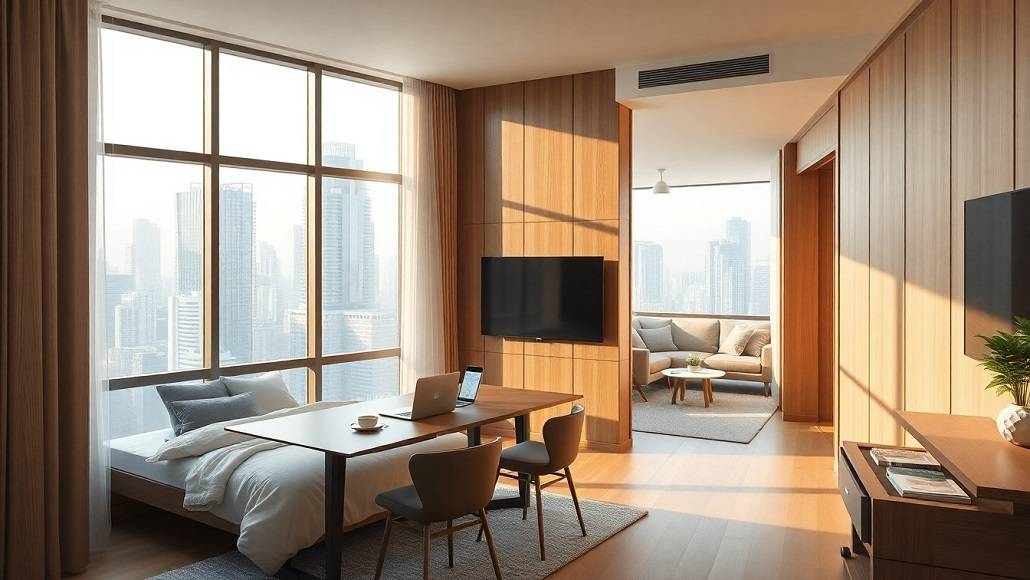
The contemporary urban dweller will often have a hectic lifestyle, with work, leisure, and family life frequently overlapping. To meet this challenge, designers and builders are turning to minimized living arrangements that optimize functionality while not sacrificing comfort. Multifunctional areas are made to be flexible, enabling homeowners to reorganize their space to meet varying needs, whether that involves home working, entertaining, or engaging with family.
Even in urban areas such as Singapore, for instance, new housing developments are embracing flexible space designs that enable changing the usage of spaces. Home offices can be easily transformed from living rooms by installing modular furniture and intelligent storage solutions. According to a study conducted by the Housing and Development Board (HDB), as many as 80% of Singapore residents favor dwellings with flexible elements, manifesting the increasing trend towards multifunctional living.
Innovative Design Solutions
The design principles of multifunctional spaces are based on optimizing space and embedding technology. Designers and architects are now more and more integrating elements like foldable furniture, movable partitions, and incorporated storage units that enable users to modify their living areas quickly. For example, a Murphy bed can be used to turn a bedroom into an office during the day, while a dining table can also serve as a working area.
In addition, technology is also an important factor in adding functionality to these areas. Smart home innovations allow residents to manage lighting, temperature, and entertainment systems via their devices, creating an ease of transition between work and leisure. Based on a report prepared by Statista, the Asian market for smart homes is forecasted to increase by over 25% each year, indicating the growing incorporation of technology into daily life.
Cultural Shifts and Family Dynamics
The transformation of multifunctional spaces: living with hybrid lifestyles is also highly affected by cultural changes in Asian societies. Historically, most Asian households have been dominated by extended family living arrangements. In line with modernization and rising urbanization, smaller nuclear families are increasingly becoming the norm. This change has necessitated flexible living spaces able to accommodate diverse family structures.
In addition, the pandemic has further fueled this trend, as work-from-home and online schooling have grown more common. Homes are now being asked to be both offices and classrooms as well as social spaces, which means families need to reconfigure their living situations.A McKinsey survey indicates a significant rise in the number of individuals working from home in Asia. Up to 60% of those surveyed expressed a preference for hybrid work schedules. This change has created a demand for housing that can accommodate these multifunctional lifestyles.
The Future of Multifunctional Spaces
With further evolution of Asian cities, the idea of multifunctional spaces: adjusting to hybrid lifestyles will probably become the norm in residential construction. Urban developers and planners are increasingly becoming aware of the significance of building spaces that bring people together yet also offer the flexibility that contemporary families demand.
New developments, including mixed-use ones that include residential units blended with commercial areas, are increasingly popular. Such developments promote the feeling of a community and decrease the necessity for lengthy commutes, making the urban context more sustainable. Moreover, the focus on sustainable building methods is prompting the implementation of environmentally friendly materials and energy-saving technologies in such multifunctional facilities.
Conclusion
In conclusion, the development of multipurpose areas in Asia, which have adapted to hybrid lifestyles, is indicative of a larger cultural movement in favour of adaptability and flexibility in living environments. The need for residences that can move fluidly between work, play, and family life will only increase as metropolitan areas become more crowded and lifestyles shift.
With creative architectural solutions, technology integration, and an emphasis on cultural changes, residential living appears to have a bright future. In an ever-changing environment, urban inhabitants may build places that not only meet their varied requirements but also promote a stronger sense of community and connection by adopting the concepts of multifunctionality.