
























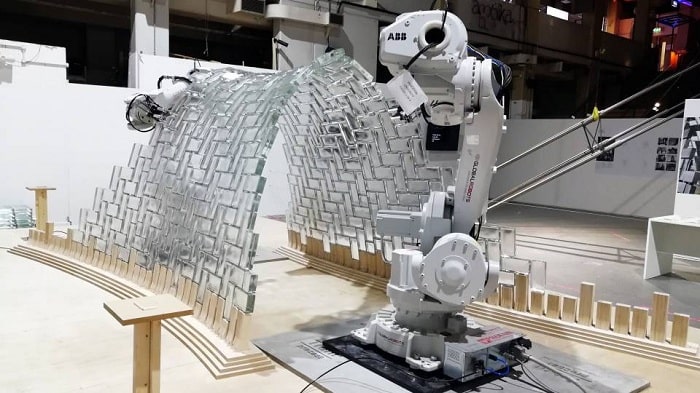

Two Princeton researchers, architect Stefana Parascho and engineer Sigrid Adriaenssens, dreamed of using robots to simplify construction, even when building complex forms.
“We want to use robots to build beautiful architecture more sustainably,” said Adriaenssens, an associate professor of civil and environmental engineering and the director of the Form Finding Lab.
So the professors partnered with architecture and engineering firm Skidmore, Owings and Merrill (SOM) to create a striking and unique installation for the SOM exhibition “Anatomy of Structure” in London last March. They used two industrial robots provided by U.K.-based Global Robots to build a breathtaking vault, 7 feet tall, 12 feet across and 21 feet long, constructed of 338 transparent glass bricks from Poesia Glass Studio.
The nearly finished central arch awaits its last brick. Like the entire LightVault structure, the central arch is constructed without any scaffolding or other external supports. The two industrial robots take turns placing a brick and supporting the structure, working from one side to the other.
Critically, the LightVault reduced resource use in two ways: eliminating the need for forms or scaffolding during construction, and improving the vault’s structural efficiency by making it doubly curved, which reduced the amount of material required. These were only possible because of the robots’ strength and precision.
“I try to find out what robots can do that humans cannot do well,” said Parascho, an assistant professor of architecture at Princeton who developed the idea behind the robotic assembly of the vault. Parascho is the director of CREATE Laboratory Princeton, where CREATE stands for computation and robotics enabling architectural technologies
“My work is not trying to replace human labor by automating it, but to increase the possibilities for architecture by using robots for tasks that humans are rather bad at,” she said. “For example, holding a 3 kilogram [7 pound] brick for seven minutes — without moving, to allow the glue to dry — is very hard for humans to do.”
“Robotic construction opens up a number of design and building opportunities where robots complement human work,” said Alessandro Beghini, an associate director and senior structural engineer at SOM, who collaborated on the LightVault. “Robots could be leveraged in places where it would be dangerous for people to work or where access to humans is difficult.”
Robots are inherently good at executing precise movements in space, unlike humans, who need guides or support structures to construct complex geometries. This is what inspired the researchers to explore the potential of striking and unexpected shapes. Edvard Bruun, a Ph.D. student in civil and environmental engineering, worked on the implementation of the project.
He noted that while human builders would need to double- and triple-check their placement of the blocks, “by leveraging the inherent precision of the robots in navigating 3D space, we could spend more time focusing on making the design as efficient as possible, while not getting bogged down in the physical construction challenges typically associated with such a structure.”
The team devised a process in which the two robots worked together to assemble the central arch of the vault without any scaffolding or other support. Each robot would place one brick, then hold the structure while the other robot placed the next brick.
A graduate student touches a glass brick in the structure
Isla Xi Han, a Ph.D. student in architecture technology who worked on developing the LightVault prototypes, looks at the concrete-and-glass prototype at Princeton’s ECL.
“Beauty and material or structural efficiency are not mutually exclusive,” said Bruun. “Construction is energy and material intensive. Future global well-being depends on being able to build strong buildings that are efficient with how much material they are built with. Robots have the potential to help us achieve this goal as we develop better ways to utilize them in construction work.”
Isla Xi Han, a Ph.D. student in Parascho’s lab, was responsible for developing and implementing the robotic fabrication process.
“To describe LightVault, I tend to do a mini dance,” she said. “A traditional way to build an arch is two hands coming from opposite ends and meeting in the top middle. Meanwhile, two robotic arms making an arch are rolling hands sweeping from left to right.”
After the robots finished constructing the central arch together, they switched to working independently, each building one side of the vault. To ensure the stability of the unfinished structure, the bricks were placed such that each newly placed brick would support the next one.
