

























Key Takeaways
- Robotic welding achieves 99%+ first-pass quality compared to manual welding achieving 85-90% consistency
- Laser cutting systems maintain positional accuracy of ±0.5mm, enabling tight tolerances impossible through manual cutting
- Vision-based seam tracking compensates for material variation, maintaining weld quality despite component fit-up differences
- Automated welding reduces defects including porosity, undercut, and spatter by 70-80% compared to manual operations
- Real-time quality monitoring sensors detect weld anomalies and automatically trigger corrections before defects propagate
- Robotic systems achieve consistent results across entire production runs, eliminating quality variation inherent in manual processes
Welding and cutting represent core manufacturing operations in prefabrication. Structural steel frames require welding connecting beams and columns. Cladding panels require laser cutting creating apertures and component boundaries. Components require precise cutting to specification. Traditional approaches employ skilled welders and cutting operators—craftspeople with years of experience developing expertise enabling quality execution.
Yet traditional welding and cutting introduce inherent inconsistency. Even highly skilled welders vary weld quality based on component fit-up variations, ambient conditions, and fatigue. Manual cutting requires operator vigilance to maintain precision as fatigue accumulates. Quality variation between craftspeople proves inevitable—some operators produce superior work while others produce adequate but less refined results. This variation creates quality inconsistency and requires quality control processes catching defective work.
Smart robotic welding and cutting systems eliminate this inconsistency through precision automation. Rather than skilled operators executing operations, robots execute operations with manufacturing-level precision. Robotic welding maintains exact heat input, travel speed, and arc stability regardless of operator fatigue or component variation. Laser cutting systems maintain micron-level positional accuracy. Plasma cutting systems maintain consistent cut quality regardless of material thickness variation. The result combines superior precision with consistency impossible through manual operation.
Robotic Welding System Architecture
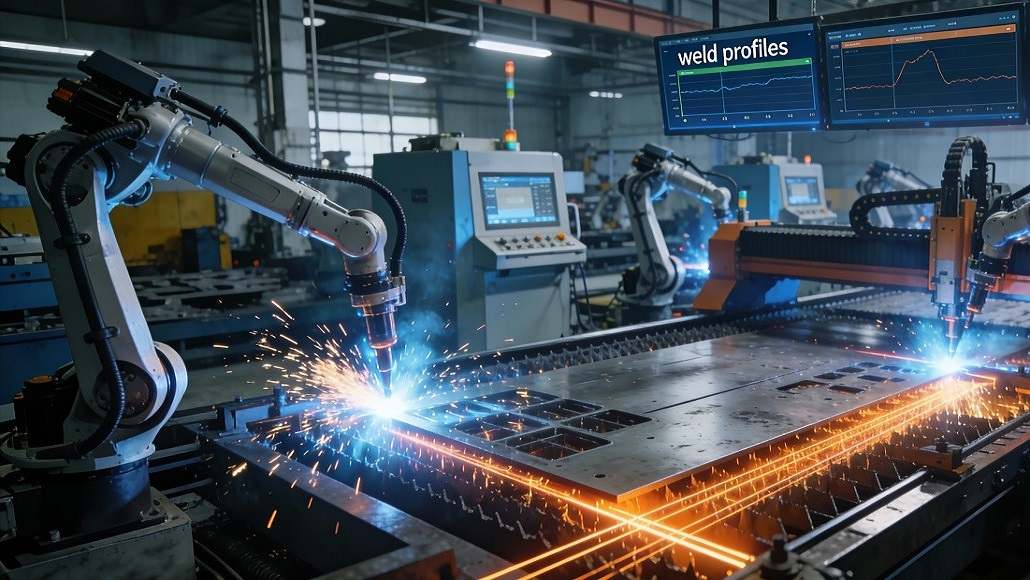
Modern robotic welding systems employ multi-axis arms equipped with welding torches. Six-axis robots provide the flexibility to reach any welding location and orient the torch optimally for quality welds. Rather than a robot moving in a single plane, six-axis systems position and reorient for complex geometries.
Welding systems incorporate multiple sensing and control mechanisms ensuring quality execution. Arc voltage and current sensors monitor welding process, detecting anomalies indicating quality problems. Travel speed monitoring ensures consistent speed maintaining proper heat input. Wire feeder controls regulate material supply maintaining consistent arc conditions. Thermal sensors monitor torch temperature preventing overheating.
Vision-based seam tracking represents a sophisticated capability enabling robots to weld despite component variation. Rather than requiring components positioned with perfect alignment, vision systems detect joint location and orient torches accordingly. If a joint deviates slightly from expected position, vision systems detect deviation and redirect the torch to follow the actual joint location. This adaptive capability enables tolerances in upstream fabrication that would be impossible with rigid fixturing requirements.
Laser and Plasma Cutting Precision
Laser cutting systems employ concentrated laser beams vaporizing material along precisely programmed paths. Numerical control systems guide laser position with positional accuracy approaching ±0.5mm. Unlike manual cutting requiring operator attention throughout operations, laser systems execute complete cuts automatically following programmed patterns. Multiple cuts can execute sequentially without operator intervention.
Laser cutting advantages include superior precision enabling tight tolerances, clean cut edges minimizing post-cutting finishing, and minimal material waste compared to mechanical cutting. Different laser types suit different materials—CO2 lasers suit nonmetals and some metals, fiber lasers suit metals particularly, and excimer lasers suit delicate materials. Equipment selection optimizes for specific applications.
Plasma cutting systems employ electrically ionized gas creating plasma arcs vaporizing material. While slightly less precise than laser systems, plasma cutting excels at thick material cutting with faster cutting speeds. Combined with CNC numerical control, plasma systems maintain consistent cutting precision across all materials and thicknesses.
Quality Improvements and Defect Reduction
Quality comparisons between manual and robotic welding prove dramatic. Manual welding achieves consistency where 85-90% of welds meet specifications. Robotic welding achieves 99%+ consistency. The quality difference reflects both robotic precision superiority and consistency throughout production runs.
Robotic welding defects including porosity, undercut, spatter, and lack-of-fusion reduce dramatically compared to manual welding. Porosity (gas pockets within welds) results from inconsistent arc stability and improper travel speed—conditions robotic control prevents. Undercut (weak zones along weld edges) results from excessive heat or excessive travel speed—conditions robots maintain optimally. Spatter (weld material scattered around joints) results from arc instability—conditions robotic systems eliminate. Lack-of-fusion (incomplete joint penetration) results from inadequate heat input—conditions robots control precisely.
The cumulative effect proves substantial. Organizations implementing robotic welding report defect reductions of 70-80% compared to previous manual operations. Rework costs plummet as nearly all welds meet specifications on first production. Quality control processes shift from intensive destructive testing identifying defective work to verification testing confirming automated systems maintain expected performance.
Material Handling and Fixturing Optimization
Robotic welding systems incorporate sophisticated material handling enabling flexible operations. Rather than requiring permanent fixtures for each component, changeable fixtures accommodate multiple component types. Robots receive data regarding component type, and fixturing changes automatically position components for optimal welding access. This flexibility enables efficient production of multiple component types without extended changeover times.
Positioners rotate components enabling optimal torch orientation for any joint. Rather than requiring multiple passes from different angles, positioners orient components enabling single-pass welding. This reduces weld time and improves consistency through minimizing multiple-pass operations.
The sophistication of modern systems enables lights-out manufacturing where unmanned facilities operate continuously. Robots weld components automatically, material handling systems position components and remove completed work, quality monitoring systems verify results, and humans only intervene if system problems emerge. Lights-out operations maximize facility utilization far beyond traditional human-staffed operations.
Real-Time Quality Monitoring and Correction
Advanced robotic welding systems incorporate real-time quality monitoring triggering automatic corrections. If arc quality degrades, control systems adjust parameters immediately. If travel speed drifts, systems correct automatically. If thermal conditions deviate from specifications, systems compensate. This continuous monitoring and correction maintains quality throughout production runs.
Artificial intelligence increasingly enables predictive quality management. Rather than reacting to detected quality problems, AI systems detect patterns predicting quality issues and adjust parameters preemptively. If specific material sources tend to produce inconsistent welds, AI systems adjust parameters compensating for known material characteristics. The result improves quality further beyond reactive adjustment.
Weld inspection systems employ both automated and manual approaches. Automated inspection systems examine welds immediately after production, detecting obvious defects. Selected welds undergo manual inspection or destructive testing validating that automated inspection systems accurately assess quality. This combined approach provides quality assurance while minimizing expensive testing.
Customization Within Standardization
A persistent challenge involves maintaining flexibility for design customization while achieving robotic efficiency. Fully standardized designs enable maximum robotic efficiency but limit customization. Excessive design variation complicates robotic implementation.
Modern systems achieve balance through standardized welding and cutting approaches accommodating design variation. Rather than unique welds for each design, standard weld types accommodate multiple design applications. T-welds, corner welds, and overlap welds represent standard types applied to varied contexts. Control systems select appropriate standard weld type for specific joint, execute it robotically, and move to next joint. This standardized approach enables flexibility within consistent execution patterns.
Similarly, cutting patterns follow modular approaches where standard cut profiles combine to create varied final geometries. Laser systems might define several standard cuts—straight cuts at various angles, circular holes at various diameters, rectangular apertures at various dimensions. Programming selects required cuts and their positions, and systems execute complete parts automatically.
Integration with BIM and Digital Design
The full potential of robotic welding and cutting emerges through integration with Building Information Modeling systems. Rather than engineers creating weld specifications separately from designs, BIM models contain complete welding and cutting instructions. Control systems extract welding sequences directly from BIM models, programming robots automatically. Design changes propagate automatically to robotic programming, eliminating manual reprogramming.
This direct design-to-fabrication integration accelerates manufacturing initiation. Rather than weeks of manual specification development and programming, BIM-integrated systems begin manufacturing days after design approval. The timeline compression creates competitive advantages enabling shorter project schedules.
Workforce Implications and Training Requirements
Robotic welding and cutting substantially reduce manual welding and cutting positions. Organizations cannot simply install robotic systems and expect traditional welders to immediately reprogram and maintain them. Roles shift toward programming, maintenance, and quality oversight requiring different skillsets than traditional welding.
Workforce transition proves challenging. Traditional welders develop expertise over years, with craft pride in executing quality work. Robotic systems reduce direct craft involvement, which some workers experience as negative. Enlightened organizations recognize this transition challenge, invest in retraining programs, and create career pathways for welders transitioning to technical roles.
Organizations report success with hybrid approaches where experienced welders program robotic systems, ensuring that robotic operations reflect best practices. These former welders provide valuable expertise optimizing robotic performance and troubleshooting problems that pure programmers might overlook.
Competitive Implications and Future Direction
Organizations operating robotic welding and cutting systems develop substantial advantages. Superior quality enables higher reliability and customer satisfaction. Consistent quality reduces warranty costs. Production flexibility within standardized execution enables efficient customization. These advantages compound as organizations accumulate expertise operating systems.
The industry increasingly recognizes robotic welding and cutting as competitive requirement. Equipment manufacturers increasingly design components for robotic welding compatibility. Training programs increasingly emphasize robotic programming. Professional standards increasingly codify robotic welding practices. These systemic changes drive adoption toward industry standard.
The future of prefabrication involves comprehensive robotic welding and cutting integrated with BIM design systems. Rather than human welders and cutters manually executing operations, robotic systems will execute operations with superior precision and consistency. Organizations leading this transition establish competitive positions others struggle to match.
