



























Key Takeaways
- AI-powered visual inspection systems achieve 96-99% defect detection accuracy, exceeding human inspector capabilities
- Machine learning analyzes production data identifying patterns predicting quality issues before defects occur
- Real-time inspection reduces defect detection cycles by 30-50%, enabling immediate corrective action
- Automated systems analyze thousands of images consistently throughout shifts without fatigue degradation
- Predictive quality enables proactive parameter adjustments preventing defects rather than reactive rework
- Continuous learning ensures systems improve accuracy over time as new defect types are encountered and documented
Quality control in prefabrication depends on identifying defects before components reach installation sites. Discovering defects during installation proves catastrophically expensive—components might be permanently installed before problems surface, requiring expensive remediation. Discovering defects during quality control enables rework or replacement before installation.
Yet traditional quality control faces persistent challenges. Human inspectors examine components systematically, but fatigue degrades attention as shifts progress. Inspection consistency varies between inspectors—some catch subtle defects others overlook. Micro-level defects invisible to human vision escape detection. Inspection timelines limit thoroughness—inspectors cannot examine every component exhaustively due to time constraints.
Machine learning powered quality control transforms quality assurance through eliminating human fatigue effects, detecting defects at scales humans cannot perceive, and providing consistent objective assessment across all components. Artificial intelligence systems visually inspect components, identify defects reliably, and predict quality issues before they manifest as defects. The result achieves quality levels impossible through human inspection alone.
Visual Inspection AI Systems
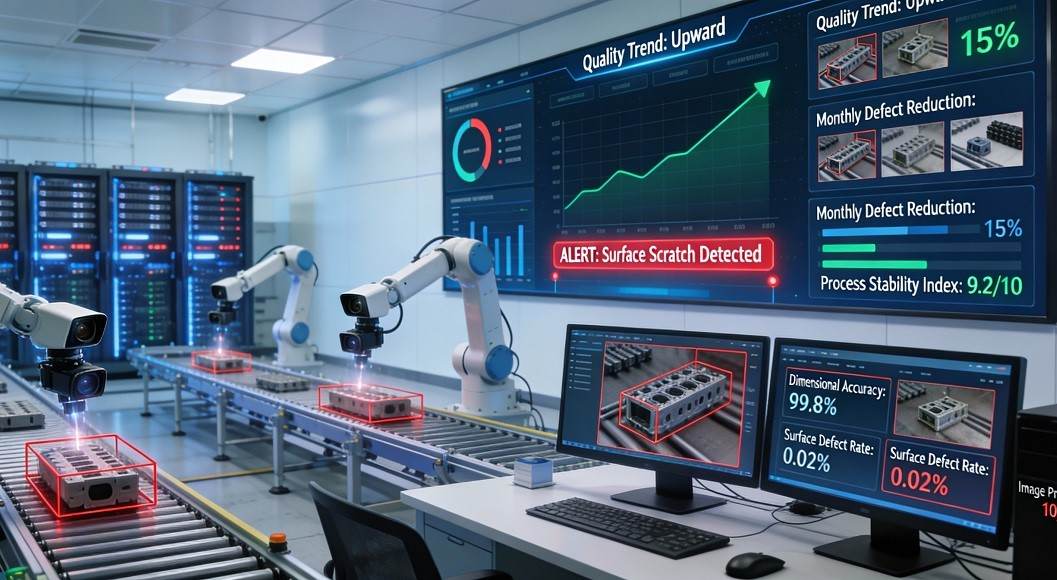
Visual inspection AI employs computer vision and deep learning analyzing images of components seeking defects. Cameras photograph components from multiple angles, capturing high-resolution images containing detailed surface and structural information. Machine learning algorithms analyze images identifying defects—cracks, misalignments, incomplete welds, material irregularities, surface blemishes.
Training machine learning systems requires substantial defect image libraries. Organizations train systems on thousands of defect images representing various defect types. Systems learn to recognize defect patterns, identifying them reliably even when presented with variations they haven’t specifically seen. This pattern recognition capability enables systems to identify defects previously unseen in training data.
The advantages of AI inspection compared to human inspection prove substantial. AI systems achieve 96-99% defect detection accuracy. Human inspectors operating optimally achieve 85-90% accuracy, with accuracy declining as fatigue accumulates. AI systems maintain constant accuracy throughout extended inspection periods without fatigue degradation. AI systems can detect defects at scales impossible for human vision—micro-level misalignments, hairline cracks, subtle material irregularities.
Inspection speed proves equally impressive. AI systems inspect components in seconds. Human inspectors require minutes per component. Comprehensive AI inspection examines 100% of production. Resource constraints typically limit human inspection to sampling—perhaps 5% of components receive thorough inspection. The coverage difference ensures AI systems detect defects human sampling misses.
Defect Type Identification and Classification
Machine learning systems don’t simply identify that defects exist. Advanced systems classify defect types—distinguishing cracks from misalignments from incomplete welds. Classification proves critical for effective corrective action. Different defect causes require different remedies. Weld defects require process parameter adjustments. Dimensional defects require tool corrections. Surface defects require surface preparation modifications. Accurate classification enables targeted corrections.
The sophistication of defect classification improves continuously as systems encounter and learn from diverse defect types. Early systems might identify broad categories. Mature systems distinguish subtle variations within categories. Over time, as systems accumulate experience with production variations, classification accuracy and specificity improve.
Explainability represents another important capability. Rather than simply reporting “defect detected,” modern systems explain why defects were detected—highlighting image regions showing defect indicators. This explainability helps operators understand defect root causes and implement effective corrections.
Predictive Quality Analytics
Beyond detecting existing defects, machine learning systems predict quality issues before defects occur. Rather than reactive defect detection after production, predictive quality enables proactive prevention. Systems analyze production data—material properties, environmental conditions, process parameters, machine performance—identifying patterns preceding quality problems.
Machine learning models trained on historical production data learn relationships between input parameters and quality outcomes. If specific material batches combined with particular process parameters historically produced defects, systems recognize these conditions and alert operators before defects occur. Operators adjust parameters preemptively, preventing defects entirely.
This shift from reactive to proactive quality represents profound improvement. Defects prevented cost nothing. Defects detected late require expensive rework or replacement. Defects discovered during installation cost catastrophically. Predictive quality moves problem identification as far upstream as possible, minimizing costs.
Predictive quality proves particularly valuable for new product types or process changes. Rather than learning through production errors, predictive systems forecast likely quality challenges enabling preventive steps. Machine learning models trained on similar products and processes transfer knowledge to new contexts, providing quality guidance even for production scenarios without historical data.
Continuous Improvement and Process Optimization
Machine learning systems generate detailed production data enabling continuous improvement. Rather than aggregated quality statistics, systems track individual component outcomes. These detailed records enable root cause analysis identifying why specific batches exhibited problems.
Data-driven root cause analysis proves more effective than intuitive analysis. Rather than supervisors guessing causes based on experience, objective data identifies actual causes. If specific supplier material consistently produces defects, data reveals this relationship objectively. If particular process parameter settings correlate with defects, data documents this relationship. Organizations implementing corrections based on data evidence achieve better results than those relying on intuition.
Continuous improvement cycles accelerate with machine learning support. Organizations implementing organized improvement processes—defining problems, analyzing root causes, implementing solutions, measuring results, iterating—achieve quality improvements compounding over time. Machine learning accelerates every cycle phase through providing objective data and predictive insights.
Integration with Manufacturing Systems
Machine learning quality control systems integrate seamlessly into Manufacturing Execution Systems (MES) enabling coordinated response to quality issues. If quality systems detect emerging patterns predicting problems, these alerts can trigger manufacturing system adjustments—parameter modifications, production rate changes, material batch adjustments.
This automated response capability enables sophisticated quality management. Rather than requiring human decision-making for routine parameter adjustments, systems adjust parameters automatically based on quality predictions. Human oversight monitors for unexpected situations requiring judgment, but routine quality management operates automatically.
Real-time quality dashboards provide immediate visibility into component quality status. Rather than waiting for end-of-shift quality reports, supervisors see quality status continuously. Emerging problems trigger immediate alerts enabling rapid intervention.
Implementation Considerations and Requirements
Successfully implementing machine learning quality control requires substantial initial investment. System development requires defect image libraries, algorithm training, and integration with manufacturing systems. Organizations must invest in training personnel to interpret AI recommendations and implement corrective actions.
Data quality proves critical for system performance. Systems trained on incomplete, biased, or inaccurate data produce unreliable results. Organizations must invest in careful image collection, accurate defect labeling, and periodic system validation ensuring continued accuracy as production conditions change.
System governance structures define how AI recommendations translate into production actions. Do AI defect identifications automatically trigger component rejection, or do they trigger human review? Different approaches suit different circumstances. High-volume production with consistent products might employ automatic rejection. Specialty production with unique components might employ human verification of AI recommendations.
Operator change management proves important. Systems that recommend production adjustments must be understood and trusted by operators. Training regarding system capabilities and limitations builds appropriate confidence. Organizations that present systems as infallible automation rather than tools supporting human decision-making often struggle with adoption.
Privacy and Data Security Considerations
Machine learning systems require access to production data—images, process parameters, quality outcomes. This data becomes increasingly valuable as organizations accumulate comprehensive production history. Protecting data from unauthorized access proves critical. Organizations must implement robust security ensuring sensitive production data remains confidential.
Image-based inspection raises unique privacy considerations. Rather than storing abstract quality metrics, organizations store component images that might contain identifying information. Security protocols must protect image archives carefully.
Competitive Advantages and Market Dynamics
Organizations operating machine learning quality control systems develop substantial competitive advantages. Superior quality enables premium pricing and customer confidence. Reduced rework directly improves profitability. Faster quality issue identification enables shorter production cycles. These advantages compound as organizations accumulate production experience improving system accuracy.
The industry increasingly recognizes machine learning quality control as competitive requirement. Equipment manufacturers increasingly incorporate AI capabilities. Software platforms increasingly provide machine learning functionality. Organizations continuing traditional manual inspection struggle to compete with machine learning-enabled competitors.
Future Evolution and Advanced Capabilities
Machine learning quality control capabilities continue advancing. Multi-modal inspection combining visual with thermal, acoustic, or electromagnetic sensing enables detection of internal defects invisible to visual inspection alone. Robotic systems might physically test components, with AI interpreting test results predicting structural integrity.
Augmented reality systems might overlay AI-generated quality information directly onto physical components, guiding human technicians to problem areas requiring investigation. Rather than replacing human expertise, AI systems guide human experts toward problems requiring judgment.
The convergence of machine learning quality control, robotic manufacturing, and digital design represents a comprehensive digital transformation. Future prefabrication facilities will operate as integrated systems where designs flow automatically to manufacturing, manufacturing occurs robotically under AI quality oversight, quality data flows automatically to design systems enabling continuous refinement. The result will be manufacturing systems of unprecedented quality, flexibility, and efficiency.
