
























Converting an occupied office tower, hospital or campus from combustion heating to heat pumps is one of the most valuable decarbonization moves a building owner can make, and one of the easiest to get wrong. Unlike a rooftop unit swap, an electrified heating retrofit reaches into shafts, mechanical rooms, ceilings and risers, often across winter heating seasons, in buildings full of tenants who expect heat tomorrow morning. The projects that succeed share a common pattern: they reduce loads before replacing plant, they phase construction around the heating calendar, and they treat disruption to occupants as a designed-for constraint rather than an accepted side effect.
Why Heating Retrofits Stall in Occupied Buildings
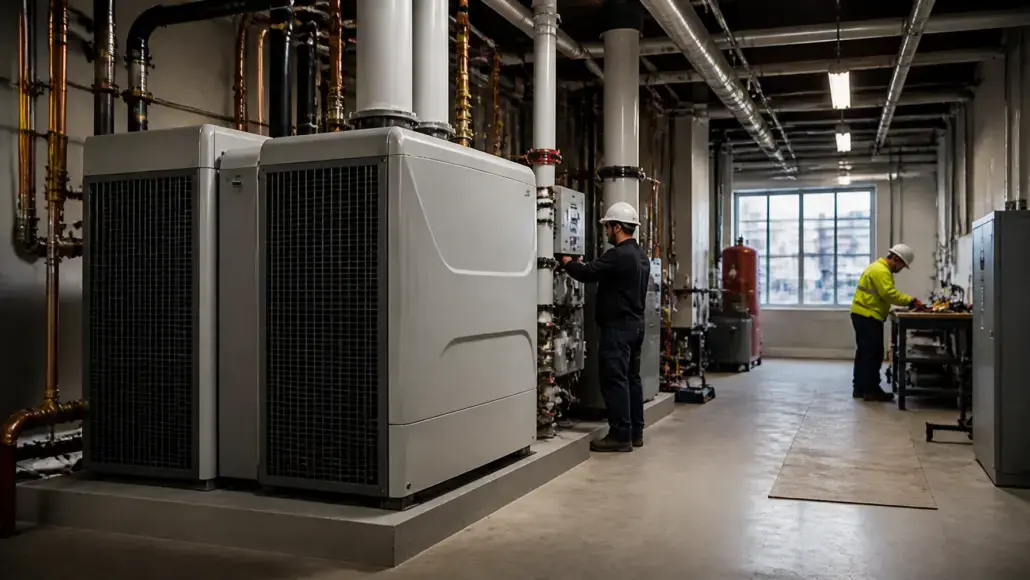
The economics of electrified heating have never been more favorable on paper. Heat pump technology covers most commercial heating loads efficiently, incentives such as utility programs and tax provisions reward conversion, and portfolio decarbonization commitments create real demand. Yet occupied-building conversions still stall in feasibility studies, and the reasons are operational rather than technological. Heating plant replacement requires draining hydronic systems, opening risers and interrupting, however briefly, the systems that keep tenants comfortable and safe.
Those interruptions carry costs that go beyond tenant irritation. Leased buildings face lease clauses and abatement exposure when services are disrupted. Hospitals, laboratories and data-adjacent spaces have uptime requirements that make conventional shutdown windows impossible. Cold weather adds a hard external deadline: a building that loses heat during a freeze risks pipe damage, water intrusion and business interruption claims that can dwarf the project’s savings. Owners therefore postpone projects, and the postponement compounds the eventual problem as aging combustion plants edge toward failure on someone else’s schedule. Breaking that cycle requires a construction method designed around continuity of service.
Cost expectations help frame the planning conversation. Electrified plant conversions for large commercial buildings vary widely with climate zone, load density and existing infrastructure, but the dominant cost drivers are consistent across projects: the heat pump plant itself, the electrical service upgrade that often accompanies it, and the distribution work that connects new plant to existing terminals. Load reduction attacks the second driver directly and the third indirectly, which is why the sequence matters as much as the technology. Buildings that skip the load analysis tend to oversize plant, oversize electrical infrastructure and inherit operating inefficiencies that persist for the life of the equipment, and a load model built from actual interval data, rather than rules of thumb, is the foundation document of any credible conversion plan.
Reducing Load Before Replacing Plant
The single most effective disruption-reduction strategy is also the best financial one: shrink the heating load before touching the plant. Every Btu removed from the design load shrinks the heat pump plant, the electrical service upgrade, the pipe sizes and the mechanical room footprint, and each of those reductions removes a scope item from the occupied-space construction sequence. Envelope work such as insulation upgrades, glazing improvements, airtightness sealing and ventilation heat recovery directly lowers the building’s heating demand and, with it, the scale of the mechanical intervention.
Load reduction also changes the terminal equipment math. A building whose heating loads drop significantly may convert high-temperature hydronic terminal units, designed around 180-degree water, to air-side systems or to heat pumps operating with lower supply water temperatures, without replacing every piece of terminal equipment in occupied ceilings. In some buildings, the load analysis reveals that plant capacity can be staged: an initial heat pump installation sized to carry 70 to 80 percent of annual heating load, with the existing boiler retained as a backup for the coldest days, cuts both capital cost and construction risk while delivering most of the emissions benefit. That hybrid sequence is now standard practice in serious retrofit engineering, because it converts an all-or-nothing project into a staged program with revenue-neutral intermediate states.
Sequencing Terminal Units, Risers and Plant
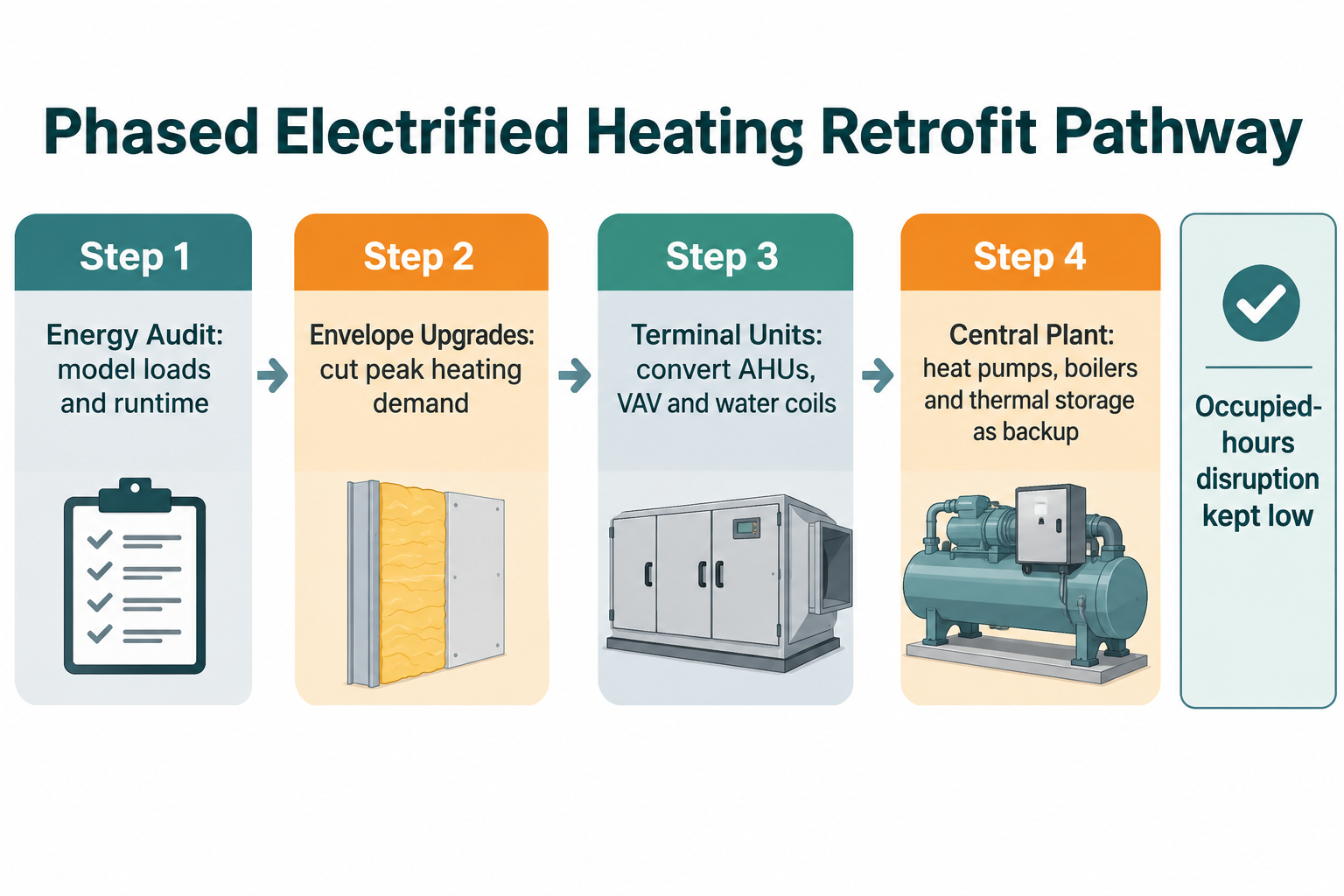
Execution planning determines whether tenants ever feel the project. Successful electrified heating retrofits typically follow a sequencing discipline similar to the following:
- Survey and model first: audit plant condition, distribution losses, terminal equipment compatibility and the building’s real load profile before fixing a design.
- Cut the load: complete envelope and ventilation heat recovery work in heating seasons one and two, when the existing plant is still running.
- Convert terminal zones in rotation: work floor by floor or wing by wing, using isolation valves and temporary cross-connections so that converted zones operate while work proceeds elsewhere.
- Stage the plant: install heat pump modules alongside the existing boiler, cutover in mild seasons, and retain the boiler as cold-weather backup until the new plant proves itself.
- Use temporary systems deliberately: temporary boilers, spot coolers and short-duration swing spaces keep occupied zones served during tie-ins, and their cost belongs in the baseline budget, not the contingency.
The heating calendar is the project’s master schedule. Tie-ins that require draining risers belong in shoulder seasons, and the coldest months should carry only low-risk interior work. Contractors who plan around the weather, rather than against it, avoid the emergency winter shutdowns that generate claims and tenant escalations.
Sequencing also protects the project’s financial schedule. Phased conversions generate partial energy savings from early stages, which can support internal funding cases for later stages, and they spread capital expenditure across fiscal years in ways single-phase projects cannot. Portfolios running multiple buildings can staff rotating crews that move from one conversion to the next, converting construction learning into standardized details and repeatable costs. The most successful programs treat each building conversion as one production run of a repeatable process rather than as a bespoke project.
 Keeping Tenants Comfortable During Changeovers
Occupant experience is measurable, and sophisticated owners now specify it. Notification protocols, defined temperature tolerances during tie-in windows, noise limits and named points of contact turn an abstract construction program into a managed service for tenants. Communication quality, more than any technical factor, determines whether a retrofit is remembered as routine or as a grievance.
Temporary infrastructure deserves the same design attention as permanent systems. Temporary boilers need fuel delivery paths, emissions permits and clearances just like permanent plant. Spot heating in swing spaces affects humidity and air quality. Where buildings host sensitive occupancy, vibration and dust isolation plans protect operations that cannot pause. In practice, the disruption budget, the hours of planned service impact per zone, becomes the key project metric, and experienced teams track it weekly alongside schedule and cost.
Case patterns from completed conversions illustrate the method. Office conversions typically concentrate riser and plant work into shoulder-season weekends, using temporary boilers on roofs or loading docks for bridge coverage. Campus conversions phase building by building, letting central plant upgrades follow demand reductions already achieved in converted buildings. Hospital and laboratory work proceeds under strict isolation plans with redundant temporary capacity, because these occupancies cannot tolerate any unplanned interruption. The details differ, but the discipline, temporary capacity sized and permitted as seriously as permanent plant, is common to all of them. The refrigerant dimension adds one more coordination layer, since new heat pump plants bring modern safety requirements into mechanical rooms: teams should read the emerging A2L requirements alongside their electrical and ventilation design, as covered in detail in analyses of the A2L refrigerant transition now reshaping equipment safety codes.
Business Case and Risk Allocation
The financial argument for electrified heating retrofits strengthens when disruption is engineered down. Phased projects generate earlier energy savings, spread capital expenditure across budget cycles and reduce the peak tenant disruption that drives abatement claims. Hybrid plants protect against worst-case cold snaps while delivering most annual emissions reductions, and they give owners real operating data before the final boiler retirement decision. On the risk side, contracts should allocate the specific risks of occupied-building work: weather delays, latent conditions behind walls and ceilings, refrigerant code changes and temporary system performance all belong in explicit contract language rather than in disputes.
Incentive structures strengthen the case further. Utility programs across many markets now pay directly for heat pump conversions, custom calculations reward measured load reductions, and federal provisions have made electrification investments more attractive for taxpaying owners. Program rules matter, however: some incentives require pre-approval, some reward only full conversions and some measure savings against baselines that phased projects complicate. Folding incentive strategy into phasing decisions, rather than chasing programs after design is fixed, routinely changes project economics by meaningful margins.
Owners who treat electrified heating retrofits as operational programs, with load reduction first, staged plant conversion second and disciplined tenant management throughout, are finding that the feared disruption never materializes at the scale anticipated. The buildings keep running, the tenants stay, and the decarbonization commitment converts into measurable performance rather than a stalled study. That is the difference between a mechanical project and an infrastructure program, and it is the standard the next decade of heating conversions will be judged against.