























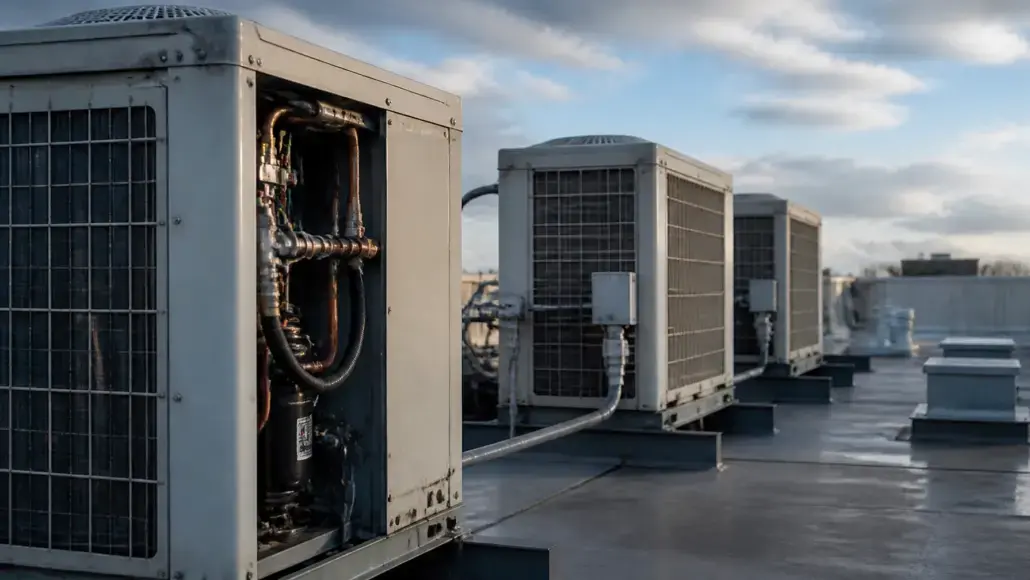

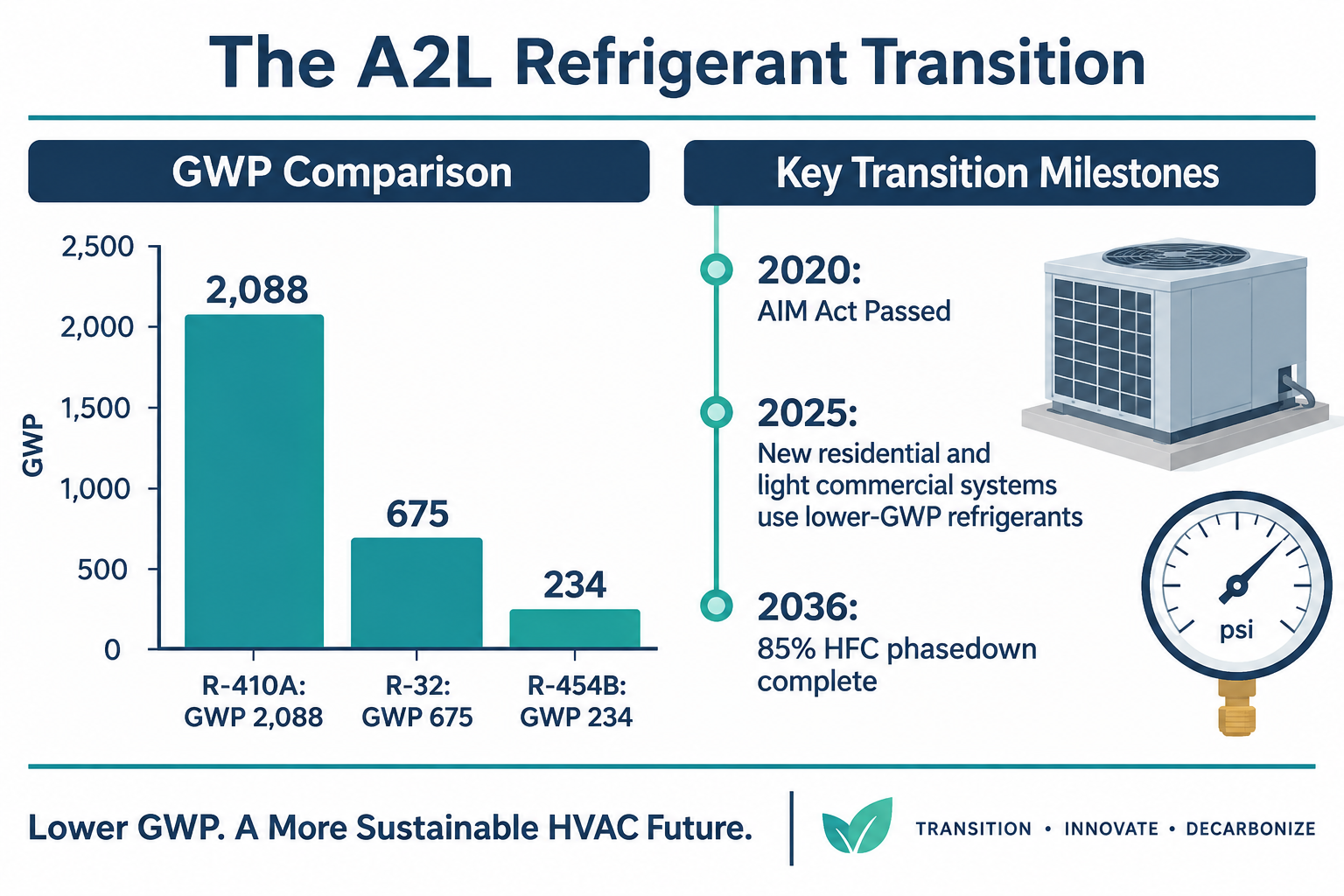
Refrigerant rules that once sat quietly in code appendices now sit on the critical path of nearly every rooftop replacement, chiller purchase and VRF project in North America. Under the AIM Act of 2020, the Environmental Protection Agency has moved the industry onto a schedule that restricts the manufacture and import of new residential and light commercial systems using high global warming potential HFC refrigerants beginning January 1, 2025, with an overall phasedown of HFC production reaching 85 percent by 2036. For contractors, engineers and facility teams, the practical result is a working environment in which refrigerant choice shapes equipment cost, safety procedures, code compliance and long-term service economics all at the same time.
Why A2L Refrigerants Are Replacing Legacy HFC Blends
The refrigerants entering the market fall into ASHRAE Standard 34 safety class A2L, a designation for refrigerants with lower toxicity and lower flammability. The defining technical characteristic of an A2L fluid is a low burning velocity, generally below 10 centimeters per second, which means a leak is far less likely to sustain a flame than the A3 hydrocarbons such as propane. That classification gives manufacturers a workable middle ground: meaningful global warming potential reductions without the charge restrictions and installation complexity that A3 refrigerants would impose on unitary equipment.
The two fluids doing most of the work in light commercial and residential applications are R-32, with a global warming potential of 675, and R-454B, with a global warming potential of 234. Both replace R-410A, whose global warming potential of 2,088 makes it the primary target of the phaseout. In applied and centrifugal chillers, the shift follows a different path, with low pressure machines moving toward refrigerants such as R-1233zd(E) and R-513A. The equipment consequences are already visible across product catalogs: major manufacturers have redesigned rooftop units, heat pumps, VRF systems and split systems around these blends, and new equipment shipments of high-GWP systems face the January 2025 restriction.
The A2L refrigerant transition is therefore not a single switchover date but a rolling change that touches procurement, code adoption and workforce skills on different timelines. Existing R-410A systems remain legal to operate and service for decades, which means contractors will run parallel fleets, parallel toolchains and parallel refrigerant inventories for many years. That dual-market reality is one of the least appreciated operational consequences of the rulemaking: a service organization now has to be competent in both refrigerant generations simultaneously, and distributors have to manage blending and recovery logistics for a shrinking but still essential legacy refrigerant.
The global context reinforces the direction of travel. The Kigali Amendment to the Montreal Protocol commits most of the world’s economies to HFC phasedown schedules similar to the American one, and the European Union’s F-Gas Regulation is pushing its own market toward refrigerants with even lower global warming potential, including propane-based A3 systems in some applications. Global equipment manufacturers build for these overlapping regimes, which means the A2L refrigerant transition is not an American detour but the settled direction of the international equipment market. Firms that build internal competence now are aligning with where the entire supply chain is going, while firms that delay will find fewer compliant options, fewer trained technicians and rising prices when their replacement cycles arrive anyway.
What Changes on the Design Side
For engineers, the A2L shift changes the mechanical design process well before anyone selects a model number. Safety standards such as ASHRAE Standard 15 and UL 60335-2-40 govern how much refrigerant can sit in a given space and what mitigation systems are required when charge limits are exceeded. Because A2L fluids are flammable at low burning velocity, the standards require specific measures when charges exceed the calculated limits for a room, and those measures influence equipment layout, mechanical room design and even architecture. Key design considerations now include:
- Refrigerant concentration limits: charge per circuit must be checked against room volume, particularly for VRF systems serving small mechanical closets or occupied zones.
- Leak mitigation: larger charges trigger requirements for refrigerant detection, ventilation and automatic shutoff strategies that must be coordinated with electrical and fire protection design.
- Component listings: compressors, valves, controls and electrical enclosures must be listed for use with A2L fluids, which constrains substitutions and aftermarket parts.
- Heat exchanger construction: manufacturers have moved toward microchannel and leak-reduced coil designs to control total charge and minimize leak pathways.
- Capacity and efficiency recalculation: performance ratings change when a design moves from R-410A to R-32 or R-454B, and energy models need updated inputs rather than assumptions carried over from legacy catalogs.
None of these items is individually difficult, but together they add coordination steps that did not exist in a pure A1 world. Design teams that treat refrigerant selection as a late-stage catalog decision are discovering that room volume calculations and mitigation requirements can force layout changes late in design, when changes are most expensive.
Installation Under Updated Safety Codes
The installation consequences flow directly from the design changes. The 2024 editions of the International Mechanical Code and International Plumbing Code, along with ASHRAE Standard 15.2 for residential applications, incorporate provisions that recognize A2L fluids and define the conditions under which they may be installed. Adoption, however, is not uniform: jurisdictions update codes on their own schedules, and contractors working across municipal boundaries will encounter authorities having jurisdiction at different stages of familiarity with A2L requirements. Permitting conversations that used to be routine may now involve education, and early projects in slow-adoption markets can face review delays.
Field practice changes in smaller but numerous ways. Technicians handle refrigerant cylinders with new labeling and, in some cases, different cylinder valves. Recovery machines, vacuum pumps and leak detectors must be rated for A2L service, and manufacturers have introduced instrument lines specifically for the new fluids. Brazing and electrical work near A2L systems follows documented risk assessment procedures that responsible contractors are already embedding into job hazard analyses. None of this is exotic, but it demands written procedures and training records rather than informal practice, and larger mechanical contractors are treating that documentation as a differentiator when bidding institutional work.
The boundary between new construction and retrofit deserves particular attention. Existing systems are grandfathered, but any major modification raises the question of whether the work triggers current code requirements, and the answer varies by jurisdiction and by the scope of the change. Contractors bidding replacement work on older R-410A systems should verify early whether a like-for-like swap remains available in their market, whether an A2L-based replacement requires mechanical room or mitigation upgrades, and what the local inspector will require for either path. Those questions cost hours to answer early and weeks to answer late.
Servicing Economics and Training Demands
The service side of the A2L refrigerant transition carries the most immediate cost consequences. Technicians need updated EPA Section 608 certification content, manufacturer-specific training and new instruments, and contractors are budgeting real money for that transition. The skill premium matters because A2L systems are arriving in volume at exactly the same time as the industry’s well-documented technician shortage, which puts training capacity, not equipment supply, near the top of the constraint list for many service organizations.
Refrigerant pricing adds another layer. As R-410A production allocations tighten, legacy refrigerant prices have risen sharply, which changes the economics of repairing versus replacing older equipment. Reclamation and recovery discipline, historically a compliance checkbox, now has direct financial value, and contractors that run tight recovery programs can protect margin in ways that sloppy programs cannot.
The A2L refrigerant transition also reshapes the market for technicians themselves. As manufacturers concentrate new production on A2L platforms, the technicians most in demand will be those certified and experienced on the new fluids, and service firms are already using training investment as a recruiting and retention tool. Larger organizations have built structured curricula that combine manufacturer coursework, supervised field work and safety documentation, while smaller firms lean on distributor programs and industry associations. For facility managers awarding service contracts, asking a prospective contractor to describe its A2L training program and tooling inventory is now a legitimate and revealing qualification question.
Warranty terms also deserve attention: owners and service firms should read the fine print on what refrigerant-related failures are covered, since first-year field issues with new blends are a known risk in any refrigerant changeover.
Cost, Risk and Compliance Planning for Owners
For building owners, the transition is a portfolio planning problem rather than a purchasing problem. Equipment budgets should assume that the next replacement cycle buys A2L-based systems at a modest premium, with pricing pressure easing as production volumes grow. Asset registers should flag every R-410A system by expected end of life, because the answer to “repair or replace” shifts as legacy refrigerant costs climb. Insurance and underwriting teams are beginning to ask about flammable refrigerant inventories on site, and facility documentation should record refrigerant type, charge and safety provisions for every system so that compliance reviews and emergency response do not depend on tribal knowledge.
Financial planning should also reflect the trajectory of the transition rather than its snapshot. Equipment premiums are expected to compress as volumes grow, while legacy refrigerant costs are expected to rise as allocations shrink, and both trends reward earlier rather than later replacement decisions for equipment already near end of life. Owners holding large R-410A inventories should treat refrigerant price risk like any other commodity exposure: quantify it, decide deliberately whether to hedge by maintaining spares or to accept it, and avoid discovering the answer through a mid-winter repair invoice.
Most critically, the refrigerant schedule now intersects with decarbonization programs. Replacements that were once simple like-for-like swaps increasingly coincide with heat pump conversions and plant upgrades, and those projects are the moments when refrigerant selection, safety design and electrification strategy get decided together. For portfolios pursuing deeper carbon reductions, refrigerant planning increasingly overlaps with retrofitting commercial buildings for electrified heating, since the same plant replacement that switches a building to heat pumps is also where A2L charge calculations, mitigation systems and long-term service strategy get locked in. Owners who coordinate those decisions once, rather than twice, will avoid paying for the same engineering twice.