


























Electricity prices and grid stress concentrate into a few hundred hours each year, and HVAC systems concentrate their own consumption into largely the same hours. That coincidence is the entire commercial logic of thermal energy storage: make heating and cooling when energy is cheap and plentiful, store the result in the form of chilled water, ice or hot water, and consume it when the grid is expensive and strained. Once a niche technology confined to district cooling plants and a few iconic ice-storage installations, thermal storage is now moving into mainstream commercial practice as time-of-use rates spread, demand charges climb and electrification pushes heating loads onto grids already managing tight peaks.
Why Thermal Storage Is Moving Into Mainstream HVAC
The economics that once limited thermal storage to special cases are changing in its favor. Utilities across high-growth markets have moved commercial customers onto time-of-use rates and tightened demand charges, and the gap between off-peak and on-peak energy prices has widened as solar generation reshapes daily load curves. A chiller that makes ice at midday when solar output is abundant and melts it at 4 p.m. when the grid peaks is now performing an arbitrage that tariffs explicitly reward. In markets where demand charges represent a large share of the commercial electricity bill, shifting the peak chiller load off the billing interval can move the entire demand line item down, not just the energy consumption.
Electrification multiplies the value. As heating converts to heat pumps, buildings add large electrical loads precisely during winter evening peaks, the hours when grid operators face their hardest constraints. Thermal storage for heating, in the form of hot water tanks and brick or concrete stores charged by heat pumps during mild hours, gives those buildings a way to decouple comfort from the grid’s worst moments. Regulators have formalized the trend: the Department of Energy’s grid-interactive efficient buildings programs, and demand response markets that pay for load flexibility, both treat thermal storage as among the most cost-effective flexibility resources a building can install, because energy stored as heat or cold is far cheaper per unit than energy stored in batteries.
Cost dynamics reinforce the comparison. Storage tanks, insulation and heat exchangers are mature, low-cost components manufactured at industrial scale, and their cost per stored unit of energy remains well below electrochemical batteries for durations beyond a few hours. Batteries respond faster and store electricity itself, which matters for frequency-type services, but buildings rarely need speed; they need hours of shifted load, which is precisely what thermal stores provide. The two technologies are therefore complements rather than competitors in most building energy strategies, with thermal storage absorbing the large, slow HVAC loads and batteries serving fast, electrical functions where they exist at all.
Choosing a Storage Medium
The three dominant storage technologies suit different building types, and selection is driven by space, load profile and temperature requirements:
- Ice storage: freezes water in tanks during off-peak hours and supplies chilled brine or low-temperature water during discharge. Its advantage is density, storing a large cooling capacity in a small footprint, which makes it practical for dense urban sites; its cost is that ice requires chillers to operate at lower evaporating temperatures, which slightly reduces generation efficiency.
- Chilled water storage: stores cooling in large water volumes at standard chilled water temperatures, avoiding the low-temperature penalty. It needs significant tank volume, which favors campuses, district systems and buildings with land or basement capacity.
- Heating storage: hot water tanks charged by heat pumps or electric boilers during off-peak and low-carbon hours serve hydronic heating, domestic hot water and winter peak shedding. With electrification increasing, heating storage is the fastest-growing segment for commercial retrofits.
Hybrid configurations are increasingly common, with thermal storage sized to shave the peak hours rather than to carry full daily load, and with the storage medium selected to match the plant’s temperature regime rather than to force a retrofit around it.
How Grid-Interactive Controls Change Plant Operations
Hardware is only half the system. Thermal energy storage creates value only when controls decide, hour by hour, whether to generate, store or discharge, and those decisions are becoming automated and market-facing. Modern grid-interactive HVAC systems consume signals, whether utility price feeds, demand response event notices, or carbon intensity data from the grid operator, and optimize plant operation against them through model predictive control rather than simple schedules. Open standards such as OpenADR allow utilities and aggregators to send automated demand response events directly to building systems, and buildings with storage can respond by shedding chiller or heat pump load for hours without occupants noticing any comfort change.
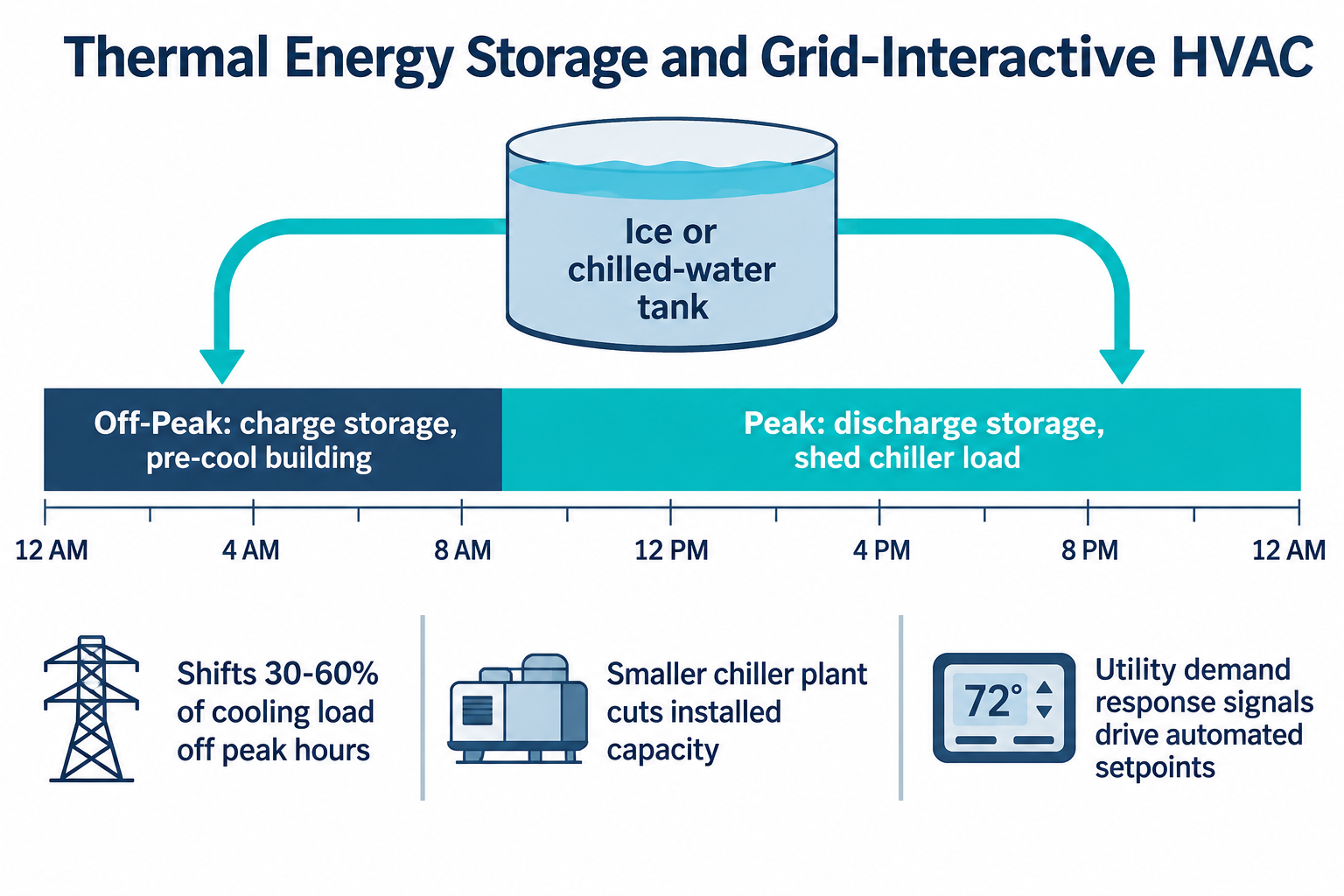
The operational shift is significant for facility teams: the plant no longer runs to meet the instantaneous load but to manage an inventory of stored thermal energy against price and comfort constraints. Commissioning, operator training and maintenance practices need to reflect that, and owners should budget for control sophistication, not just tanks. Projects that install storage but leave it on fixed schedules forfeit much of the value, particularly as dynamic tariffs replace static ones.
Data infrastructure underpins that optimization. Interval metering at 15-minute or finer resolution, reliable plant-level submeters and accurate temperature sensing give the control system the information it needs to decide when charging actually pays, and market-facing programs increasingly require measurement and verification to settle payments. Buildings lacking that instrumentation should count its installation as part of the project scope rather than discovering the gap at program enrollment.
Demand Charges, Rates and the Economics
The financial model for such projects is built from three revenue streams, and their relative weight varies by market. Peak demand reduction is usually the largest: discharging stored cooling or heating through the utility’s billing window reduces the demand charge that anchors the monthly bill. Energy arbitrage follows, exploiting the spread between off-peak and on-peak rates, which is widest in markets with strong solar penetration. Demand response payments come third, from utility programs and capacity markets that compensate buildings for measurable load reduction during events. Teams evaluating projects should model all three against actual tariff structures, because a configuration that thrives under a flat energy rate with heavy demand charges may underperform under steep time-of-use rates, and vice versa.
Tariff risk deserves explicit treatment in underwriting. Rate structures that make a project attractive can change with regulatory cycles, and long-lived assets should not depend on a single tariff remaining static for two decades. Conservative financial models use forward-looking rate forecasts, stress-test savings against adverse tariff changes and, where possible, lock in demand response program participation through contracts rather than assumptions. Owners who apply that discipline find that storage projects survive scrutiny that other efficiency investments fail, precisely because their savings streams, demand reduction, arbitrage and program payments, are diversifiable rather than single-source.
Electrified heating adds a fourth consideration that connects storage strategy to equipment strategy. Heat pump plants paired with storage can pre-heat buildings before winter price peaks and coast through them on stored heat, and buildings combining heat pumps with thermal stores are emerging as the reference architecture for cold-climate electrification, as discussed in analyses of cold climate heat pumps and their grid interactions.
What Owners Should Evaluate Before Investing
Thermal energy storage rewards rigorous evaluation and punishes enthusiasm. The checklist that separates sound projects from disappointing ones is short: model storage sizing against actual hourly load profiles rather than monthly averages, verify the tariff structures that will govern the savings and their stability over the holding period, confirm physical space and structural capacity for tanks, and assess whether the controls team and automation platform can execute dynamic optimization. Payback periods vary widely, from under five years in high-demand-charge markets to more than a decade where tariffs are flat, and the honest modeling that reveals that range before construction is worth far more than the brochure that obscures it.
Space constraints are the practical veto. Ice systems fit dense urban footprints; chilled water systems rarely do. Roof space, basement volume and structural loading decide feasibility as often as tariffs do, and early due diligence on those physical questions prevents wasted engineering. A feasibility screen that pairs hourly load modeling with a site survey costs little and eliminates the majority of false starts.
For owners with decarbonization commitments, the strategic value extends beyond the utility bill. Storage-equipped buildings shift consumption toward hours when the grid is clean, reducing Scope 2 emissions under time-varying carbon intensity, and they insulate operations from the price volatility that electrification would otherwise import directly into heating costs. Thermal energy storage has crossed from a specialist technology into a standard option in the HVAC planning toolkit, and the buildings that treat stored thermal energy as an asset class, bought low, sold high, managed actively, are setting the pattern the rest of the market is now following.