


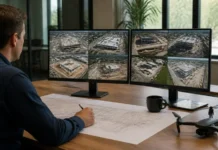



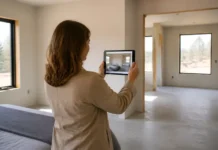













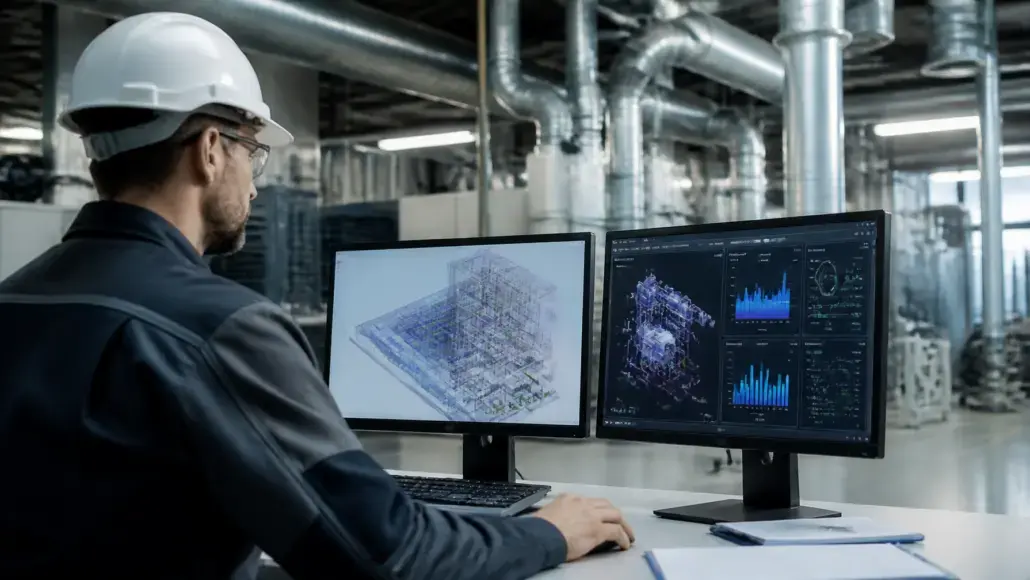

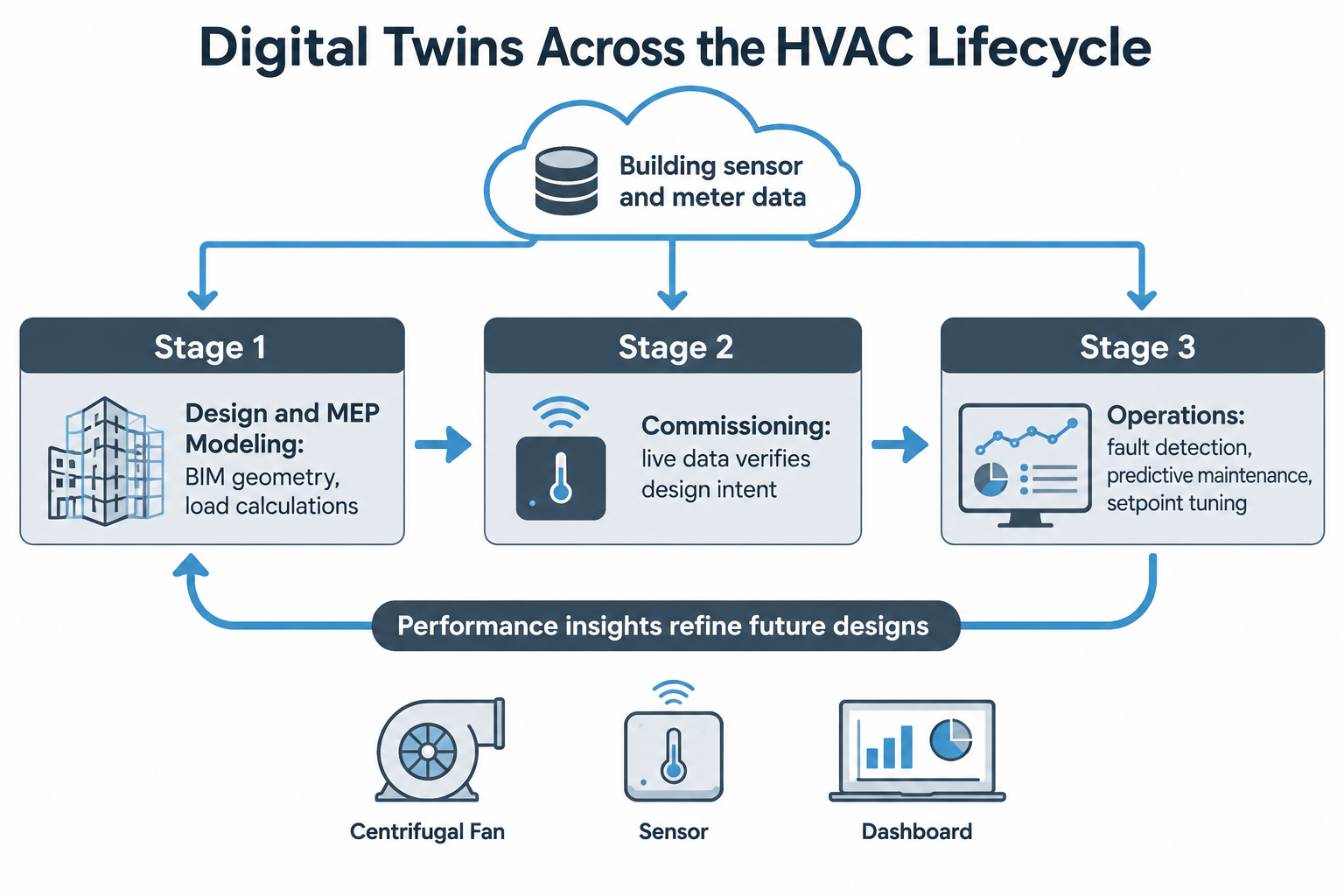
For most of the past decade, the digital twin lived on the design side of the building industry: a rich building information model used for clash detection, load calculations and construction coordination, then largely abandoned at handover. That pattern is breaking. Owners with large portfolios, pressured by energy targets, maintenance costs and equipment complexity, are extending those models into operations, connecting them to live building data and using them to manage HVAC performance for decades after construction. HVAC digital twins, in short, are graduating from project artifacts to operating infrastructure, and the result is a technology category that began as an MEP design tool maturing into a permanent operating asset, and it is changing who wins facility management contracts.
Market signals confirm the shift. Large institutional owners now include operational data deliverables in standard construction contracts, governments in several markets require asset information models for public buildings, and facility service providers increasingly compete on analytics capability rather than labor rates alone. Equipment complexity pushes in the same direction: variable-speed drives, heat recovery sequences and refrigerant safety systems have multiplied the number of interacting control loops that operations teams must understand, and no spreadsheet tracks them adequately.
From Static BIM Models to Living System Replicas
The distinction between a model and a twin is data flow. A building information model is geometry and specification, accurate on the day of handover and increasingly wrong thereafter. An HVAC digital twin adds three ingredients: connectivity to live data from sensors, meters and building automation systems; a semantic structure that lets software understand what each asset is, what it serves and how it should behave; and analytics that compare observed behavior against expected behavior continuously. The twin is not a visualization, though good ones visualize well. It is a computational replica that can answer operational questions: why is this AHU consuming 15 percent more energy than its twin on the floor below, what happens to humidity in the east zone if this setpoint changes, which asset’s failure would disrupt tomorrow’s critical occupancy.
The economics of the handover gap explain why the market is moving. Studies of building performance consistently find a gap between design intent and operational reality, and commissioning data shows measured energy use frequently exceeding design predictions by meaningful margins. The information needed to close that gap, design loads, control sequences, equipment selection rationale, already exists in the design model, and discarding it at handover guarantees that operations teams relearn the building by trial and error. Owners who transfer the model into operations inherit that engineering knowledge instead of repurchasing it, which is why leading institutional owners now specify digital deliverables and data requirements in construction contracts rather than hoping for them.
What an Operational Twin Needs Beyond Geometry
Building operational HVAC digital twins requires deliberate investment in data infrastructure that design-phase BIM never needed. The essential components are:
- Live data integration: connections to building automation systems, utility meters and standalone sensors through protocols such as BACnet, with sensible data historians that retain trend data at useful resolution.
- Semantic modeling: tagging frameworks such as Brick Schema or Project Haystack that label every point and asset so analytics software understands relationships, not just signal values.
- Calibrated physics: a load and system model, whether detailed simulation or reduced-order model, that reproduces the building’s actual behavior closely enough to detect deviation and test scenarios.
- Fault detection logic: rule sets and analytics that continuously compare measured performance against expected performance and route actionable diagnoses to staff or service contractors.
- Governance: defined ownership of the twin, update procedures when equipment changes, and security controls appropriate to a system that can influence building operation.
The governance item fails most often. Twins decay when retrofits and equipment swaps go unrecorded, when sensor maintenance slips and drift goes uncorrected, and when no one owns the answer to the question of which version is authoritative. Owners who treat the twin as a maintained system, with a budget line and a custodian, keep its value; owners who treat it as a project deliverable watch it become another abandoned model within three years.
Interoperability practice is improving through standards rather than vendor goodwill. Semantic tagging frameworks give analytics software a shared vocabulary, open automation protocols expose data without proprietary gateways, and contract language requiring open export formats protects owners from building intelligence they cannot carry forward. The practical advice for owners is blunt: insist on data ownership and exportability before selecting a platform, because the switching costs of a closed system grow with every year of accumulated history.
Fault Detection, Diagnostics and Predictive Maintenance
The first operational payoff usually arrives through fault detection and diagnostics. HVAC digital twins compare expected and observed behavior across thousands of points and surface problems that traditional building automation alarms miss entirely: simultaneous heating and cooling in terminal units, economizer dampers stuck in fixed positions, sensor drift distorting control loops, and schedules serving rooms whose occupancy patterns changed years ago. Industry analyses of fault detection deployments consistently report that a large share of faults found were previously unknown, and that energy waste from undetected faults commonly runs in the range of several percent to over 20 percent of HVAC consumption in buildings that have never been systematically diagnosed.
Predictive maintenance extends the same data foundation from energy to asset care. Twins that trend vibration, runtime, start counts and performance degradation enable intervention based on condition rather than calendar, catching bearing wear, valve leakage and heat exchanger fouling before they cascade into failures. For critical facilities, the value calculation is dominated by avoided downtime rather than energy, and portfolio owners report measurable reductions in emergency work orders once condition-based programs mature. The diagnostic capability also changes the service relationship: buildings whose twins generate verifiable performance data can contract for outcomes, guaranteed comfort and energy levels, rather than for hours of labor.
Deployment discipline determines whether those results materialize. Programs succeed when they start with a limited set of high-value faults, verify each diagnosis in the field before automating responses, and close the loop by tracking confirmed savings. Programs that flood operations teams with unverified alerts train staff to ignore the system, a failure mode common enough to have its own reputation among facility managers. Prioritizing faults by energy and reliability impact, rather than by alarm count, keeps attention on the handful of issues that matter. The technology works; the implementation method decides whether anyone benefits.
Energy Optimization and Continuous Commissioning
Beyond finding faults, HVAC digital twins enable a discipline best described as continuous commissioning: using the model to test operating strategies before deploying them, then verifying results with measured data. Setpoint changes, schedule revisions and even retrofit options can be evaluated in the twin’s simulation environment, and the same environment can verify that commissioning measures deliver their predicted savings, closing the performance gap that has always separated design intent from utility bills. Savings from systematic re-commissioning and continuous optimization typically fall between 5 and 15 percent of HVAC energy, achieved largely through control corrections rather than capital spending. Ventilation offers some of the clearest examples, because models that track zone-level carbon dioxide and airflow make the trade-offs involved in balancing indoor air quality and energy efficiency explicit and testable rather than intuitive.
This optimization loop increasingly incorporates the outside world as well. Twins connected to utility price feeds and grid signals can evaluate load-shifting strategies, and when paired with storage assets they become the optimization engine of a grid-interactive building. The operational twin thus becomes the platform on which successive efficiency technologies stack, rather than a standalone application.
Barriers: Data Quality, Interoperability and Ownership
The obstacles are as real as the benefits. Sensor networks installed for control are often inadequate for analytics, and analytics programs routinely expose missing points, mislabeled tags and drifted instruments that must be fixed before the twin can be trusted. Interoperability across vendors remains imperfect despite open protocols and semantic standards, and multi-building portfolios face the unglamorous work of normalizing data models across buildings constructed in different decades. Cybersecurity deserves explicit treatment, since a system with live write access to building controls is part of a facility’s risk surface.
Cost and business model questions follow. Twin development for a large building is a real investment, and its value accrues across energy, maintenance, uptime and reporting functions, which complicates the budget conversation in organizations where those functions hold separate funds. Procurement should demand open data export rights and vendor-neutral formats so that the twin survives its original software vendor. Where that discipline is applied, the trajectory is clear: digital twins are becoming the standard memory and intelligence layer of complex HVAC operations, and the organizations building that capability now are assembling a durable operational advantage over those still relearning their buildings by hand every time something breaks. Ventilation performance, heating plant health and energy verification all converge in that single operational asset, which is why forward-looking facility teams now treat the twin, not the design model, as the definitive record of how their buildings actually work.