


























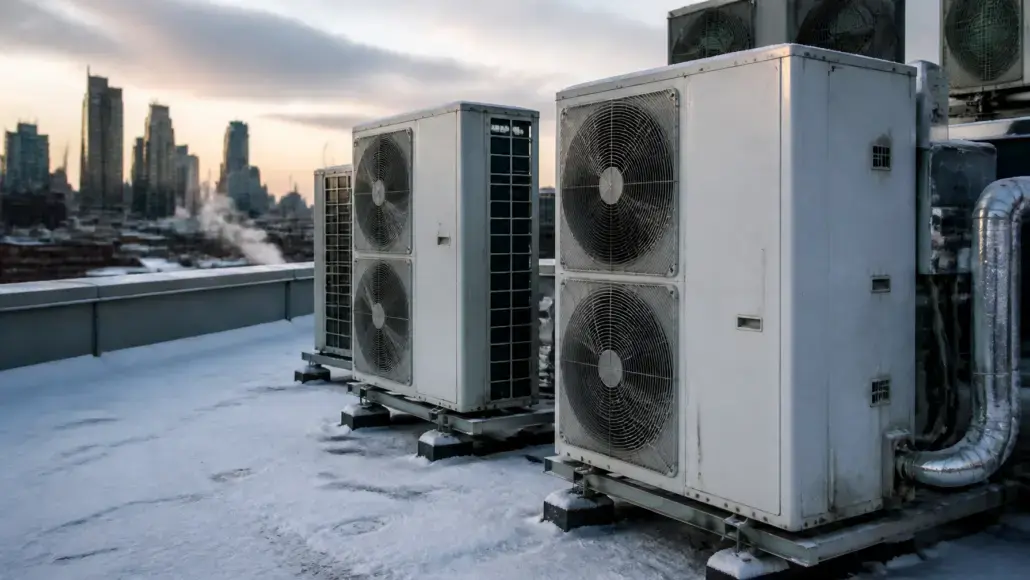

Heat pumps have become the default answer to the question of how commercial buildings decarbonize their heating, and in most climate zones that answer is sound. Across severe cold regions, however, the technology’s marketing narrative and its operational reality still diverge in ways that project teams ignore at their own cost. Modern equipment performs far better at low ambient temperatures than the units of a decade ago, but capacity, efficiency and electrical demand all degrade as temperatures fall, and those degradations interact with envelope quality, utility rates and grid constraints in ways that decide whether an electrification project succeeds or disappoints.
How Modern Heat Pumps Perform at Low Ambient Temperatures
The technical progress is genuine and worth stating precisely. Inverter-driven compressors, enhanced vapor injection and optimized heat exchangers have pushed rated operation well below the point where earlier equipment simply gave up. Many current products deliver useful heating capacity at minus 13 degrees Fahrenheit, and a growing list carries ratings down to minus 22 degrees Fahrenheit or colder. The Department of Energy’s cold-climate designation, informed by Northeast Energy Efficiency Partnerships testing, expects equipment to hold roughly 70 percent of rated capacity at 5 degrees Fahrenheit with a coefficient of performance of at least 1.75 at that temperature, a bar that today’s best machines clear.
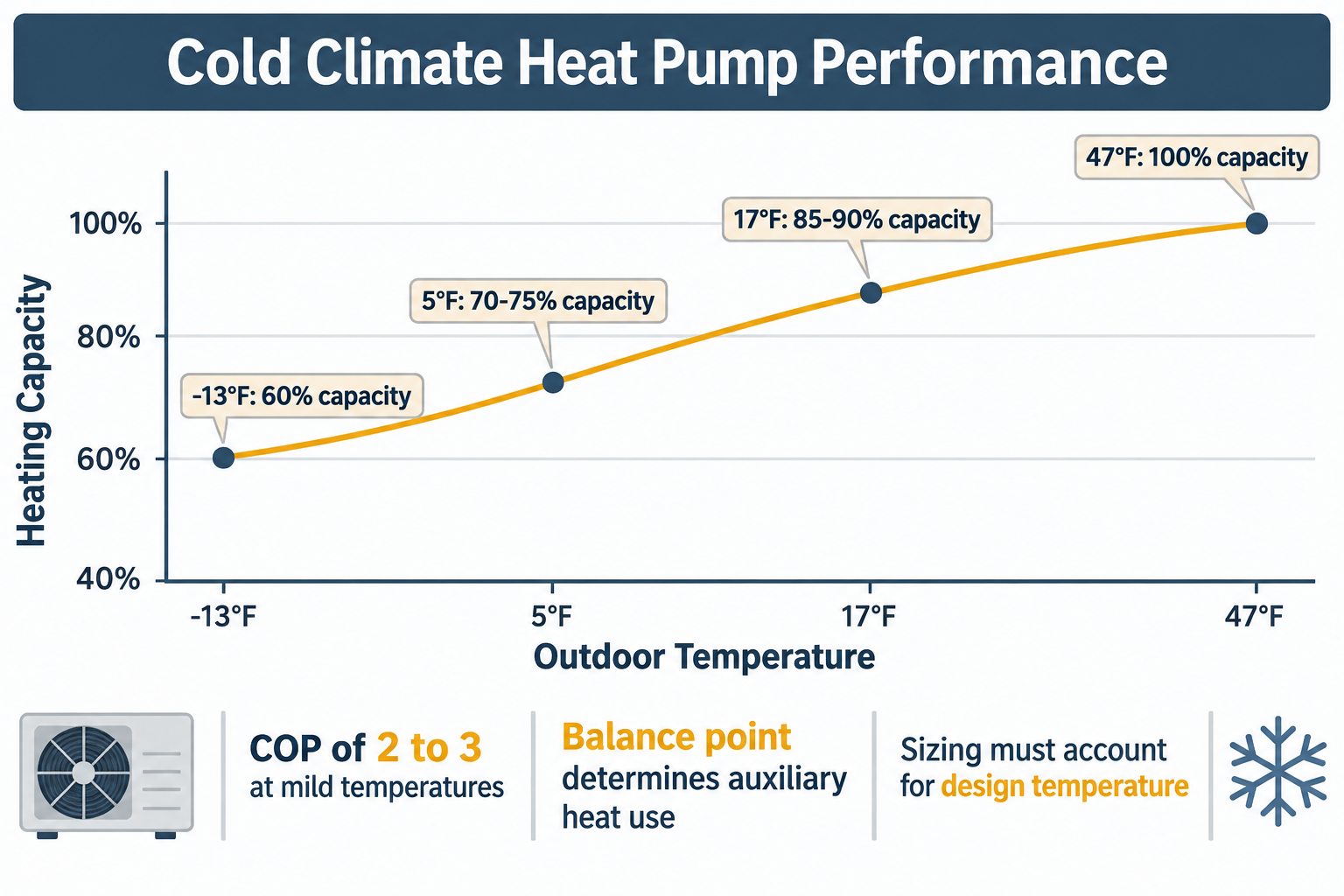
That progress, however, is a curve rather than a flat line. As outdoor temperature drops, both capacity and efficiency decline: an outdoor unit that delivers 100 percent of its nominal capacity at 47 degrees Fahrenheit typically delivers 85 to 90 percent at 17 degrees, 70 to 75 percent at 5 degrees, and around 60 percent at minus 13 degrees. Coefficient of performance falls along a similar path, from values of 2 to 3 in mild weather toward the 1.5 to 2 range in severe cold. Defrost cycles add further interruptions in humid cold climates. None of this makes cold climate heat pumps a poor choice; it makes them a sized-and-verified choice, one whose performance depends on matching the actual capacity curve against the actual building load curve rather than trusting a nameplate.
The Balance Point Problem and Auxiliary Heat
Every heat pump heated building has a balance point: the outdoor temperature at which the equipment’s heating output exactly matches the building’s heat loss. Above that temperature the heat pump covers the load alone; below it, supplemental heat fills the gap. The balance point is where electrification projects either pencil out or fall apart, because the supplemental heat is usually electric resistance, and resistance heat is expensive to run and punishing to the electrical service.
The financial mechanics are unforgiving. In a poorly insulated building with a high balance point, resistance heat may carry a meaningful share of total winter energy, and heating costs under time-of-use rates can exceed the gas baseline the project was meant to beat. In a tight building with a low balance point, the heat pump carries nearly the entire load and the economics work. The same equipment, in the same city, can produce opposite outcomes depending on the envelope it is installed in. Utility demand charges and grid-level winter peaks compound the problem: a cold snap that drives every heat pump in a region to activate resistance heat simultaneously creates the kind of load event that grid planners have flagged as a real constraint on large-scale electrification.
Control strategy sits between the equipment and the economics. Well-configured systems treat auxiliary heat as a last resort, staging compressors fully before engaging resistance elements and using weather-anticipated warmup rather than reaction to indoor temperature drops. Poorly configured systems do the opposite, and field audits repeatedly find auxiliary heat locked into naive setpoints that guarantee resistance operation during the most expensive hours. Optimizing that logic is often the highest-return, lowest-cost measure available in an existing installation, and metering the auxiliary circuit separately, where meters allow, converts the optimization from an estimate into a measured line item.
Envelope Quality Decides Electrification Outcomes
Because capacity and efficiency decline with temperature, the cheapest way to improve heat pump performance in cold climates is not to buy a bigger machine but to shrink the load it must meet. Insulation levels, airtightness, glazing performance and ventilation heat recovery all directly lower the balance point, which shrinks both the required heat pump capacity and the hours of auxiliary heat. Retrofit projects that sequence envelope work before plant replacement consistently report smaller, cheaper and better-performing mechanical installations than projects that bolt heat pumps onto existing loads.
This load-first logic is well understood in new construction, yet retrofit budgets often reverse it under schedule pressure. The discipline matters most precisely where heat pumps are hardest: older masonry stock, buildings with hydronic systems designed for high water temperatures, and facilities with intermittent occupancy that forces rapid morning warmup through deep winter setbacks. In those cases, aggressive setback strategies can actually increase resistance heat use, and controls teams should verify that warmup curves, rather than naive schedules, govern recovery periods.
Ventilation heat recovery occupies a special position in this sequence because it interacts directly with heating plant sizing. Buildings recovering a large share of exhaust energy reduce the outdoor air conditioning load that heat pumps must carry, and in cold climates that reduction frequently proves large enough to change the equipment selection itself. Teams specifying cold climate heat pumps should therefore model the building twice, before and after planned envelope and recovery measures, and size the plant against the improved condition rather than the existing one. Funding load reduction out of the mechanical budget often looks unorthodox to accounting systems built around discipline silos, yet the combined expenditure is almost always lower than the mechanical scope it displaces.
Grid, Rates and the Operational Reality
Cold climate heat pumps also change a building’s relationship with its utility. Winter peak demand becomes a design variable: electric service capacity, transformer sizing and rate structure selection should all be checked against the worst-case heating hour, not the annual average. Where time-of-use and demand charges are significant, control strategies that pre-heat within thermal comfort bands before price peaks, or that trim auxiliary heat operation, can meaningfully reduce cost without sacrificing comfort.
Utilities are responding to winter peak growth with programs that compensate flexible heating load. Some offer rate designs that reward off-peak heating, some deploy direct load control over resistance elements and heat pump compressors during grid events, and some combine both with incentives for thermal storage. Commercial building teams evaluating electrification should engage their utility early, because program availability shapes both the project’s financial model and its control design, and where interconnection queues or service upgrades are slow, early engagement can be the difference between a two-year and a five-year timeline. A building designed for flexibility can earn revenue for the flexibility it already has; a building designed as a static load pays peak prices without compensation.
Grid interaction is the emerging complement to these strategies, and it connects heating electrification to the storage technologies now entering mainstream practice. Buildings that pair heat pumps with thermal energy storage and grid-interactive HVAC systems can shift load away from the coldest peak hours rather than simply absorbing them, which softens both the demand charge and the grid event.
Procurement Guidance for Building Teams
Teams specifying low-ambient heating equipment can protect themselves from the gap between brochure and performance by demanding transparency and verification. The following practices separate successful cold climate installations from disappointing ones:
- Request full performance tables: capacity and coefficient of performance at 17 degrees, 5 degrees and minus 13 degrees Fahrenheit, not just nominal ratings.
- Verify the balance point calculation: model the building’s heat loss curve against the equipment’s capacity curve and state the balance point explicitly in the design documents.
- Define the auxiliary heat strategy: quantify expected resistance heat hours and cost, and evaluate whether a hybrid gas or thermal storage supplement beats full electric operation.
- Size for design temperature, not averages: equipment chosen against mean winter conditions will lean on resistance heat exactly when prices peak.
- Commission in real cold weather: verify defrost behavior, warmup curves and changeover sequences under actual low-ambient conditions before accepting the system.
Skeptics of the technology sometimes read the capacity curves as an argument against electrification in cold regions, and the reading is mistaken. The curves are an argument against undersized engineering, against envelope neglect and against assuming that yesterday’s grid connection fits tomorrow’s heating plant. None of those failures is a property of cold climate heat pumps as a technology; each is a property of design and installation decisions.
Cold climate heat pumps remain the central technology of building electrification, and in most applications they deserve the role. The real-world limits are not reasons to avoid them; they are the specific engineering parameters, balance point, envelope quality, auxiliary heat and grid capacity, that determine whether the promised performance arrives on the utility bill. Projects that treat those parameters as design requirements rather than afterthoughts are consistently the ones that deliver.