























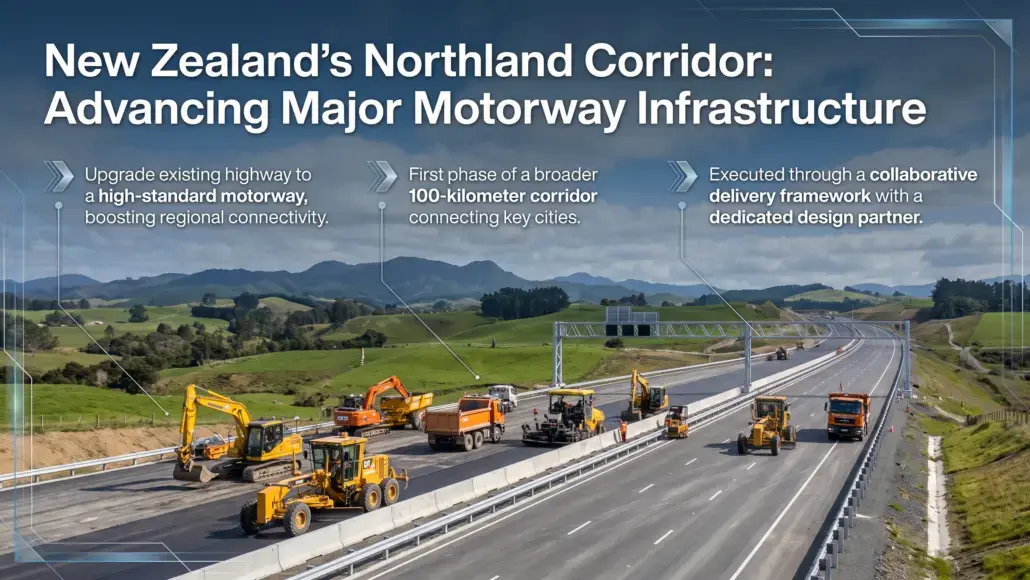


AECOM has been appointed as the design partner for the Warkworth to Te Hana project in New Zealand — the first section of the country’s expansive Northland Corridor Program. The project will upgrade the existing State Highway 1 between Warkworth and Te Hana into a higher-standard motorway, forming Section One of a planned 100-kilometer corridor designed to connect Auckland with Whangārei.
A Collaborative Delivery Framework
The Northland Corridor Project is being delivered through the Northway Consortium, with ACCIONA serving as the lead contractor alongside Aberdeen Investments. AECOM will provide comprehensive design services in close coordination with the delivery team and NZ Transport Agency Waka Kotahi, New Zealand’s national transport authority.
AECOM’s design scope for the project includes a new system interchange and targeted changes to the roadway alignment. These changes are specifically aimed at improving curves and sight distances, incorporating safer gradients for all road users — elements central to the project’s overarching safety objectives.
Resilience at the Core of Design
A key focus of AECOM’s design approach for the Warkworth to Te Hana project is infrastructure resilience. The design incorporates dedicated measures intended to reduce the impact of flooding, landslides and other extreme weather events on the corridor. This reflects a broader industry emphasis on building transportation networks that can withstand environmental pressures over the long term.
The upgraded motorway is expected to improve movement for passenger vehicles, freight and public transportation, while directly addressing congestion along the existing route. As part of the Northland Corridor Program, the project plays a meaningful role in better connecting communities across Northland with Auckland, New Zealand’s largest economic center.
Material Efficiency as a Design and Construction Priority
AECOM’s design approach also integrates a deliberate strategy around material management. The design includes provisions for reusing materials already available at the project site, which is intended to reduce dependence on imported materials and minimize construction waste.
Utilizing on-site materials also reduces hauling requirements and the associated embodied carbon, while offering potential improvements to material-related project costs. For contractors and project owners working on large-scale transportation construction programs, material management remains a critical operational and financial consideration — particularly where earthworks, hauling and imported materials can account for significant portions of overall project activity.
A Program That Sets the Standard for Transportation Construction
The Northland Corridor Project brings together roadway upgrades, interchange development, resilience engineering and material-management strategies within a single, coordinated construction program. AECOM’s role as design partner places engineering and construction coordination at the center of this first project section, underscoring the value of integrated design and delivery on complex transportation infrastructure.
For transportation owners and contractors, the project reflects the growing emphasis on resilient infrastructure design and construction approaches that reduce material movement and waste — all while maintaining and improving roadway performance standards.