


























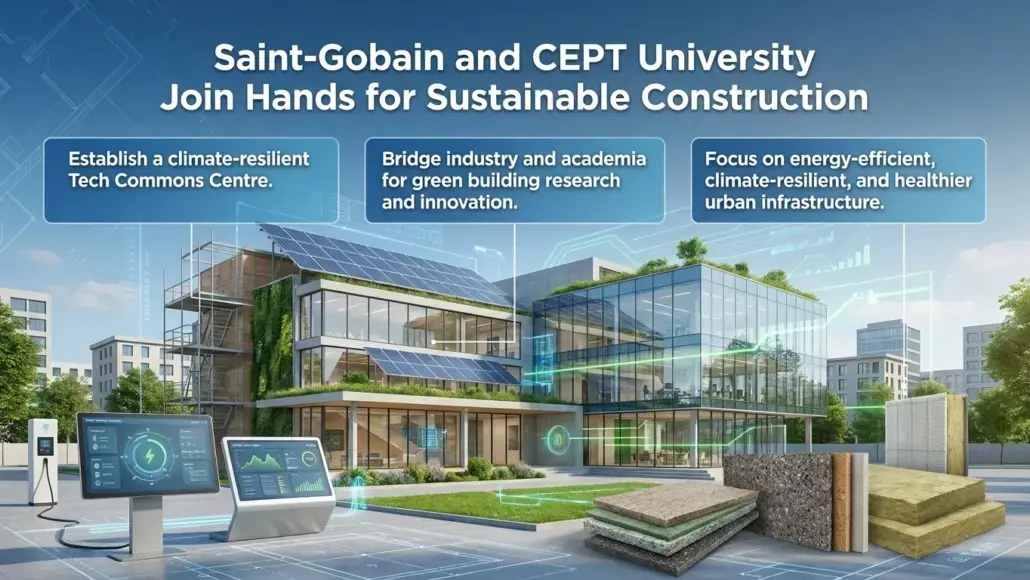


Saint-Gobain and CEPT University have announced a long-term partnership to establish a climate-resilient Tech Commons Centre in Ahmedabad, bringing industry and academia together to support research, innovation, and practical learning in green buildings. The collaboration is intended to strengthen work on energy-efficient buildings, climate resilience, and healthier indoor environments at a time when India is expanding its urban infrastructure and pursuing lower carbon emissions. According to the organisations, the new centre will support research, prototype development, skill training, and knowledge sharing for students, researchers, and professionals working in architecture, engineering, design, and urban development.
The Tech Commons Centre is expected to function as a shared platform where students and industry experts can test building technologies, examine construction materials, and study ways to improve building performance under Indian climatic conditions. The initiative is designed to connect classroom learning with practical challenges faced by the construction sector.
Sreedhar N., Senior Vice-President and CEO, Asia Pacific and India Region, Saint-Gobain, said the partnership reflects a shared focus on sustainable and energy-efficient construction. “Saint-Gobain’s sustainable solutions create climate-resilient building spaces that consume up to 40% less energy, reduce embodied carbon, improve circularity, enhance durability, deliver healthier and comfortable living spaces. Our aim is to advance sustainable and energy-efficient construction while placing well-being at the center. This shared vision is at the heart of our partnership with CEPT. Together, we will provide architecture students with a living lab for sustainable construction relevant to India’s unique needs and create awareness in the next generation of talent that will shape the future of India’s built environment for decades to come.”
Four Specialised Hubs to Drive Research
The centre will include four specialised hubs covering Building Science and Climate Resilience, Urban Intelligence and Digital Twins, Computational Design and Visualisation, and Communications and Media. These facilities are intended to support interdisciplinary work and encourage collaboration between researchers, students, and construction professionals.
The announcement comes as India continues to place greater emphasis on sustainable urban development. Buildings account for a significant share of global energy use and greenhouse gas emissions, making energy-efficient design an important part of climate strategies worldwide. Indian research institutions and government agencies have increasingly focused on reducing energy demand in buildings through improved materials, better insulation, efficient cooling systems, and climate-responsive design.
Building practices centered around green buildings can reduce electricity demand for cooling and lighting while improving indoor comfort. Better insulation, natural daylight, improved ventilation, and fire-resistant materials are among the measures widely promoted by architects and building scientists to lower operating costs and improve occupant health. These measures are becoming increasingly important as Indian cities experience rising temperatures and rapid urban growth.