










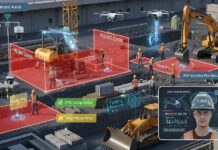










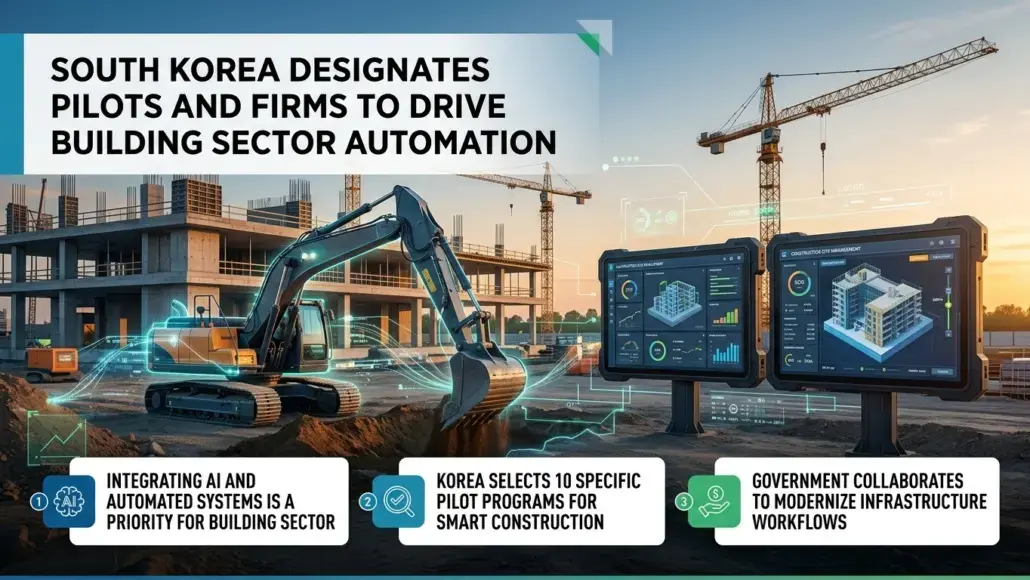


The integration of artificial intelligence and automated systems is becoming a central priority for the building sector as governments seek to modernize traditional infrastructure workflows. On July 12, 2026, the South Korean Ministry of Land, Infrastructure and Transport, in collaboration with the Korea Institute of Civil Engineering and Building Technology (KICT), announced that they have selected 10 specific pilot programs and 12 high-potential small-scale firms to advance smart construction technology through AI integration and automated building. This initiative is designed to accelerate the deployment of off-site construction methods and provide a growth platform for innovative corporations that can lead the industry’s digital transition. By leveraging the Smart Construction Alliance—a consultative body consisting of approximately 380 corporations supported by public, academic, and research sectors—the program aims to bridge the gap between technical development and field implementation.
Strategic Demonstration and Field Integration
The technology demonstration support project provides smaller enterprises with essential access to construction sites managed by mid-tier and large-scale companies. The demonstration support program allocates up to 25 million won to facilitate the practical application of smart construction technology at sites managed by larger enterprises. Small and medium-sized firms that have developed excellent products or services but struggle to secure physical testing environments will benefit from this support. To ensure comprehensive results, the selection of these targets was finalized in the first half of the year to allow for a six-month demonstration period throughout the second half of 2026. Within the demand-based category, six projects were chosen, featuring rotational SLAM (simultaneous localization and mapping) equipment for apartment complex crack inspections and a VLM (vision-language model) linked with intelligent edge cameras to analyze hazardous work conditions. In the self-proposed category, four projects were approved, including vision AI systems for uniformizing ready-mixed concrete quality and carbon management systems for site resource circulation. The findings from these field trials are scheduled to be showcased at the 2026 Smart Construction EXPO this November.
Fostering Competitive Small and Medium Enterprises
In addition to site-specific pilots, the government is focusing on long-term corporate growth by designating 12 “small but strong” companies characterized by high technical capability and market potential. While the program previously selected 20 firms annually over a three-year period, this year’s selection was refined to 12 corporations to focus resources on those with the highest growth potential. These designated entities, including Hansung Modular for integrated panels, ITONE for safety platforms, and KCT ENC for underground collapse risk monitoring, will receive up to 30 million won for prototype production and will be formally disclosed through KISCON. A roundtable will be held on July 15, 2026, providing a forum for these designated corporations to present their certificates, discuss operational difficulties, and explore additional corporate support measures with the Ministry and KICT.