





















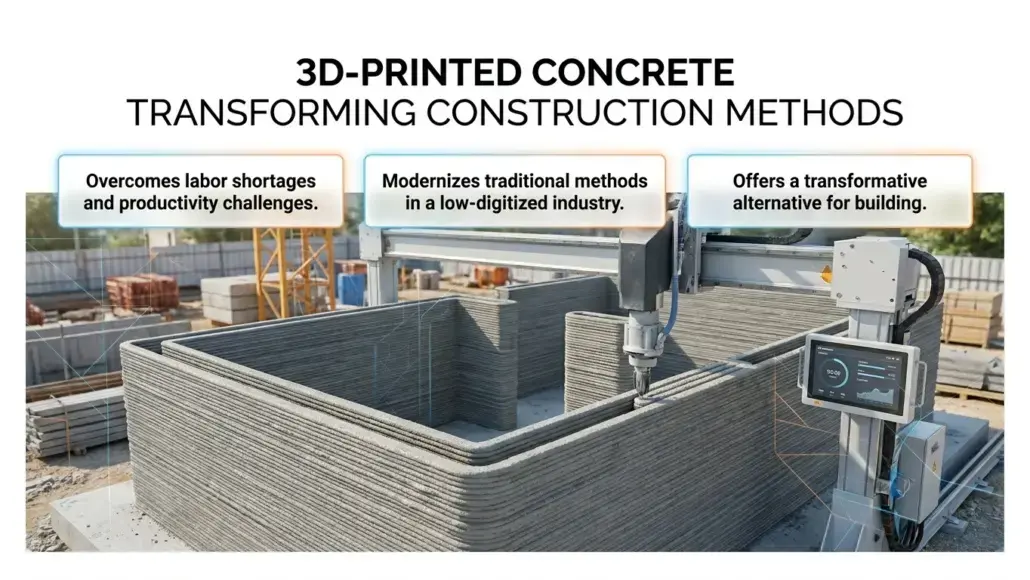


Despite significant advances in engineering, materials, and project management, construction remains one of the least digitized industries globally. Projects continue to face familiar challenges, including labor shortages, schedule delays, cost pressures, and productivity constraints. While digital technologies have improved planning and coordination, many core construction activities still rely heavily on traditional building methods.
As a result, the industry is increasingly exploring alternative approaches that can improve efficiency without compromising quality or performance. Among the most discussed innovations is 3D-printed concrete, a technology that is redefining how structures can be designed, manufactured, and assembled.
Although still in the early stages of adoption, 3D-printed concrete is attracting attention because it has the potential to reshape construction workflows rather than simply improve individual building components.
From Conventional Construction to Digital Fabrication
Traditional construction typically involves multiple sequential processes, including formwork installation, reinforcement placement, concrete pouring, curing, and finishing. These activities require substantial labor, coordination, and time.
3D-printed concrete introduces a different approach. Using automated printing systems, specially engineered concrete mixtures are deposited layer by layer to create structural and architectural elements directly from digital models.
This process reduces dependence on conventional formwork and allows structures to be produced with a level of precision and automation that would be difficult to achieve using traditional methods.
More importantly, it shifts construction toward a manufacturing-based model where digital designs can be translated directly into physical structures.
Speed Is Driving Industry Interest
Project delivery speed remains a major concern across the construction sector. Delays can affect profitability, disrupt supply chains, and increase financing costs.
One reason 3D-printed concrete has generated considerable interest is its potential to accelerate certain construction activities. Automated printing systems can produce walls, structural components, and building sections more quickly than traditional methods under suitable conditions.
The ability to automate repetitive tasks also reduces dependence on extensive manual labor during specific stages of construction.
For developers and contractors seeking greater schedule certainty, these advantages are becoming increasingly attractive.
However, speed alone is not the primary value proposition. The broader significance lies in how digital fabrication can transform project execution.
Design Freedom Beyond Traditional Constraints
Construction has traditionally required designers to balance creativity with the practical limitations of materials and construction methods.
Complex geometries often increase costs because they require specialized formwork, additional labor, and more complicated installation procedures.
3D-printed concrete changes this equation by enabling the production of highly customized forms directly from digital models. Curved walls, intricate facades, and complex architectural elements can often be produced without the same level of manufacturing complexity associated with conventional construction.
This capability is opening new opportunities for architects and engineers seeking to combine performance with design innovation.
As digital design tools continue to evolve, the relationship between architecture and construction is becoming increasingly interconnected.
Material Efficiency Is Becoming More Important
Material optimization is a growing priority throughout the construction industry. Rising costs, sustainability targets, and resource constraints are encouraging project teams to minimize waste while maintaining performance standards.
Traditional construction methods frequently generate excess material through formwork systems, offcuts, and inefficient material usage.
Because 3D-printed concrete deposits material only where it is needed, it offers opportunities to improve material efficiency and reduce waste generation.
The ability to optimize material placement through digital design can also contribute to lighter structures and more efficient resource utilization.
As sustainability objectives become increasingly important, material efficiency is likely to remain a major driver of interest in additive construction technologies.
Addressing Construction Workforce Challenges
Labor shortages continue to affect construction markets around the world. Skilled workers are becoming increasingly difficult to recruit, while project demands continue to grow.
Automation is therefore becoming an important part of industry discussions regarding future workforce strategies.
Rather than eliminating the need for human expertise, 3D-printed concrete is shifting labor requirements toward digital design, machine operation, engineering oversight, and quality control.
This transition reflects a broader trend in which construction work is becoming increasingly technology-driven.
The challenge for the industry will be ensuring that workforce development keeps pace with technological change.
Applications Are Expanding Beyond Demonstration Projects
Much of the early attention surrounding 3D-printed concrete focused on demonstration structures and experimental projects. Today, however, applications are gradually expanding into more practical construction environments.
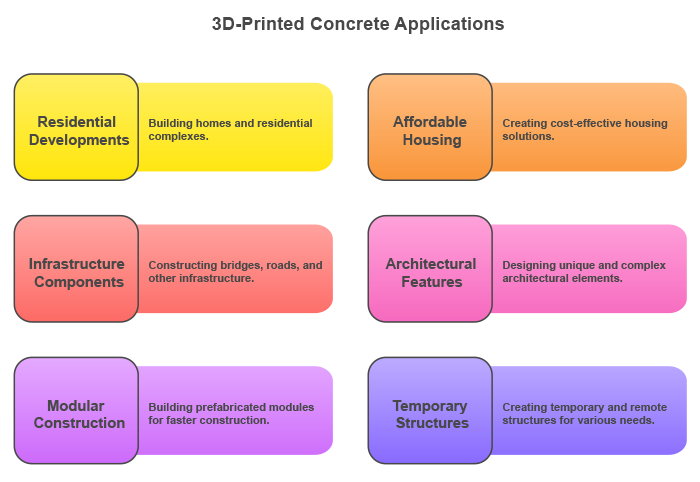
The technology is being explored for:
- Residential developments
- Affordable housing projects
- Infrastructure components
- Architectural features
- Modular construction systems
- Temporary and remote structures
These applications demonstrate that the conversation is moving beyond technical feasibility and toward commercial viability.
As more projects enter operational use, the industry is gaining a clearer understanding of where additive construction methods can deliver meaningful value.
Barriers to Widespread Adoption
Despite its potential, 3D-printed concrete faces several challenges that continue to limit large-scale implementation.
Building regulations and construction codes have traditionally been developed around conventional construction methods. Integrating new fabrication technologies into these frameworks can be a complex process.
Additional challenges include:
- Material standardization
- Structural validation requirements
- Equipment investment costs
- Workforce training needs
- Scalability across different project types
Many developers and contractors also remain cautious regarding long-term performance data, particularly for large commercial applications.
As industry experience grows and regulatory frameworks evolve, these barriers may become easier to overcome.
The Rise of Data-Driven Construction
The emergence of 3D printing reflects a broader transformation occurring across the construction sector.
Projects are increasingly being shaped by digital workflows that connect design, engineering, manufacturing, and construction activities. Technologies such as digital twins, building information modeling, robotics, and automation are creating more integrated project delivery systems.
Within this environment, 3D-printed concrete represents more than a new material application. It represents a shift toward data-driven construction methods where digital information directly influences how physical assets are produced.
This convergence of digital technology and construction processes is expected to play a major role in shaping the industry’s future.
A Different Way to Think About Construction
The long-term significance of additive construction may not be measured solely by how many buildings are printed.
Its greater impact may lie in changing how the industry approaches project delivery. By reducing reliance on traditional workflows and introducing greater levels of automation, digital fabrication encourages construction professionals to rethink established practices.
For decades, improvements in construction have often focused on incremental gains. Technologies such as 3D-printed concrete offer the possibility of more fundamental change by redefining how structures are created from the ground up.
Conclusion
Construction is entering a period where productivity, efficiency, and innovation are becoming increasingly important competitive factors. Traditional methods continue to serve the industry well, but growing project complexity and workforce challenges are creating demand for alternative approaches.
3D-printed concrete is emerging as one of the most significant developments in this transition. By combining automation, digital design, material efficiency, and construction flexibility, it offers a glimpse into how future projects may be planned and delivered.
As frequently highlighted across industry platforms such as World Construction Today, the future of construction will likely be shaped by technologies that connect digital intelligence with physical execution. In that future, 3D-printed concrete may play a far more important role than simply changing how concrete is placed it may help redefine how construction itself is performed.