

























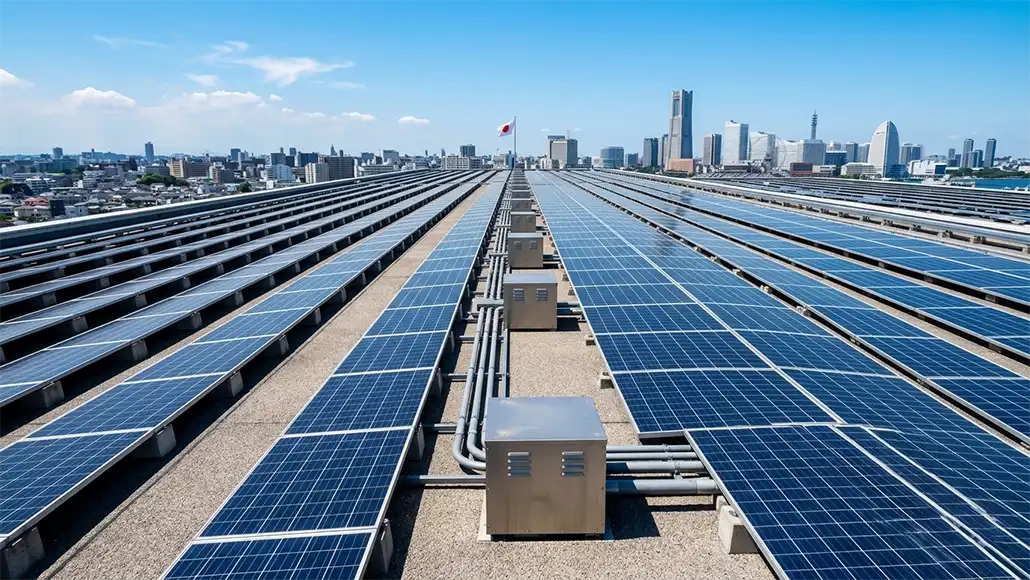


Taisei Corporation, a leading Japanese construction company, has confirmed that its Yokohama Technology Centre ZEB demonstration building ran entirely on solar power for the entire year. Balance was maintained by Lithium-ion battery, low-pressure hydrogen storage for solar-building ensured seasonal carryover storing a summer solar surplus as hydrogen and utilising it to run the building through winter nights.
The demonstration, which started in the winter of 2023, shows a full annual cycle of solar-only building operation without relying on the grid, with recorded data from June 2024 and February 2025 showing that the energy management system functioned as designed.
The holy grail of hydrogen storage for solar-building has been to run a building completely on solar power all year, through the winter nights when solar generation happens to be the lowest. This is now possible, as demonstrated by the technology centre of Taisei Corporation in Totsuka-ku, Yokohama. The facility employs an energy management system that integrates battery, low-pressure hydrogen storage in order to bridge the seasonal gap.
The building, which has been a net-zero energy building for 11 years in a row since 2014, launched a more ambitious demonstration in the winter of 2023, and that was running entirely on solar generation with no grid electricity drawn at all. Taisei announced the results on April 16, 2026, and confirmed the annual cycle went as planned.
The system architecture is simple in concept and difficult in practice. Lithium-ion batteries manage the daily cycle, soaking up excess solar generation throughout the day and discharging it overnight. Electrolysis-based hydrogen production addresses the inter-seasonal storage problem that batteries cannot economically solve – when solar generation always produces more electricity than what the building and battery can absorb, that excess is transformed into hydrogen and stored at low pressure. If there is insufficient solar power available in winter, particularly when it is dark for long periods of time or the sky is cloudy, the fuel cell will tap into the hydrogen it has stored to produce electricity.
The operation becomes robust by the measured data. On a representative sunny day in June 2024 with 12.1 hours of sunshine, the roof solar system went ahead and produced 444 kWh. 57 kWh of that went straight to the building, 155 kWh charged the battery, and 232 kWh went through the electrolyser to hydrogen storage.
A typical sunny day in February 2025, however, saw 8.4 hours of sunshine generate 297 kWh, with a further 168 kWh supplied from the fuel cell, hence using hydrogen created months earlier in the summer in order to power the building from evening up until early morning the following day.
It is well to be noted that Taisei’s energy management system operates in real-time and uses weather predictions and load profiles along with generation data to continuously decide whether excess power should be fed to the battery, the electrolyser or even both. The system is completely developed in-house, a conscious decision to allow the company to fine-tune the control logic and eventually provide the platform to other building owners.
It was in early 2025 that FuelCellsWorks reported on a similar demonstration at the residential scale Japan’s first apartment block with integrated hydrogen that also uses excess solar power so as to produce and store hydrogen onsite. Apparently, Panasonic has been evaluating a combined hydrogen fuel cell and solar system at Osaka Metro and has plans to use it for future hydrogen-powered rail operations FuelCellsWorks.
The Taisei demo is at the intersection of these trends – a highly commercially attractive building, run by a large construction and engineering company, with commercially accessible system elements which are controlled by proprietary software.
Interestingly, the low-pressure hydrogen storage is to be noted in particular. High-pressure storage at 350-700 bar imposes cost, complexity and security requirements that can make building-integrated hydrogen systems unrealistic. The Taisei system has made a conscious choice to employ low-pressure storage, accepting a sacrifice in energy density for the benefits of a simpler, more secure and affordable infrastructure. That tradeoff makes sense for a building application in which storage density is not the limiting factor.
The company says it will continue to track planning, control and efficiency and aims to drive the technology for wider use. A firm that has done this demonstration at its own technology centre using real consumption data across real seasons has a qualitatively distinct commercial proposition for the construction sector compared to one which simply offers a concept.