

























The global construction landscape is currently being redefined by an unprecedented boom in the development of data centers. As the world transitions toward a more digital-centric economy, powered by cloud computing, artificial intelligence, and the Internet of Things, the demand for physical infrastructure to house these technologies has reached a fever pitch. This “data center gold rush” is not merely another sector within the industry; it is a transformative force that is altering how construction firms approach design, supply chain management, and project execution. Unlike traditional commercial or residential builds, these facilities are high-stakes, mission-critical environments where speed-to-market is the primary metric of success. This urgency is forcing a shift toward modularity and prefabrication, while the massive power requirements of these “digital factories” are making energy infrastructure the centerpiece of modern construction strategy.
The Shift Toward Mission-Critical Project Delivery
The unique requirements of data centers have birthed a specialized field within construction often referred to as “mission-critical” delivery. In this environment, the margin for error is non-existent. A few minutes of downtime in a hyperscale facility can result in millions of dollars in lost revenue and catastrophic data loss for global enterprises. Consequently, construction strategy has shifted away from a generalized approach toward a highly specialized, engineering-led methodology. Project teams now integrate electrical and mechanical experts from the earliest feasibility stages to ensure that the complex cooling and power distribution systems are flawlessly executed. This focus on reliability and redundancy means that the commissioning phase of a data center is often more rigorous than the construction phase itself, requiring thousands of hours of testing to simulate every possible failure scenario before the facility goes live.
Modular Construction and the Race for Speed-to-Market
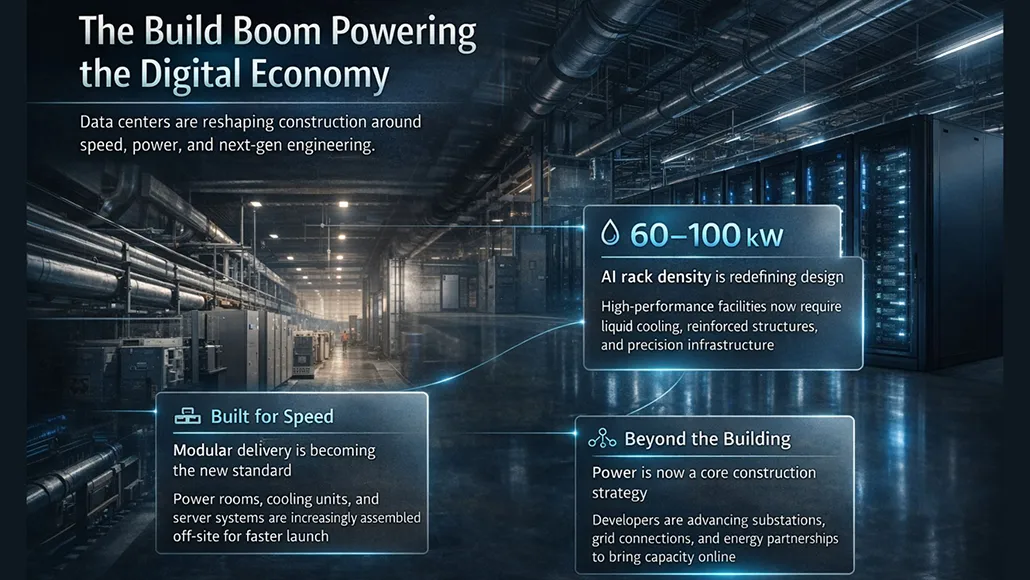
In the world of cloud service providers, being first to a new geographic market is a significant competitive advantage. This pressure has rendered traditional “stick-built” construction methods too slow. To meet aggressive timelines, the industry has embraced modular construction and prefabrication on a massive scale. Entire sections of a data center including power rooms, cooling units, and server racks are now manufactured off-site in controlled environments and shipped to the location for final assembly. This “LEGO-style” approach reduces on-site labor requirements and mitigates the impact of weather-related delays. Furthermore, it allows for a level of quality control that is difficult to achieve in the field. For construction firms, this means transitioning from traditional on-site management to a more logistics-oriented role, where the synchronization of deliveries from various global manufacturers becomes the heart of the project’s success.
Standardized Designs vs. Custom Engineering
To further accelerate delivery, many hyperscale operators are moving toward standardized “reference designs.” These blueprints allow contractors to build nearly identical facilities across different continents, reducing the time spent on bespoke engineering. However, the local environment still dictates significant modifications, particularly concerning seismic requirements, soil conditions, and ambient temperature for cooling systems. The challenge for modern construction firms is to balance the benefits of standardization with the technical expertise required to adapt these designs to local realities. This “global design, local execution” strategy has become the hallmark of the most successful data center contractors, requiring a deep bench of talent that can navigate diverse regulatory and environmental landscapes while maintaining a uniform standard of excellence.
Solving the Power and Cooling Conundrum
The most significant bottleneck in the data center boom is not labor or materials, but the availability of power. A single hyperscale data center can consume as much electricity as a small city, putting immense strain on local utility grids. This reality has forced construction strategy to expand beyond the perimeter of the building site. Major developers are now becoming energy infrastructure partners, often funding the construction of new substations, transmission lines, and even renewable energy projects to ensure their facilities have a reliable power source. On the cooling side, the heat generated by modern high-density AI chips is pushing traditional air-cooling systems to their limits. We are now seeing a shift toward liquid cooling and “immersion” technologies, which require specialized piping systems and structural considerations that are vastly different from standard HVAC installations.
The AI Factor: Liquid Cooling and Rack Density
The explosion of generative AI has drastically increased the power density of server racks. Where a standard cloud rack might draw 10-15 kilowatts (kW), an AI-optimized rack can draw upwards of 60-100 kW. This intensification of heat has made liquid-to-chip cooling a necessity in new builds. For construction teams, this means installing complex leak-detection systems and specialized fluid distribution networks that must be integrated directly into the structural flooring. The added weight of these liquid-cooled racks and the accompanying infrastructure also necessitates more robust structural engineering, often requiring thicker concrete slabs and reinforced steel supports. This shift highlights how the specific technology being housed within the data center is now a primary driver of the building’s structural and mechanical design.
Navigating Supply Chain Constraints and Global Logistics
The rapid scale-up of data center construction has placed immense pressure on the global supply chain for specialized equipment. Items such as high-voltage transformers, large-scale generators, and industrial chillers now have lead times that can extend beyond two years. This has fundamentally changed the procurement lifecycle. Construction firms can no longer wait for a design to be finalized before ordering equipment; they must now engage in “speculative procurement,” securing manufacturing slots and purchasing long-lead items based on preliminary capacity projections. This shift requires a high degree of financial liquidity and a willingness to take on significant inventory risk. Furthermore, the global nature of the data center market means that a shortage in one part of the world can quickly derail projects thousands of miles away, making real-time supply chain visibility a critical component of the strategic plan.
Sustainability and the Drive for Green Data Centers
As data centers become more prominent, they are coming under intense scrutiny for their environmental impact. The construction industry is responding by integrating sustainability into the very core of data center strategy. This includes the use of low-carbon concrete and recycled steel for the building shell, but the real impact lies in operational efficiency. The industry-standard metric, Power Usage Effectiveness (PUE), is now a primary design target. Construction firms are implementing advanced building management systems that use AI to optimize airflow and cooling in real-time, significantly reducing energy waste. Additionally, there is a growing trend toward “circular” data centers, where waste heat from the servers is captured and redirected to heat nearby homes or commercial greenhouses.
Water Scarcity and Cooling Innovation
Beyond electricity, data centers are significant consumers of water for cooling purposes. In regions facing water scarcity, this has become a major flashpoint for community opposition. Construction strategy is therefore pivoting toward “waterless” cooling solutions, such as closed-loop systems and enhanced air-side economizers. While these systems are often more expensive and complex to install, they are becoming a requirement for obtaining planning permission in many jurisdictions. The ability to design and build facilities that minimize both carbon and water footprints is now a key differentiator for construction firms competing for major tech contracts, as hyperscale operators look to fulfill their public environmental pledges.
Future Outlook: The Evolution of Digital Infrastructure
The data center boom shows no signs of slowing down, especially as AI continues to permeate every aspect of the global economy. Looking forward, we can expect to see the rise of “edge” data centers smaller facilities located closer to end-users to reduce latency. This will require a different construction strategy, focused on small-scale, highly repeatable designs that can be deployed rapidly across hundreds of locations. Simultaneously, the search for more power will lead to the exploration of “on-site” energy solutions, such as small modular reactors (SMRs) or massive hydrogen fuel cell arrays. The construction firms that will lead this next era are those that can bridge the gap between traditional building practices and advanced technology, serving as both contractors and consultants to the tech giants shaping our digital future.