



























Key Takeaways:
- Enhanced Efficiency and Speed: Robotics significantly accelerates project timelines, from initial surveys to final construction and maintenance, reducing delays and optimizing resource allocation.
- Improved Safety Standards: By deploying robots in hazardous or repetitive tasks, human exposure to risks is minimized, leading to a dramatic improvement in worker safety on infrastructure sites.
- Unparalleled Precision and Quality: Robotic systems offer accuracy far exceeding human capabilities, resulting in higher quality builds, reduced material waste, and extended infrastructure lifespan.
- Cost Reduction in the Long Run: While initial investment can be substantial, the long-term benefits of robotics including reduced labor costs, faster project completion, and lower maintenance expenses deliver significant economic advantages.
- Transformative Impact Across Sectors: Robotics is not limited to one area; it is fundamentally reshaping road construction, bridge maintenance, and rail project technology, creating a cohesive vision for smart infrastructure construction.
Robotics in Infrastructure Development: Transforming Roads, Bridges, and Rail Projects
The bedrock of any thriving society lies in its infrastructure – the intricate network of roads, bridges, and rail lines that connect communities, facilitate commerce, and ensure the smooth flow of daily life. For centuries, the construction and maintenance of these vital arteries have relied heavily on traditional manual labor and established engineering practices. However, as the demands on our infrastructure grow, coupled with pressing challenges such as aging systems, labor shortages, and the need for greater sustainability, a profound transformation is not just desirable but absolutely essential. This transformation is now being spearheaded by the rapid integration of robotics in infrastructure development, ushering in an era of unprecedented efficiency, safety, and precision.
The concept of leveraging advanced machinery to assist in large-scale construction is not entirely new, yet the sophistication and autonomy of today’s robotic solutions represent a paradigm shift. We are moving beyond mere mechanization to intelligent systems capable of performing complex tasks with minimal human intervention, learning from their environments, and executing work with pinpoint accuracy. This evolution is fundamentally reshaping how we approach every facet of civil engineering, from the initial survey of a potential railway line to the routine inspection of a centuries-old bridge and the rapid deployment of new road networks. The promise of robotics in infrastructure development is not just about doing things faster or cheaper; it is about building smarter, more resilient, and safer infrastructure that can withstand the tests of time and evolving societal needs.
The Imperative for Innovation in Infrastructure Construction
The global infrastructure deficit is staggering, with many nations grappling with aging networks that are often past their intended lifespan and struggling to cope with increased loads and environmental pressures. Simultaneously, there’s a burgeoning demand for new infrastructure to support growing populations and economic expansion, particularly in rapidly developing urban centers. The traditional methods, while proven over time, are often slow, resource-intensive, and fraught with inherent risks to human workers. The complexities of modern infrastructure projects, demanding precision, speed, and often operating in challenging or dangerous environments, highlight an urgent need for revolutionary approaches. This is where infrastructure construction robotics emerges as a critical enabler, offering solutions to tackle these multifaceted challenges head-on. By automating repetitive, dangerous, or highly precise tasks, these technologies alleviate the burden on human labor, enhance project timelines, and deliver a consistently higher quality of work.
Robotics in Road Construction: Paving the Way for Unprecedented Efficiency
Road networks are the circulatory system of our land-based transport. The process of building and maintaining them, traditionally a labor-intensive endeavor, is now being dramatically reconfigured by automation. Road construction automation encompasses a wide array of robotic applications, from the initial grading and excavation to the final paving and line marking.
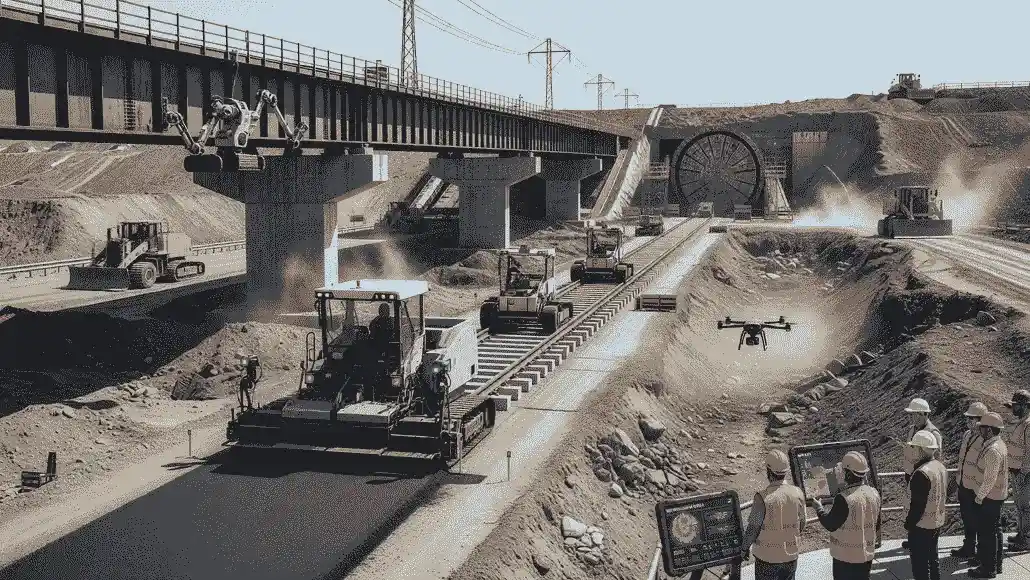
Automated Earthmoving and Surveying: Imagine a fleet of autonomous excavators and dozers precisely preparing a construction site, guided by GPS and LiDAR data, working tirelessly and flawlessly around the clock. Drones equipped with high-resolution cameras and advanced sensors conduct aerial surveys, generating highly accurate 3D models of terrain far more rapidly and safely than manual methods. This initial phase, critical for project success, is becoming significantly more efficient and accurate thanks to robotic assistance.
Precision Paving and Compaction: In the laying of asphalt and concrete, consistency is paramount. Robotic pavers are capable of maintaining exact thicknesses and widths, ensuring a smooth, durable surface. Similarly, automated compactors follow predefined patterns, applying optimal pressure to achieve uniform density, a crucial factor in extending pavement lifespan. The integration of real-time data feedback allows these machines to adjust their operations on the fly, correcting imperfections and minimizing material waste. Even the intricate task of road line painting is being automated, with robots capable of executing highly accurate markings, enhancing safety and visual clarity for drivers. The cumulative effect of these advancements is faster project completion, reduced traffic disruption, and roads that are built to a superior standard, directly attributable to the systematic deployment of robotics in infrastructure development.
Revolutionizing Bridge Construction and Maintenance with Robots
Bridges are architectural marvels, critical for connecting disparate lands and facilitating passage over obstacles. Their structural integrity is non-negotiable, and their maintenance a perpetual challenge, often involving hazardous work at significant heights or over water. Here, bridge inspection robots are proving to be game-changers.
Intelligent Inspection and Assessment: Traditionally, bridge inspections have relied on human teams, often requiring complex scaffolding, rope access, or expensive lift equipment. This work is not only costly and time-consuming but also inherently dangerous. Robotic solutions, such as drones equipped with thermal, ultrasonic, and visual cameras, can quickly and thoroughly inspect large bridge sections, identifying hairline cracks, corrosion, and other structural defects that might be missed by the human eye. Crawler robots can traverse bridge decks and girders, providing close-up inspections of critical components, even in hard-to-reach areas. These robots significantly reduce inspection times and costs while dramatically improving the safety of personnel by keeping them away from precarious situations. The data collected by these robotic infrastructure solutions is then analyzed using AI to predict potential failures, allowing for proactive maintenance rather than reactive repairs, thus extending the lifespan of these vital structures.
Robots in Construction and Repair: Beyond inspection, robots are also being deployed in the actual construction and repair of bridges. Automated welding robots can perform complex welds with extreme precision and consistency, vital for structural strength. Robotic manipulators can assist in lifting and placing heavy components, increasing safety and efficiency on the job site. Even tasks like abrasive blasting or painting, traditionally dirty and hazardous, can be performed by robots, protecting workers and ensuring a higher quality finish. This integration of robotics in infrastructure development for bridges represents a comprehensive approach to ensuring these structures remain safe and functional for generations to come.
Advancing Rail Projects: Precision and Safety on the Tracks
Rail networks are the backbone of modern freight and passenger transport, and their expansion and maintenance require meticulous precision and unwavering safety standards. Rail project technology is increasingly leveraging robotics to achieve these stringent requirements.
Automated Track Laying and Maintenance: Laying new rail lines demands incredible accuracy in alignment and leveling to ensure smooth and safe train operations. Robotic systems are now capable of automating aspects of track laying, precisely positioning sleepers and rails, and ensuring correct gauge. In maintenance, specialized robots traverse tracks, inspecting for deformities, worn components, and fastening issues using advanced sensor arrays. These automated inspections are far more consistent and less disruptive than manual checks, allowing maintenance crews to address issues proactively before they escalate into safety hazards or operational disruptions. This level of automated civil engineering on rail lines minimizes downtime and maximizes the reliability of the network.
Robots in Tunneling and Overhead Line Work: For new rail projects, particularly those involving tunneling, robots play a crucial role. Tunnel boring machines (TBMs) are increasingly automated, with robotic guidance systems ensuring they follow precise trajectories, minimizing deviations and maximizing efficiency. Furthermore, in the construction and maintenance of overhead line equipment (OHLE) – the complex network of wires that power electric trains – robotic platforms can conduct inspections and repairs at height, significantly reducing the risks associated with human workers operating in elevated positions. The use of robotics in infrastructure development for rail projects is not just about speed; it’s about building a safer, more reliable, and future-proof rail system.
The Broader Spectrum of Robotic Infrastructure Solutions
While roads, bridges, and rail projects are prominent examples, the utility of robotic infrastructure solutions extends far beyond these core areas. From utility trenching to pipeline inspection and the creation of smart city components, robots are proving invaluable. Autonomous excavators, guided by digital blueprints, can dig trenches with unparalleled accuracy, reducing rework and material backfill. Drones are used for large-scale topographical mapping, environmental impact assessments, and monitoring construction progress on massive projects like dams or ports. Underwater robots inspect submerged structures, pipelines, and offshore wind farm foundations, operating in environments too dangerous or inaccessible for human divers.
Furthermore, as the concept of smart infrastructure construction gains traction, robotics will play an even more integrated role. Imagine roads that self-monitor their condition and deploy small repair robots, or intelligent bridges that communicate their structural health in real-time. These sophisticated systems will rely heavily on an ecosystem of interconnected robotic devices and AI-driven analytics to maintain optimal performance and longevity.
Challenges and the Path Forward
Adopting robotics in infrastructure development is not without its hurdles. The initial capital investment for advanced robotic systems can be substantial, requiring careful cost-benefit analysis. There’s also the challenge of integrating these new technologies into existing workflows and training the current workforce to operate and maintain them. Regulatory frameworks need to evolve to accommodate autonomous machinery on public and private job sites, ensuring safety and compliance. Cybersecurity also becomes a paramount concern as more systems become connected and automated.
Despite these challenges, the long-term benefits – including enhanced safety, improved efficiency, higher quality construction, and ultimately, significant cost savings – make the transition inevitable and highly advantageous. The industry is moving towards a future where robotics in infrastructure development is not an auxiliary tool but an integral component of every project. Collaboration between technology developers, construction companies, government bodies, and academic institutions will be crucial in overcoming these obstacles and realizing the full potential of these transformative technologies.
Conclusion
The vision of a future built on intelligent, resilient infrastructure is rapidly becoming a reality, largely due to the pervasive influence of robotics in infrastructure development . From the intricate dance of autonomous road pavers to the silent vigil of bridge inspection robots and the precise choreography of automated rail maintenance systems, these technologies are redefining the very essence of civil engineering. They promise not only to accelerate the pace of construction but, more importantly, to elevate safety standards, enhance the quality and longevity of our critical assets, and ultimately deliver a more sustainable and economically viable infrastructure for generations to come. The journey towards truly smart infrastructure construction is well underway, with robotics leading the charge, building a more connected, efficient, and safer world, one automated project at a time.