

























The rapid urbanization of the global population, combined with the escalating effects of climate change, has placed our cities under unprecedented strain. From catastrophic flooding and sea-level rise to extreme heatwaves and intensifying storms, the traditional “fail-safe” approach to engineering is no longer sufficient. The emergence of climate-resilient infrastructure design for cities represents a fundamental shift toward an “evolve-safe” philosophy. This strategy focuses on building systems that can not only withstand extreme events but also adapt and recover quickly when they occur. By integrating advanced materials, digital twins, and nature-based solutions, urban planners are creating a new generation of infrastructure designed for survival in an unpredictable century. This transition is about building in redundancy and flexibility, ensuring that the urban fabric remains functional even when its primary defenses are breached.
The Shift from Rigid to Adaptive Engineering
For over a century, urban infrastructure has been built on the principle of resistance using rigid, massive structures like seawalls and dams to hold back the forces of nature. However, climate-resilient infrastructure design for cities acknowledges that nature will eventually exceed even the most robust defenses. Adaptive engineering involves building flexibility into the system. This might include modular flood barriers that can be deployed as needed, or bridges designed with “sacrificial” components that can fail under extreme stress without compromising the entire structure. By allowing infrastructure to bend without breaking, we can manage the impact of extreme weather more effectively and reduce the long-term costs of disaster recovery. This approach also involves the use of “self-healing” systems that can autonomously detect and address minor structural failures before they escalate.
Nature-Based Solutions: The “Sponge City” Concept
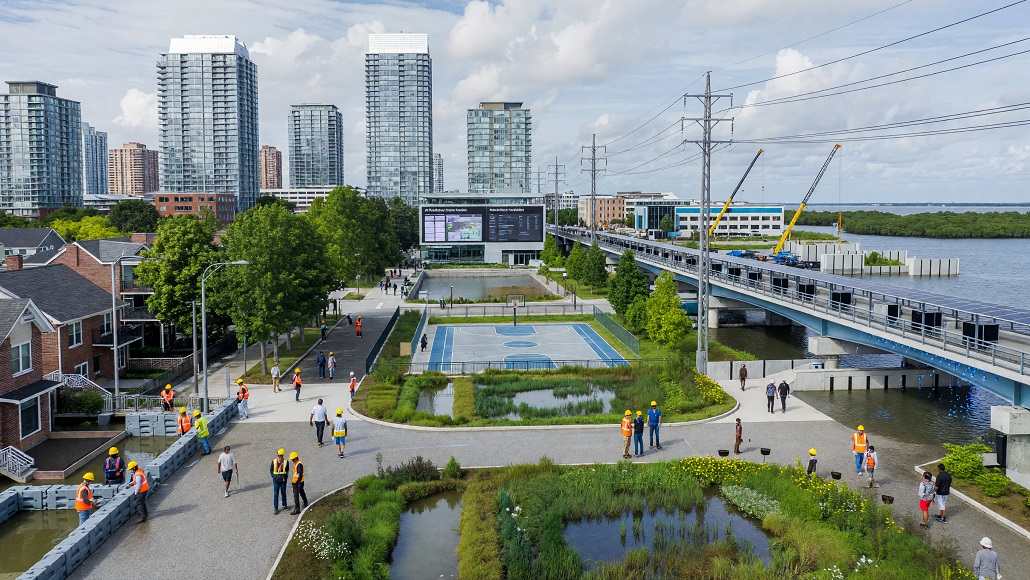
One of the most effective strategies in climate-resilient infrastructure design for cities is the integration of nature-based solutions (NbS). The “Sponge City” model, pioneered in several Asian metropolises, replaces impermeable concrete surfaces with permeable pavements, bioswales, and urban wetlands. Instead of trying to funnel all rainwater into a single, overwhelmed sewer system, the sponge city allows the environment to absorb, store, and filter the water naturally. This reduces the risk of urban flooding while simultaneously recharging groundwater supplies, mitigating the urban heat island effect, and providing much-needed green space for city residents. Nature is no longer seen as a threat to be managed, but as a vital infrastructure partner that provides “ecosystem services” for free, from carbon sequestration to natural cooling.
Heat Mitigation and the Cool City Initiative
Extreme heat is often the deadliest of all climate-related events, yet it is frequently overlooked in infrastructure planning. Modern climate-resilient infrastructure design for cities prioritizes thermal management through the use of high-albedo “cool” materials for roofs and roads, which reflect rather than absorb solar radiation. Additionally, the strategic planting of urban forests and the installation of “green roofs” provide natural cooling through evapotranspiration. By redesigning the urban fabric to promote airflow and shade, planners can reduce city temperatures by several degrees, drastically lowering heat-related mortality and reducing the energy demand for air conditioning during peak summer periods. The integration of “cool corridors” that promote pedestrian movement under shade is also becoming a vital part of urban heat-resilience strategies.
Protecting Critical Utilities and Communications
The resilience of a city is only as strong as its weakest link, which is often its utility grid. Climate-resilient infrastructure design for cities focuses on the hardening and decentralization of energy and water systems. Microgrids, powered by localized renewable energy and battery storage, can keep hospitals and emergency centers running even if the main grid fails during a storm. Similarly, modular water treatment plants that can be quickly moved or scaled provide a defense against saltwater intrusion or drought. Ensuring that communication networks—the digital lifeblood of the modern city—are redundant and resilient is also a top priority for disaster management and coordination. This involves moving critical data infrastructure to higher ground and ensuring that satellite-based backup systems are in place for emergency coordination.
Data-Driven Planning and Predictive Modeling
The foundation of effective climate-resilient infrastructure design for cities is accurate data. Engineers are increasingly using high-resolution climate models and “digital twins” to simulate how a city will react to various catastrophe scenarios over the next fifty to one hundred years. These simulations allow planners to identify “choke points” in the infrastructure before they fail in real life. By integrating real-time sensor data from the physical environment with predictive AI, city managers can receive early warnings of impending failures, allowing for proactive maintenance and emergency response that saves both lives and money. This “forensic” approach to planning ensures that we are not building for the climate of the past, but for the volatile climate of the future.
The Economic Case for Resilient Investment
While the upfront cost of climate-resilient infrastructure design for cities can be higher than traditional construction, the return on investment is undeniable. Every dollar spent on resilience today can save between four and seven dollars in future disaster recovery costs. Furthermore, resilient cities are more attractive to businesses and insurers, leading to lower premiums and higher property values. Institutional investors are increasingly looking for “climate-proof” assets, making resilience a key driver of urban competitiveness. In the long term, the cost of inaction the potential loss of an entire city’s economic output far outweighs the cost of building for durability and adaptation. This financial reality is beginning to shift the global real estate market, with resilience becoming a primary metric for asset valuation.
Social Equity and the Just Resilience Movement
A critical component of climate-resilient infrastructure design for cities is the pursuit of social equity. Historically, marginalized communities have lived in the most vulnerable areas with the least amount of protection. “Just Resilience” ensures that the benefits of green infrastructure and flood defenses are distributed fairly across the entire urban population. This involves community-led planning processes where residents are involved in the design of the systems that protect them. By focusing on the most vulnerable neighborhoods first, we can create a more resilient city for everyone, ensuring that no community is left behind in the face of a changing climate. Resilience must not become a “premium” feature for wealthy enclaves, but a basic human right for every urban dweller.
Case Studies: Global Leaders in Urban Resilience
Cities around the world are providing the blueprints for climate-resilient infrastructure design for cities. Rotterdam, located largely below sea level, has transformed itself into a global leader in water management through the use of multi-functional spaces like “water squares” that serve as basketball courts during dry weather and reservoirs during heavy rain. New York City, following the devastation of Superstorm Sandy, is implementing the “Big U” a massive network of berms and parks designed to protect lower Manhattan from storm surges while providing recreation space. These projects demonstrate that resilience can be integrated into the beauty and functionality of the urban experience. They show that a resilient city can also be a more livable and enjoyable city, proving that climate adaptation is not just a burden but an opportunity for urban renewal.
The Role of Smart Materials and Self-Healing Infrastructure
As we move forward, the materials we use will play a larger role in climate-resilient infrastructure design for cities. Self-healing concrete, which contains bacteria that can repair cracks as they form, reduces the maintenance burden and extends the life of structures exposed to harsh environments. Advanced composites that can withstand extreme temperature fluctuations without warping are also becoming more common in bridge and rail design. By using “smart” materials that can respond to environmental stress, we can build infrastructure that is not just passive but active in its own defense, reducing the need for constant human intervention and repair. This “biological” approach to material science is blurring the line between the built environment and the natural world, leading to a more harmonious urban coexistence.
Strengthening the Resilience of the Global Supply Chain
Urban resilience is not just about the city itself, but about its connection to the rest of the world. Climate-resilient infrastructure design for cities must account for the vulnerability of the global supply chains that provide food, fuel, and materials. This involves building “redundant” logistics systems, such as multi-modal transport hubs that can switch between rail, road, and sea depending on weather disruptions. It also means encouraging localized production through technologies like 3D printing and urban agriculture. By reducing the distance that critical supplies must travel, cities can become more self-reliant and less susceptible to external climate shocks. This “localization of resilience” is a vital part of the broader strategy to create stable and prosperous urban centers in a changing world.
Conclusion: Designing for an Uncertain Horizon
The challenge of the 21st century is to build cities that are capable of thriving in a state of constant change. Climate-resilient infrastructure design for cities is the primary tool we have to achieve this goal. It requires a synthesis of engineering precision, ecological wisdom, and social commitment. As the climate continues to shift, our urban environments must shift with it, moving away from the rigid certainties of the past toward a more flexible and adaptive future. The cities that survive and prosper will be those that view resilience not as a luxury or an afterthought, but as the very foundation of their existence. Our ability to build for survival today will determine the quality of life for billions of urban residents for generations to come.