


























The global construction industry is currently undergoing a digital renaissance, moving away from fragmented, manual processes toward a unified, data-driven ecosystem. At the forefront of this change is digital construction equipment, a new generation of machinery that is as much a computer as it is a mechanical tool. This evolution is driven by the need for greater efficiency, improved safety, and the ability to manage increasingly complex projects within tighter timelines. By embedding intelligence into every facet of the construction site, from the smallest hand tool to the largest excavator, companies can now achieve a level of transparency and control that was once impossible. Site automation is no longer a niche luxury; it is becoming a fundamental requirement for staying competitive in a rapidly evolving market.
The adoption of these technologies is not merely a matter of “bolting on” new gadgets to old machines. It requires a fundamental shift in how construction projects are conceived and executed. In the past, the construction site was often a “black hole” of information, where progress was reported manually and inefficiencies were only discovered after they had already impacted the schedule. Today, digital construction equipment provides a constant stream of “live” data, allowing project managers to see exactly what is happening on the ground in real-time. This transparency allows for a more agile approach to project management, where resources can be redirected instantly to address emerging challenges or take advantage of new opportunities.
The Foundation of Smart Construction Sites
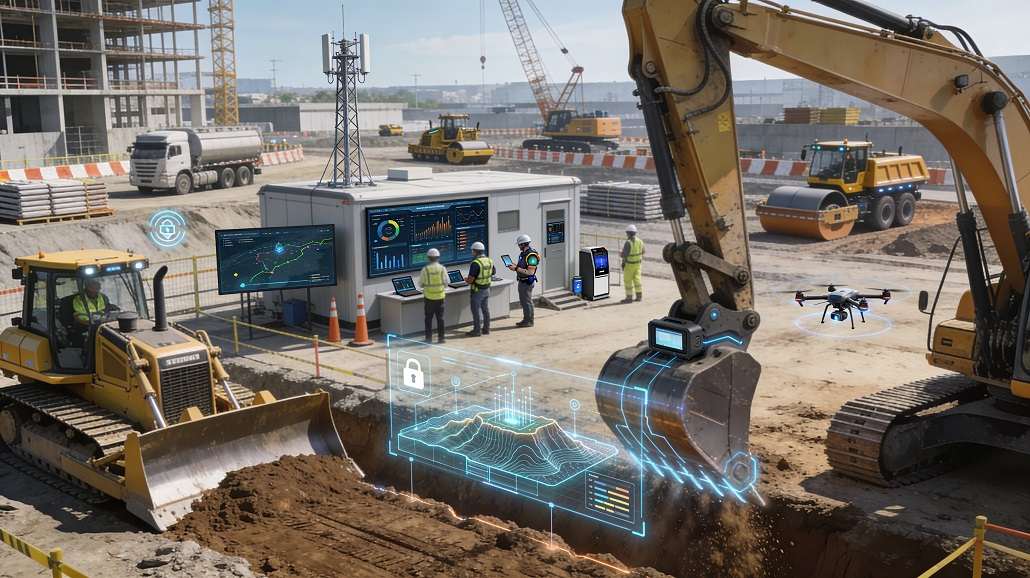
A smart construction site is defined by its ability to collect, process, and act upon data in real-time. This is made possible through the widespread deployment of IoT in construction, where sensors are used to monitor everything from environmental conditions to the physical location and health of assets. This network of connected devices provides the “nervous system” for the project, ensuring that every stakeholder has access to a single source of truth. Digital construction equipment acts as the primary data node in this network, constantly streaming information about fuel consumption, engine load, and operator behavior. This connectivity allows for the seamless integration of the physical work with digital models, such as Building Information Modeling (BIM).
The interaction between the physical site and the digital model is where the true power of site automation lies. When a piece of digital construction equipment is working on a site, its position is constantly compared to the BIM model. If an excavator is digging a trench, the system can automatically guide the bucket to ensure it follows the exact coordinates and depth specified in the design. This “model-driven” construction reduces the risk of errors and eliminates the need for manual surveying and staking. Furthermore, the data collected during the construction process can be fed back into the model to create a “digital twin” of the finished structure, providing invaluable information for the long-term maintenance and operation of the facility.
Fleet Management Systems and Operational Visibility
Managing a large fleet of machinery across multiple locations is one of the most significant challenges in heavy industry. Modern fleet management systems have solved this problem by providing a centralized dashboard that tracks the movement and status of every machine. These systems use GPS and cellular connectivity to provide real-time equipment tracking, allowing managers to see exactly where their assets are at any given time. This visibility is crucial for preventing unauthorized use, optimizing logistics, and ensuring that the right machine is in the right place at the right time.
However, the value of fleet management systems goes far beyond simple tracking. These platforms can analyze historical data to identify inefficiencies in machine utilization. For instance, if a system reveals that several excavators are sitting idle for 30% of their shift, the manager can investigate the cause whether it is a bottleneck in the haulage route or a lack of available operators and take corrective action. This data-driven approach allows companies to optimize the size and composition of their fleets, reducing the capital and operational costs associated with underutilized equipment. In an industry where profit margins are often thin, the ability to squeeze every bit of value out of a fleet of digital construction equipment is a significant competitive advantage.
Predictive Maintenance and the Elimination of Downtime
One of the most valuable applications of digital construction equipment is the ability to perform predictive maintenance. In the past, maintenance was often a reactive process, leading to costly delays and expensive emergency repairs. Today, AI-powered diagnostic tools can analyze the data from onboard sensors to detect the early warning signs of mechanical failure such as a subtle increase in hydraulic pressure or a change in the vibration pattern of a bearing. By identifying these issues before they cause a breakdown, companies can schedule repairs during planned downtime, ensuring that the machine is back in service as quickly as possible.
This proactive approach to maintenance does more than just reduce downtime; it also extends the overall life of the equipment. By addressing minor issues before they lead to major damage, companies can maximize the return on their significant capital investments. Furthermore, predictive maintenance improves the safety of the site by reducing the risk of catastrophic failures that could lead to accidents or environmental incidents. The data collected from these systems can also be shared with equipment manufacturers to help them design more reliable and easier-to-maintain machines in the future. In the world of site automation, a healthy machine is a productive machine.
Enhancing Productivity through Construction Automation
While site automation is often associated with fully autonomous vehicles, it also encompasses a wide range of semi-automated technologies that assist human operators in their daily tasks. For example, automated grade control systems use GPS and digital terrain models to guide the movements of an excavator’s bucket or a dozer’s blade. This ensures that the ground is leveled to within a few millimeters of the design specification, eliminating the need for manual staking and reducing the number of passes required. These “smart” features allow even less-experienced operators to perform high-precision tasks, helping to bridge the chronic skills gap in the construction industry.
As digital construction equipment continues to evolve, we will see even higher levels of automation. This includes “task-based” automation, where a machine can be programmed to perform a specific sequence of actions such as digging a series of foundation piers or leveling a large area without any human input. This frees up the human operator to focus on more complex tasks, such as site coordination or troubleshooting. The ultimate goal of site automation is not to replace human workers, but to augment their capabilities, making the construction process faster, safer, and more accurate than ever before.
The Role of IoT in Construction and Safety Protocols
Safety is the area where site automation and IoT in construction have the most immediate and profound impact. The construction site is inherently dangerous, with heavy machinery, moving vehicles, and workers in close proximity. Digital construction equipment can be equipped with collision avoidance systems that use LiDAR, radar, and cameras to detect obstacles in the machine’s path. These systems provide a 360-degree view around the vehicle and can automatically slow or stop the machine if a person or another object is detected. This provides an extra layer of protection that is particularly valuable in low-visibility conditions or in crowded urban sites.
Furthermore, IoT in construction extends to the workers themselves through the use of wearable sensors. These devices can track a worker’s location, monitor their heart rate, and even detect if they have suffered a fall. If a worker enters a “no-go” zone, such as the swing radius of a crane, both the worker and the equipment operator receive an instant alert. This interconnected safety ecosystem ensures that everyone on the site is aware of their surroundings and the potential hazards they face. The data from these systems can also be used to conduct “near-miss” analysis, helping companies to identify and mitigate safety risks before they lead to an injury. In a smart construction site, safety is not just a protocol; it is an integrated feature of the technology.
Data Security and Infrastructure for Digital Sites
As construction sites become more reliant on digital technology, the importance of data security and infrastructure cannot be overstated. A smart construction site requires a robust and secure network that can handle the high volume of data generated by digital construction equipment and IoT sensors. This often involves the deployment of private 5G networks or satellite-based connectivity to ensure reliable coverage in remote locations. The network must be capable of providing low-latency communication, which is essential for the safe operation of autonomous and semi-autonomous systems.
Furthermore, as the value of the data increases, companies must invest in cybersecurity measures to protect their intellectual property and operational data from cyber threats. This includes encrypting data transmissions, implementing strong access controls, and conducting regular security audits. The transition to a digital site is not just about buying new machines; it is about building a secure and resilient digital foundation that can support the future of construction. Companies that fail to address these issues risk not only their operational efficiency but also their reputation and financial stability. The digital construction equipment of the future will only be as effective as the network that supports it.
The Long-Term Impact of Digital Transformation
The shift toward digital construction equipment and site automation is more than just a technological trend; it is a fundamental shift in the culture of the construction industry. It requires a new set of skills, from data analysis to cybersecurity, and a willingness to embrace new ways of working. However, the benefits are clear: higher productivity, lower costs, and a safer environment for everyone involved. As these technologies become more affordable and easier to use, they will become the standard for projects of all sizes, from small residential builds to massive infrastructure projects.
The future of the industry lies in the seamless integration of human creativity with machine intelligence. By automating the repetitive and dangerous tasks, we can free up our workers to focus on the things that humans do best: solving complex problems, designing beautiful structures, and building the communities of tomorrow. The digital renaissance of construction is just beginning, and the potential to reshape our world for the better is truly limitless. Digital construction equipment and site automation are the tools that will allow us to build a more sustainable, efficient, and resilient future for all.