























Engineering the Groundwork: Foundation and Soil Challenges in Terminal Construction
The development of terminal infrastructure presents some of the most complex geotechnical challenges in modern construction, where foundation and soil challenges in terminal construction require innovative engineering solutions that address unique loading conditions, environmental constraints, and operational requirements. The success of terminal projects fundamentally depends on robust foundation systems that can support massive structural loads while maintaining long-term stability in diverse soil conditions and challenging environmental settings.
Terminal construction sites often present adverse geotechnical conditions including soft soils, variable subsurface formations, high groundwater tables, and seismic considerations that require specialized foundation approaches. The integration of geotechnical engineering principles with innovative construction technologies enables the development of foundation solutions that ensure structural integrity while managing construction risks and long-term performance requirements.
Contemporary terminal projects demand foundation systems that not only provide structural support but also accommodate future expansion requirements, integrate with complex utility systems, and minimize environmental impact throughout project lifecycles. The evolution of geotechnical design approaches reflects advancing understanding of soil behavior, improved construction methodologies, and enhanced monitoring technologies that enable more sophisticated foundation solutions.
Understanding Terminal Foundation Requirements
Terminal structures impose unique foundation challenges through concentrated loads from large-span roof systems, heavy mechanical equipment, and specialized operational components that create loading patterns significantly different from conventional building applications. The combination of vertical loads, lateral forces, and dynamic loading from operational activities requires foundation systems capable of managing complex stress distributions while maintaining acceptable settlement performance.
Load transfer mechanisms in terminal foundations must accommodate not only structural loads but also operational forces from aircraft, ground support equipment, and passenger loading that create dynamic and variable loading conditions. Foundation design must account for these diverse loading scenarios while providing adequate factors of safety and long-term durability under service conditions.
Settlement considerations represent critical design parameters for terminal foundations, where differential settlement can affect structural integrity, operational equipment performance, and passenger safety systems. Foundation design must minimize both total and differential settlement while accounting for soil consolidation, creep effects, and long-term loading changes that occur throughout facility lifecycles.
Specialized Loading Conditions
Terminal foundations must support concentrated loads from trellis roof systems, large-span structures, and heavy mechanical equipment that create unique foundation challenges. These concentrated loads require specialized foundation elements including large-diameter drilled shafts, mat foundations, or pile group systems that distribute loads effectively to competent bearing strata.
Seismic design requirements add complexity to terminal foundation systems, where earthquake loading must be considered alongside operational loads to ensure adequate performance during seismic events. Seismic foundation design often requires specialized systems including base isolation, damping systems, or flexible connection details that accommodate ground motion while protecting structural elements.
Geotechnical Investigation and Site Characterization
Comprehensive geotechnical investigation forms the foundation of successful terminal construction, where subsurface conditions must be thoroughly understood to develop appropriate foundation solutions. Investigation programs for terminal projects typically require extensive drilling, sampling, and testing activities that characterize soil properties, groundwater conditions, and potential geotechnical hazards throughout project sites.
Subsurface variability represents a common challenge in terminal construction, where soil conditions may change significantly across large project sites or with depth. Investigation programs must account for this variability through sufficient sampling density and testing procedures that provide reliable data for foundation design and construction planning.
Groundwater conditions significantly affect foundation design and construction procedures, particularly in coastal or low-lying areas where many terminals are located. Groundwater investigation includes determining water table elevations, seasonal variations, and potential impacts on foundation stability and construction dewatering requirements.
Advanced Investigation Technologies
Modern geotechnical investigation increasingly utilizes advanced technologies including cone penetration testing, geophysical surveys, and continuous sampling techniques that provide detailed subsurface characterization with greater efficiency and reliability than traditional investigation methods. These technologies enable more accurate assessment of soil properties and spatial variability that supports optimized foundation design.
In-situ testing methods provide valuable data on soil strength, deformation characteristics, and engineering properties that may be difficult to obtain through laboratory testing of disturbed samples. These methods include standard penetration testing, cone penetration testing, and specialized procedures that provide design parameters for foundation analysis and construction planning.
Deep Foundation Systems and Applications
Deep foundation solutions frequently provide the most effective approach for terminal construction where surface soils cannot provide adequate bearing capacity or settlement control for project requirements. Deep foundation systems transfer structural loads through weak surface soils to competent bearing strata at depth, enabling construction in challenging soil conditions that would otherwise preclude development.
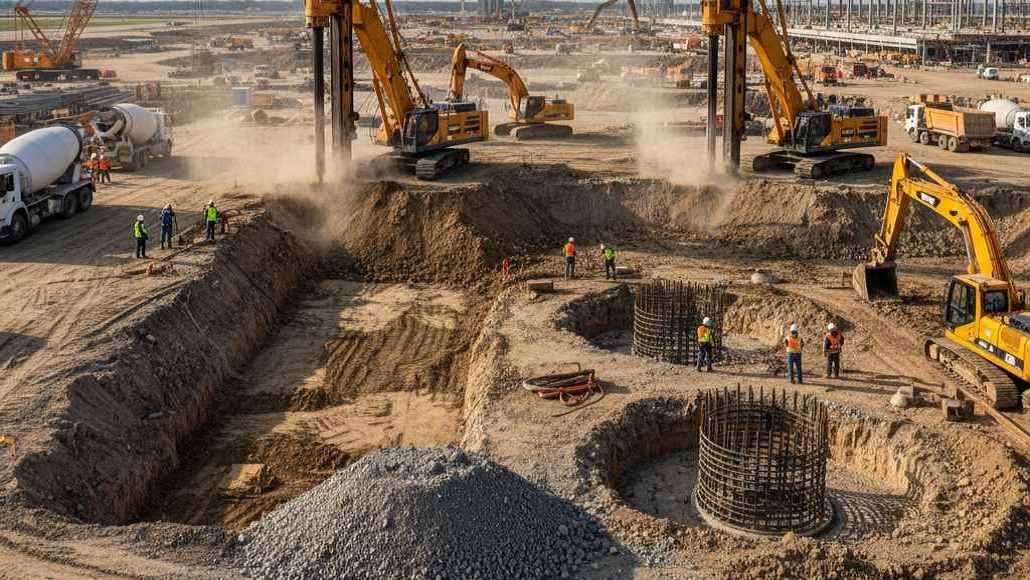
Drilled shaft foundations offer versatility and high capacity for terminal applications, providing both compression and lateral load resistance while accommodating complex loading conditions and site constraints. Drilled shaft construction enables installation through variable soil conditions while providing opportunities for base grouting, side shear enhancement, and specialized construction techniques that optimize performance.
Driven pile systems provide cost-effective foundation solutions for terminal construction where soil conditions permit efficient installation and adequate performance. Pile driving operations require careful planning and monitoring to prevent damage to existing structures while achieving required penetration and capacity. Precast concrete piles, steel H-piles, and pipe piles each offer specific advantages depending on soil conditions and loading requirements.
Load Testing and Verification
Load testing programs verify foundation capacity and performance characteristics while providing data for final design confirmation and construction quality assurance. Static load testing provides direct measurement of foundation capacity and load-settlement behavior, while dynamic testing enables rapid evaluation of pile integrity and capacity during construction operations.
High-strain dynamic testing during pile driving provides real-time assessment of pile capacity and integrity, enabling construction adjustments and quality control during installation operations. This testing method provides valuable data for construction optimization while ensuring that foundation elements meet design requirements.
Soil Improvement and Ground Modification
Soil improvement techniques provide alternatives to deep foundations in situations where ground modification can achieve required bearing capacity and settlement performance at lower cost or with reduced construction complexity. Improvement methods range from simple techniques such as surcharge loading to sophisticated approaches including chemical grouting, jet grouting, and ground freezing.
Dynamic compaction provides effective improvement for loose granular soils through high-energy impact that increases soil density and bearing capacity. This technique requires careful evaluation of subsurface conditions and potential impacts on adjacent structures but can provide cost-effective ground improvement for appropriate soil conditions.
Stone columns and vibro-replacement methods improve bearing capacity and reduce settlement in soft cohesive soils through installation of granular columns that provide preferential drainage and load transfer paths. These methods can be particularly effective for terminal applications where moderate improvement in soil properties can eliminate the need for more expensive deep foundation systems.
Chemical and Mechanical Stabilization
Chemical stabilization methods including cement mixing, lime treatment, and specialized chemical additives can improve soil strength and reduce compressibility for foundation applications. These methods require careful evaluation of soil chemistry and long-term stability but can provide effective improvement for appropriate soil conditions.
Mechanical stabilization through soil replacement, surcharge loading, and precompression techniques addresses settlement and stability concerns while providing cost-effective alternatives to more complex foundation systems. These methods often require longer implementation periods but can provide reliable long-term performance for terminal applications.
Specialized Foundation Challenges
Coastal terminal construction often encounters challenging conditions including soft marine soils, high groundwater tables, and potential scour effects that require specialized foundation approaches. Marine clay deposits frequently exhibit low strength, high compressibility, and long-term consolidation behavior that affects foundation design and construction procedures.
Liquefaction potential represents a critical consideration for terminal foundations in seismic regions, where saturated granular soils may lose strength during earthquake loading. Foundation design must account for liquefaction effects through appropriate analysis methods and mitigation strategies including densification, replacement, or specialized foundation systems that maintain performance during seismic events.
Expansive soil conditions create unique challenges for terminal foundations through swelling and shrinkage behavior that can affect foundation performance and structural integrity. Foundation design for expansive soils requires specialized approaches including deep foundations that extend below the active zone, special foundation details that accommodate movement, or soil modification techniques that reduce expansive potential.
Environmental and Sustainability Considerations
Environmental constraints increasingly influence foundation design and construction approaches, where sustainability objectives and environmental protection requirements affect methodology selection and construction procedures. Sustainable foundation approaches include material optimization, construction waste reduction, and long-term performance enhancement that reduces lifecycle environmental impact.
Contaminated soil conditions require specialized handling and disposal procedures that add complexity and cost to foundation construction while ensuring environmental protection and regulatory compliance. Remediation techniques may be integrated with foundation construction to address contamination while providing required structural support.
Innovative Construction Technologies
Advanced drilling and installation techniques enable foundation construction in increasingly challenging conditions while improving construction efficiency and quality outcomes. These techniques include oscillator drilling, casing advancement systems, and specialized drilling fluids that enable installation through difficult soil conditions including boulders, hard layers, and contaminated materials.
Real-time monitoring systems during foundation construction provide continuous assessment of installation parameters, soil conditions, and construction quality that enables immediate adjustments and optimization of construction procedures. These systems improve construction efficiency while ensuring that foundation elements meet design requirements and quality standards.
Automated construction systems increasingly support foundation installation through computer-controlled drilling rigs, automated concrete placement systems, and integrated quality control systems that improve consistency while reducing labor requirements and safety risks associated with foundation construction operations.
Quality Control and Performance Monitoring
Comprehensive quality control programs for terminal foundation construction include material testing, installation monitoring, and performance verification that ensures compliance with design specifications and construction standards. Quality control procedures must address both construction quality and long-term performance requirements that affect terminal operations throughout facility lifecycles.
Performance monitoring systems enable ongoing assessment of foundation behavior and early detection of potential issues that could affect structural integrity or operational performance. These systems provide valuable data for maintenance planning and future design optimization while ensuring continued safe operation of terminal facilities.
Future Trends and Innovation
Emerging technologies continue to advance foundation engineering capabilities through improved materials, enhanced construction techniques, and sophisticated monitoring systems that enable more efficient and reliable foundation solutions. These innovations promise continued improvement in foundation performance while reducing construction costs and environmental impacts.
Smart foundation systems integrate sensors, monitoring capabilities, and responsive technologies that provide real-time assessment of foundation performance while enabling predictive maintenance and optimized operational strategies. These systems represent the future of foundation engineering where technology integration enhances both construction and operational performance.
The evolution of foundation engineering for terminal construction reflects the ongoing development of more sophisticated, sustainable, and cost-effective solutions that address the unique challenges of complex transportation infrastructure. Organizations that embrace innovative foundation technologies and comprehensive geotechnical approaches position themselves for success in delivering critical infrastructure projects that support economic growth and community connectivity while managing the inherent challenges of complex subsurface conditions and demanding performance requirements.