
























For decades, Supervisory Control and Data Acquisition (SCADA) systems have served as the backbone of industrial automation in cold storage facilities. These systems monitor temperatures, control refrigeration equipment, and provide operators with visibility into critical processes. Yet as cold storage operations have grown more complex – managing larger facilities, responding to volatile energy costs, and facing increasing compliance requirements – traditional SCADA architectures are revealing fundamental limitations that threaten operational efficiency and competitive positioning.
The evolution beyond legacy SCADA isn’t simply about adopting newer technology. It represents a necessary shift in how multi-site cold storage operators manage complexity, ensure consistency, and leverage data for strategic advantage. Understanding where traditional SCADA falls short – and what modern control platforms must deliver – has become essential for operators planning their next decade of growth.
How SCADA Systems Shaped Industrial Automation
SCADA technology emerged in the 1970s as industries sought to automate monitoring and control across dispersed facilities. Before SCADA, plant personnel manually controlled equipment through push buttons and analog dials, requiring constant on-site presence. The introduction of programmable logic controllers and remote terminal units allowed centralized supervision without continuous human intervention.
These systems fundamentally changed industrial operations by enabling real-time data collection and automated responses. According to a comprehensive SCADA overview from Industrial Automation Co., SCADA platforms became essential for industries ranging from power generation to water treatment to manufacturing – anywhere organizations needed to monitor equipment, detect issues, and respond proactively.
In cold storage, SCADA systems provided crucial capabilities:
Core SCADA Functions in Cold Storage
Traditional SCADA implementations in refrigeration facilities typically deliver several foundational functions. Real-time monitoring displays current temperatures, equipment status, and alarm conditions through human-machine interfaces. Automated control sequences manage compressor staging, defrost cycles, and temperature setpoints according to pre-programmed logic. Data logging captures historical trends, enabling operators to review past performance and identify patterns.
The Site-Centric SCADA Model
Most SCADA deployments in cold storage evolved as site-specific implementations. Each facility received its own SCADA server, control strategies, and HMI configuration. Equipment vendors supplied SCADA packages tailored to their compressor or controls hardware. Third-party integrators customized screens and logic for specific facility requirements.
This site-by-site approach served adequately when cold storage operators managed only a handful of facilities with relatively stable operations. But as the industry consolidated and portfolio sizes grew, the limitations of isolated SCADA instances became increasingly problematic.
Where Traditional SCADA Falls Short
The fundamental constraints of legacy SCADA architecture become apparent when organizations attempt to scale operations across multiple sites or integrate modern capabilities.
Limited Scalability Across Portfolios
Traditional SCADA systems were designed for single-site deployment. Each facility operates its own SCADA server with site-specific configurations, naming conventions, and control strategies. When operators manage 10, 20, or 50+ facilities, this fragmentation creates significant operational friction.
Corporate teams lack unified visibility across their portfolio. Comparing performance between sites requires manually consolidating data from disparate systems using different formats and metrics. Best practices identified at one location cannot easily transfer to others because control logic and HMI configurations are site-specific rather than standardized templates.
Inability to Adapt to Modern Requirements
Legacy SCADA platforms were built for an era of stable energy costs, predictable operations, and limited connectivity expectations. Today’s requirements have evolved substantially. Energy markets now feature complex time-of-use rates, demand charges, and grid response programs that traditional SCADA systems cannot effectively manage. Operators need dynamic load shifting, automated demand response, and sophisticated energy optimization – capabilities that exceed the design parameters of conventional SCADA.
Compliance and traceability demands have also intensified. Food safety regulations require detailed audit trails showing who changed what settings and when. Corporate governance mandates consistent standards across all facilities. Traditional SCADA systems lack the granular permission controls, comprehensive change tracking, and enterprise-wide policy enforcement these requirements demand.
Integration and Connectivity Limitations
Most legacy SCADA implementations operate as isolated systems with limited connectivity. Integration with other business systems – enterprise resource planning, manufacturing execution, or building management – requires custom development for each connection point. Mobile access either doesn’t exist or requires VPN connections and specialized clients.
Cloud connectivity, when available, typically functions as an afterthought rather than a core architectural feature. Data synchronization happens intermittently rather than continuously. Advanced analytics requiring cloud compute resources cannot operate directly on SCADA data without complex export processes.
Maintenance and Update Burdens
Traditional SCADA software runs on dedicated servers that require manual updates. Security patches, feature enhancements, and bug fixes must be individually deployed to each site. This creates version fragmentation across a portfolio, with some facilities running current software while others operate outdated versions with known issues.
The skills required to maintain legacy SCADA platforms are increasingly scarce. Experienced SCADA engineers are retiring, and younger technical staff gravitate toward modern cloud-native architectures rather than proprietary industrial software. Organizations struggle to find qualified personnel willing to specialize in aging SCADA platforms.
The Shift Toward Cloud-Native Industrial Control Platforms
Modern industrial control platforms represent a fundamental architectural evolution. Rather than treating each facility as an isolated system, these platforms create a unified control layer across entire portfolios while maintaining necessary site-specific configurations.
Architectural Advantages of Cloud-Connected Controls
Cloud-native industrial platforms separate the control infrastructure from the physical hardware at each site. Control strategies, user permissions, and data models exist in centrally managed cloud environments while local edge devices maintain real-time control loops. This architecture delivers capabilities that traditional SCADA cannot match.
According to cloud computing research from STL Digital, cloud services enable control systems to move beyond the limitations of on-premise infrastructure. Organizations can design control architectures that are adaptable, secure, and remotely accessible while unlocking benefits like real-time monitoring, predictive analytics, and seamless integration with IoT devices.
Standardization without uniformity becomes possible. Organizations can define enterprise-wide control templates and best practices while still configuring each facility according to its unique equipment and requirements. Updates and enhancements deploy instantly across all sites without manual intervention at each location.
Portfolio-Wide Visibility and Governance
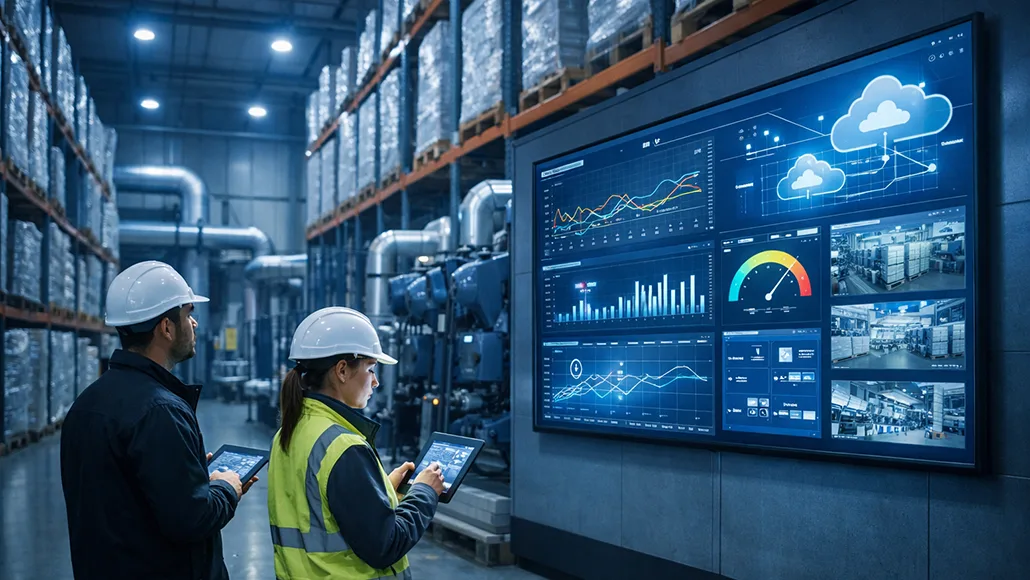
Cloud-connected platforms provide corporate teams with consolidated views across their entire portfolio. Leadership can compare energy performance, identify outlier facilities, and track progress toward efficiency targets using consistent metrics rather than manually compiled spreadsheets.
Governance capabilities extend beyond simple visibility. Organizations can enforce permission boundaries, ensuring site personnel operate within approved parameters while corporate teams maintain oversight. Comprehensive audit trails document every configuration change, meeting compliance requirements for food safety and corporate governance.
Integration With Modern Technologies
Modern platforms embrace connectivity as a core feature rather than an afterthought. RESTful APIs, standard protocols, and pre-built connectors enable straightforward integration with enterprise systems, third-party analytics tools, and emerging technologies.
Mobile applications provide authenticated access to critical data and control functions without complex VPN configurations. Operators and engineers can troubleshoot issues remotely, reducing after-hours callouts and enabling expert support regardless of physical location.
Enterprise Control Platforms for Cold Storage
The most advanced industrial control platforms specifically address the unique requirements of multi-site cold storage operations.
As an example, the CrossnoKaye ATLAS platform enables portfolio-wide standardization while working with existing equipment at each facility. Rather than requiring wholesale equipment replacement, these systems integrate with installed PLCs, compressors, and controls from various manufacturers. Organizations achieve consistency through software-defined control strategies rather than hardware uniformity.
Key Capabilities Distinguish Modern Platforms
Embedded optimization rather than reactive recommendations sets leading platforms apart. Instead of generating reports suggesting efficiency improvements that operators must manually implement, modern systems execute optimization strategies automatically within safe operating parameters.
Digital twin technology enables testing control changes virtually before deployment. Organizations can simulate “what-if” scenarios – evaluating different setpoint strategies or demand response approaches – without risking product integrity or operational stability.
Continuous evolution through cloud delivery means organizations always operate on current software versions. New features, security updates, and optimization enhancements deploy automatically across the portfolio. Facilities don’t become frozen on outdated software that gradually diverges from industry best practices.
The Cold Storage Business Case for Modern Controls
Transitioning from traditional SCADA to modern control platforms requires investment, but the operational and strategic benefits justify the expense for portfolio operators.
Energy Cost Reduction Through Intelligent Automation
Energy represents one of the largest operational expenses in cold storage. Traditional SCADA systems maintain temperatures but typically cannot dynamically optimize energy consumption in response to changing conditions and rate structures.
Modern platforms with embedded energy intelligence deliver measurable savings. Systems analyze real-time weather, utility rates, grid conditions, and facility state to continuously adjust operations for minimum cost while maintaining product safety. Load shifting, demand response participation, and optimized equipment staging happen automatically rather than requiring constant operator attention.
Operational Efficiency Gains
Portfolio-wide visibility reduces the time corporate teams spend manually gathering and analyzing data. Standardized control strategies and remote troubleshooting capabilities decrease site visits and enable faster issue resolution. Comprehensive trending and diagnostics help identify emerging problems before they cause equipment failures or temperature excursions.
For organizations operating multiple facilities, these efficiency gains compound. Best practices identified at one site propagate immediately to others. Technical experts can support entire portfolios rather than being physically tied to single locations.
Scalability for Growth
Organizations planning expansion face a critical decision: replicate their existing fragmented SCADA architecture at new facilities, or adopt a modern platform that scales efficiently. Modern platforms dramatically reduce the implementation burden for additional sites. Proven control templates deploy rapidly rather than requiring custom development. New facilities immediately benefit from portfolio-wide insights and optimizations.
Implementation Considerations and Practical Realities
While modern control platforms offer significant advantages, successful implementation requires addressing practical challenges and managing change effectively.
Integration With Existing Equipment
One concern organizations often raise involves equipment compatibility. Will a new control platform work with installed compressors, PLCs, and controls from various manufacturers and vintages? Leading platforms specifically address this challenge through flexible integration architectures. Rather than requiring specific hardware brands, these systems connect to industry-standard protocols and controllers. Organizations can modernize control capabilities without wholesale equipment replacement.
Migration Strategies That Minimize Risk
Organizations rarely implement new control platforms across entire portfolios simultaneously. Phased approaches allow learning and refinement. Many operators begin with a pilot site, validating platform capabilities and refining implementation processes before expanding to additional facilities.
This measured approach builds organizational confidence and enables optimization of training materials, standard operating procedures, and support processes based on real-world experience rather than theoretical projections.
Managing Organizational Change
Technology changes represent only part of the transition challenge. Operators accustomed to traditional SCADA interfaces and workflows must adapt to new systems. Site personnel may resist changes perceived as reducing their autonomy or adding complexity.
Effective change management addresses these concerns proactively. Involving operators in pilot implementations, demonstrating tangible benefits like reduced after-hours calls and easier troubleshooting, and providing comprehensive training all increase adoption success.
The Expanding Industrial Cloud Market
The shift toward cloud-connected industrial controls extends far beyond cold storage. According to industrial cloud market analysis from Mordor Intelligence, global spending on industrial cloud platforms reached $90.52 billion in 2025 and is projected to grow at a compound annual growth rate of 15.91% through 2031.
This growth reflects widespread recognition across manufacturing, energy, and process industries that legacy control architectures cannot meet modern operational requirements. Industry 4.0 initiatives, remote operations capabilities, and digital transformation mandates all drive migration toward cloud-enabled platforms.
For cold storage operators, this market momentum carries important implications. Platform vendors are making substantial investments in functionality, security, and integration capabilities. The technology continues rapidly improving while costs decrease through economies of scale and competitive pressure.
Organizations delaying adoption risk falling behind competitors already capturing the operational benefits of modern control platforms. The technology gap widens as leading operators compound their advantages through better data, more sophisticated automation, and more efficient operations.
Future-Proofing Cold Storage Operations
The cold storage industry faces mounting pressures from energy costs, labor challenges, food safety requirements, and competitive intensity. Traditional SCADA systems, while functional for basic monitoring and control, lack the architectural capabilities required for competitive operations in this environment.
Modern enterprise control platforms address these challenges through cloud-native architectures, portfolio-wide standardization, and embedded optimization. Organizations gain unified visibility, consistent governance, and continuous improvement capabilities that legacy SCADA cannot deliver.
The transition from traditional SCADA isn’t merely about adopting newer technology – it represents a necessary evolution in how multi-site operators manage complexity, ensure consistency, and leverage data for strategic advantage. For organizations planning their next decade of growth, the question isn’t whether to modernize control infrastructure but how quickly they can capture the competitive benefits modern platforms enable.
Cold storage operators who act decisively to modernize their control architectures will position themselves to outperform competitors still constrained by traditional SCADA limitations. The technology has matured, the business case is clear, and the operational benefits are substantial. The time to evolve beyond legacy SCADA is now.
