

























Close
WORLD OF CONCRETE
Friday, December 19, 2025
JEC WORLD 2026

Stuttgart University designs world’s first self-shaping building

Note* - All images used are for editorial and illustrative purposes only and may not originate from the original news provider or associated company.

Subscribe

- Never miss a story with notifications

- Gain full access to our premium content

- Browse free from any location or device.

Media Packs

Expand Your Reach With Our Customized Solutions Empowering Your Campaigns To Maximize Your Reach & Drive Real Results!

– Access the Media Pack Now

– Book a Conference Call

Leave Message for Us to Get Back

Related stories

Human Machine Collaboration on Modern Construction Sites

Modern construction sites increasingly feature integrated teams where workers and machines collaborate as complementary partners, each contributing unique strengths toward shared objectives. This exploration examines collaborative workflows where technology augments human skill and judgment, improving overall productivity while simultaneously reducing physical strain on workers and enabling safer, more controlled construction processes. Advanced robotics, artificial intelligence, and intuitive human-machine interfaces create opportunities for seamless integration between human expertise and mechanical precision, establishing new models for effective teamwork in dynamic construction environments.

Top Benefits of Playground Artificial Turf for Safe Outdoor Play

Kids love to run, jump, and explore. Playgrounds give...
- Advertisement -
Achema Middleeast

The University of Stuttgart’s Institute for Computational Design has developed a method for building with wood in which a building effectively shapes itself during the drying process.

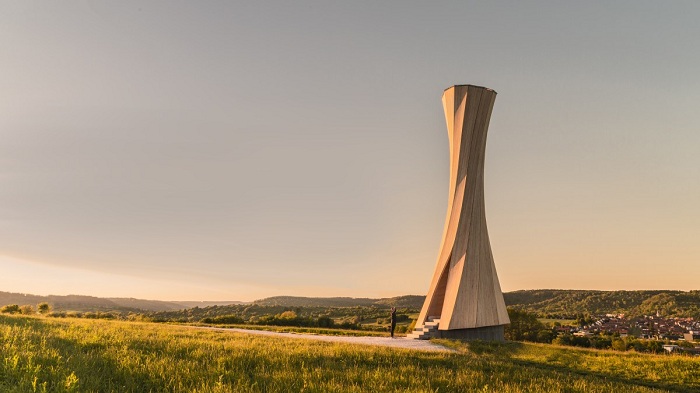
The institute has demonstrated this effect in the 14m-tall Urbach Tower, near Stuttgart, in which the curved form is “programmed” to occur during the drying process, with the elements of the tower designed and made in a flat state so that they transform themselves into the final building’s curved shape.

The University of Stuttgart’s Institute for Computational Design has developed a method for building with wood in which a building effectively shapes itself during the drying process.

The institute has demonstrated this effect in the 14m-tall Urbach Tower, near Stuttgart, in which the curved form is “programmed” to occur during the drying process, with the elements of the tower designed and made in a flat state so that they transform themselves into the final building’s curved shape.

As the institute comments on its website, “This opens up new and unexpected architectural possibilities for high performance and elegant structures, using a sustainable, renewable, and locally sourced building material. The Urbach Tower constitutes the very first structure worldwide made from self-shaped, building-scale components.”

The design is made possible by new computational simulations, which allow more accurate predictions of how the wood will change as it dries.

The Urbach tower is made from 12 sheets of cross-laminated spruce, clad with glue-laminated larch, however the technique can theoretically be used with any wood. It is one of 16 structures designed by German architects for the Remstal Gardenshow. It is intended to provide “a place of shelter, internal reflection and outward view by revealing stunning vistas and framing the landscape”.

Achema Middleeast

Latest stories

Related stories

Human Machine Collaboration on Modern Construction Sites

Modern construction sites increasingly feature integrated teams where workers and machines collaborate as complementary partners, each contributing unique strengths toward shared objectives. This exploration examines collaborative workflows where technology augments human skill and judgment, improving overall productivity while simultaneously reducing physical strain on workers and enabling safer, more controlled construction processes. Advanced robotics, artificial intelligence, and intuitive human-machine interfaces create opportunities for seamless integration between human expertise and mechanical precision, establishing new models for effective teamwork in dynamic construction environments.

Top Benefits of Playground Artificial Turf for Safe Outdoor Play

Kids love to run, jump, and explore. Playgrounds give...

RMIT Researchers Turn Coffee Waste into Low-Carbon Concrete

RMIT University, Australia researchers are coming up with a...

Subscribe

- Never miss a story with notifications

- Gain full access to our premium content

- Browse free from any location or device.

Media Packs

Expand Your Reach With Our Customized Solutions Empowering Your Campaigns To Maximize Your Reach & Drive Real Results!

– Access the Media Pack Now

– Book a Conference Call

Leave Message for Us to Get Back

Translate »