
























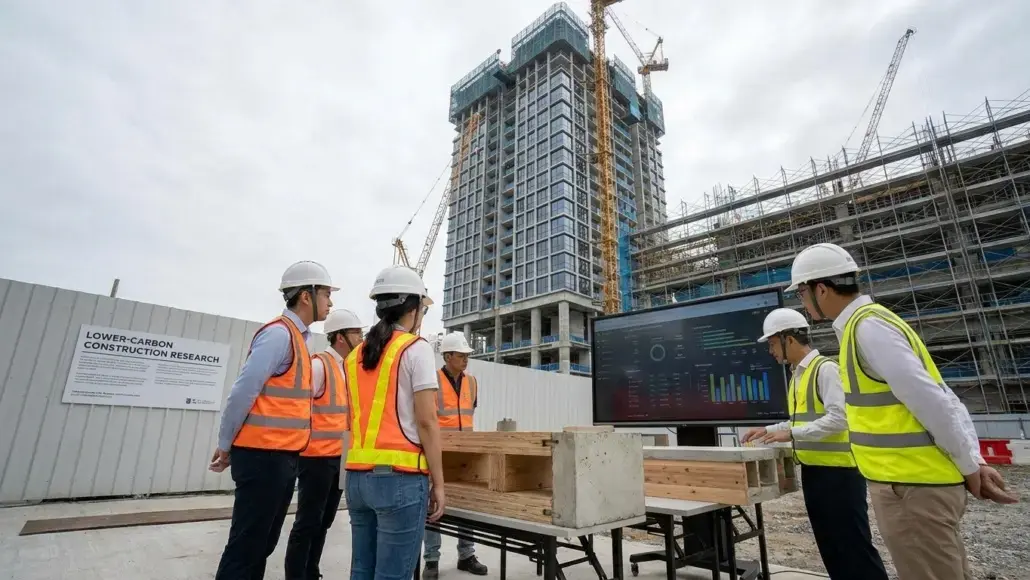


Singapore has launched a Singapore construction technology research programme worth $30.4 million to develop and deploy lower-carbon technologies across the built environment.
Led by the Singapore Institute of Technology (SIT), the three-year consortium programme brings together A*STAR, Woh Hup and other industry partners. It is supported under Singapore’s Research, Innovation and Enterprise 2025 plan.
The programme aims to accelerate the transition from research and development to real-world construction applications while reducing embodied carbon from urban development.
Seven Research Projects Target Lower-Carbon Construction
The Singapore construction technology programme includes seven research projects addressing challenges identified by the construction industry.
Key areas include scaling up ultra-low embodied carbon concrete production and developing AI-powered design tools to help engineers reduce embodied carbon, material use and structural design costs.
One project will further develop SIT’s ultra-low embodied carbon concrete technology, which was created during the first phase of the Construction Technology and Innovation Laboratory (CTIL). The technology has demonstrated up to a 65% reduction in embodied carbon. The new phase will focus on further development, validation and testing with industry partners.
Programme Targets 40% Carbon Reduction By 2029
The consortium is targeting up to a 40% reduction in embodied carbon in relevant urban development applications by 2029 compared with conventional construction approaches.
Industry partners will provide construction sites, operational expertise and testing environments to assess the technologies under actual construction conditions. The Singapore construction technology programme is also expected to create new business opportunities and potential operational cost savings for participating companies.
Training And Industry Deployment
The programme will provide applied training for undergraduate and postgraduate students and research staff. Industry professionals will receive specialised training, industry attachments and technical seminars.
The initiative builds on CTIL, which was established in 2021 to develop and test sustainable construction technologies with industry partners. From 2021 to 2026, CTIL completed 13 applied research projects involving 26 industry partners, with five technologies progressing to deployment on construction projects.
The new Singapore construction technology programme is intended to build on these results and accelerate the adoption of lower-carbon construction solutions across Singapore’s urban development sector.