




























Meta has introduced new artificial intelligence capabilities aimed at transforming AI concrete mix design in the United States, with a focus on improving domestic material usage, operational efficiency, and sustainability across the construction sector. Announced alongside the 2026 American Concrete Institute (ACI) Spring Convention, the development includes a new model, Bayesian Optimization for Concrete (BOxCrete), and supporting datasets designed to accelerate and optimise concrete mix formulation.
AI model and open-source framework rollout
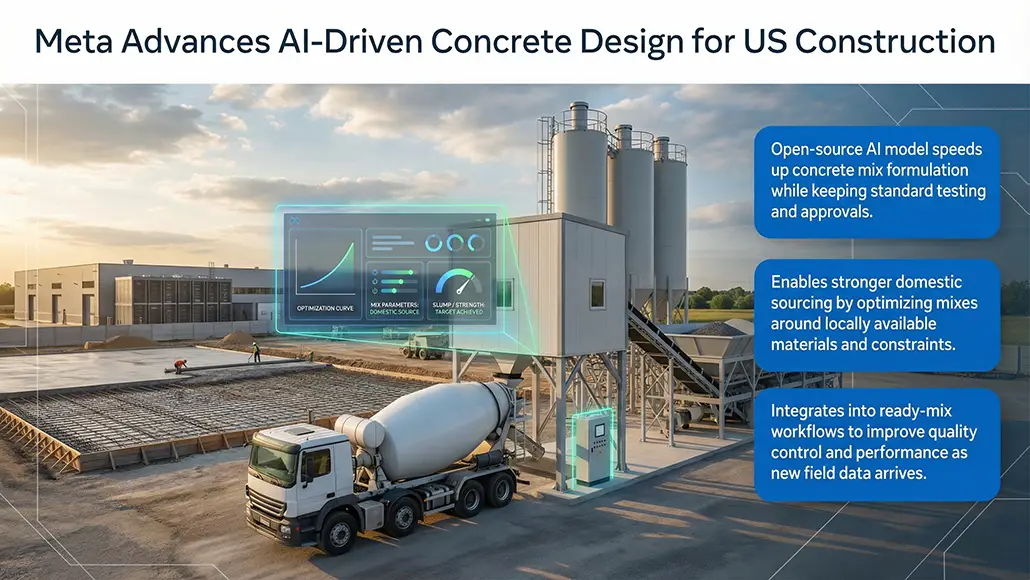
The BOxCrete model builds on Meta’s earlier work in AI concrete mix design, introducing enhanced robustness to noisy data and new predictive features such as slump estimation, a key indicator of workability. The model, along with foundational datasets used in developing concrete mixes, has been released as open-source software on GitHub under the MIT license, enabling adoption across academic and commercial environments.
Meta’s broader framework leverages adaptive experimentation through Bayesian optimisation to navigate complex formulation variables. The system learns from historical mix data, proposes high-potential formulations, incorporates technical constraints, and refines predictions with each iteration. While standard processes such as lab validation, field trials, and engineering approvals remain unchanged, the approach significantly reduces the time required to identify viable mix designs.
World Construction Today notes that this shift reflects a move toward data-driven formulation processes that reduce reliance on traditional trial-and-error methodologies.
Addressing domestic supply and economic considerations
The initiative comes against the backdrop of the U.S. construction sector’s reliance on imported cement, which accounts for approximately 20–25% of domestic consumption. Cement, a critical component of concrete, plays a significant role in determining performance and compliance with environmental standards, which vary internationally.
The cement and concrete sector contributes more than $130 billion annually to the U.S. economy and supports roughly 600,000 jobs. At the same time, reshoring efforts and foreign direct investment have brought over 1.1 million manufacturing jobs back to the country since 2020. Increasing the use of domestically produced materials in concrete mixes is therefore seen as strategically important for strengthening supply chains and retaining economic value within the U.S.
Industrial partnerships and implementation
Meta has partnered with the University of Illinois at Urbana-Champaign and Amrize, a major cement and concrete manufacturer headquartered in Chicago, to deploy AI-driven mix design at scale. Amrize operates 18 cement plants, 141 cement terminals, and 269 ready-mix concrete sites across North America, providing a large-scale testing ground for the technology.
The company has also introduced a “Made in America” cement label and announced close to $1 billion in capital investments in 2026 aimed at expanding domestic production capacity.
In Minnesota, BOxCrete was applied in collaboration with Amrize, Mortenson, and the University of Illinois at Urbana-Champaign to develop a high-performance concrete mix for a data center project in Rosemount. The AI-optimised formulation achieved full structural strength 43% faster than the original mix and reduced cracking risk by nearly 10%, while using domestically sourced materials. The mix has since been validated for broader application within the facility.
Integration into operational workflows
Adoption is also expanding through software integration. Pennsylvania-based Quadrel has incorporated Meta’s open-source AI framework into its enterprise SaaS platform for the ready-mix industry. The system supports data preprocessing, batch normalisation, feature engineering, and customer-specific model training.
These models are embedded into daily mix design and quality control workflows, continuously improving as new field data is introduced. This integration enables real-time decision-making in operations and quality management without requiring changes to existing workflows.
Strategic and market implications
Meta’s initiative aligns with its broader investment strategy in artificial intelligence, with the company committing $600 billion toward AI-related developments in the United States over the next three years. The application of AI in cement and concrete production is positioned as a practical use case demonstrating measurable industrial impact.
According to Meta, these developments aim to help producers compete on cost, reduce emissions, and enhance supply chain resilience. The company also plans to expand collaboration with industry partners and academic institutions to further refine AI applications in concrete sustainability and performance.
From an industry perspective, World Construction Today highlights that the growing integration of AI into material design processes could redefine how concrete producers approach formulation, enabling faster adaptation to domestic sourcing requirements while maintaining structural and environmental performance standards.