

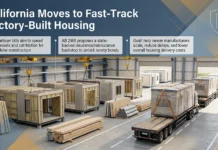




















California lawmakers have introduced a legislative package aimed at accelerating adoption of factory-built housing, with a proposal to position the state within the construction insurance framework to address persistent delivery and cost challenges in residential development. The initiative is part of a broader effort to tackle the state’s housing shortage while advancing construction innovation through off-site building methods.
Legislative package targets construction innovation
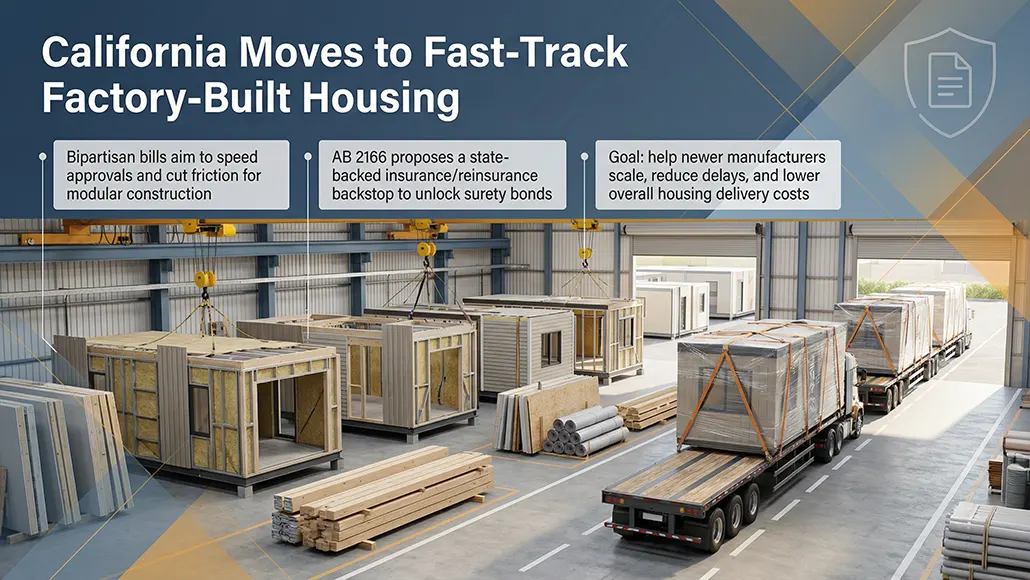
A bipartisan group led by Assemblymember Buffy Wicks of Oakland has put forward multiple bills designed to promote cost-efficient construction approaches, with a particular focus on factory-based building. The measures aim to streamline regulatory processes, reduce operational barriers, and incentivize adoption of modular construction techniques.
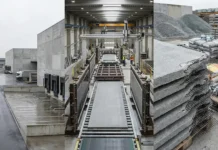
Factory-built housing, which involves producing housing units in controlled environments before transporting them for on-site assembly, is being positioned as a method to improve construction timelines, enhance worker safety, and lower total project costs. Despite these advantages, large-scale deployment has remained limited due to regulatory complexity and financial constraints.
World Construction Today observes that the legislative direction reflects a growing policy emphasis on industrialised construction methods as a pathway to address structural inefficiencies in housing delivery.
Assembly Bill 2166 introduces insurance backstop mechanism
A central component of the package, Assembly Bill 2166, authored by Wicks and Assemblymember Juan Carrillo, proposes a novel approach to construction risk mitigation. The bill seeks to provide insurance guarantees for developers and lenders engaged in factory-built housing projects by positioning the state as a reinsurer under defined conditions.
This model would enable the state to partially cover surety bond payouts in specific high-risk scenarios, although key parameters including coverage thresholds and qualifying conditions remain under development. The proposal represents a departure from conventional state-level housing interventions, introducing a financial risk-sharing mechanism aimed at unlocking private sector participation.
Addressing bonding constraints in construction projects
Construction projects inherently involve financial risks such as cost overruns, delays, and contractual disputes. To manage these risks, stakeholders rely heavily on surety bonds, which guarantee performance and payment obligations across project participants.
However, factory-based construction firms, particularly newer entrants, face significant challenges in obtaining bonding due to limited operational track records. This has created what policymakers describe as a “self-reinforcing cycle,” where developers require bonding to mitigate risk, but manufacturers cannot secure bonding without prior project experience.
Under the proposed framework, state-backed guarantees are expected to improve insurer confidence, potentially expanding access to bonding. This, in turn, could enable developers to engage more readily with factory-built housing providers, supporting broader market participation.
From an industry standpoint, World Construction Today notes that resolving financial risk barriers is critical to enabling scalable adoption of off-site construction models.
Financial and policy parallels with existing guarantee programmes
The proposed mechanism aligns conceptually with existing public guarantee frameworks in other sectors. Federal institutions such as the U.S. Department of Veterans Affairs, Fannie Mae, and Freddie Mac support mortgage markets through guarantees, while the Small Business Administration provides backing for surety bonds. At the state level, California operates a loan guarantee programme for healthcare facility construction, though no equivalent currently exists for housing.
The introduction of a similar model for factory-built housing signals a shift toward leveraging financial instruments to stimulate construction sector innovation.
Industry response highlights divergence in priorities
Stakeholder reactions to the proposal have been mixed. Some industry participants view the insurance guarantee as a means to support emerging manufacturers and stabilise project pipelines. Others question whether addressing bonding constraints alone will sufficiently accelerate adoption.
Developers already engaged in factory-built housing have indicated that direct financial incentives for projects may offer more immediate impact than insurance-based mechanisms. Established manufacturers with strong financial standing typically face fewer bonding challenges, suggesting the proposal may primarily benefit newer entrants with limited project history.
Strategic implications for construction sector scaling
The legislative package is scheduled for initial committee review in late April, with several aspects including the extent of state financial exposure yet to be defined. Policymakers have indicated that the programme could serve as a transitional support mechanism, enabling early-stage industry development until private insurers become more willing to assume risk independently.
The broader objective remains to scale factory-built housing by addressing both regulatory and financial constraints, thereby improving construction efficiency and cost structures across the sector.
