






















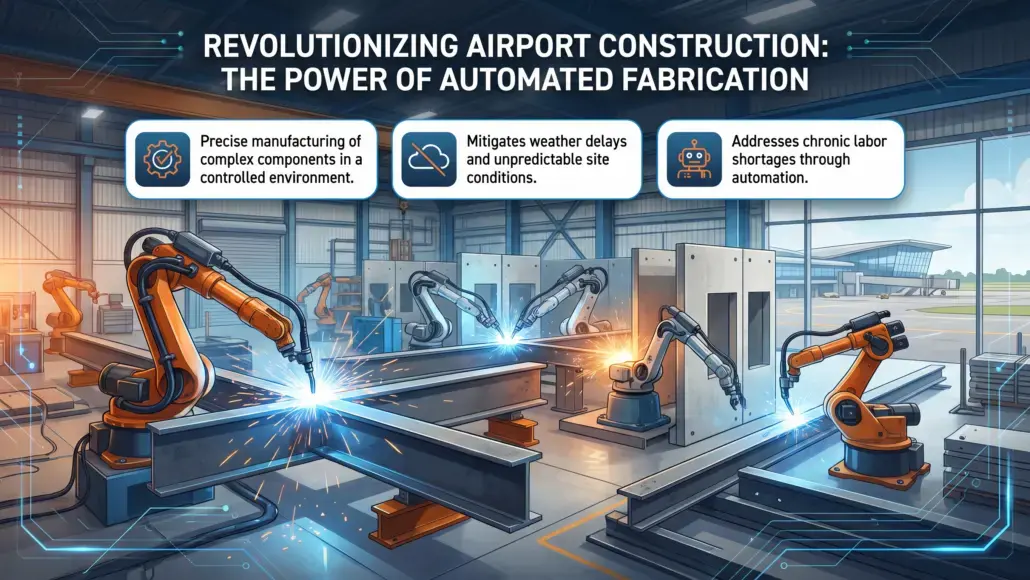


The integration of advanced robotics into the fabrication of large scale aviation facilities is fundamentally altering the timelines and quality standards of the industry. The adoption of advanced fabrication methods allows for the precise manufacturing of complex steel and concrete components in a controlled environment, away from the unpredictable conditions of an active airfield. This shift toward automation addresses the chronic labor shortages facing the construction sector while ensuring that the exacting tolerances required for airport infrastructure are consistently met. By utilizing robotic welding, automated bricklaying, and precision component placement, project teams can achieve a level of speed and accuracy that manual methods simply cannot match. This approach is particularly beneficial for the massive, repetitive structures common in terminal buildings, hangars, and cargo facilities, where even minor gains in efficiency can lead to significant cost savings over the life of the project.
Robotic Precision in Terminal Framework Fabrication
The skeleton of a modern airport terminal is a marvel of engineering, often featuring sweeping curves and vast open spaces that require complex steel configurations. The use of high precision robotic systems ensures that these components are manufactured with sub millimeter precision. Robotic welding stations can work around the clock, producing structural joints that are stronger and more consistent than those produced by human welders. This not only speeds up the fabrication process but also reduces the need for extensive on site inspections and rework. Each weld is monitored by sensors that verify quality in real time, providing a digital audit trail for every structural element. This high level of quality control is essential for structures that must withstand the vibrations and wind loads associated with proximity to heavy aircraft.
In addition to welding, automated systems are being used for the precision cutting and drilling of structural members. Computer controlled machines can process thousands of components with identical accuracy, ensuring a perfect fit when the pieces arrive on site for assembly. This “Lego like” precision minimizes the time spent on site adjustments, which is critical when working within the tight time windows often mandated by airport authorities. By moving the bulk of the complex fabrication work into a factory setting, the project team can maintain a cleaner and more organized job site, reducing the risk of errors and accidents. The result is a higher quality structure that can be erected in a fraction of the time, providing a faster path to operational readiness for the airport.
Scaling Productivity through Off Site Modular Assembly
One of the most effective ways to accelerate a project is to move as much work as possible off site. Automated Structural Assembly facilitates the creation of large scale modular sections that include structural elements, utility conduits, and even interior finishes. These modules are assembled in a dedicated facility using automated assembly lines, similar to those found in the automotive industry. Once complete, the modules are transported to the airport and lifted into place by cranes. This method allows for the parallel processing of different project elements: while the site team is preparing the foundations, the factory team is already building the upper levels of the terminal.
The impact on productivity is substantial. Because the work is performed in a weather protected environment, there are no delays due to rain, wind, or extreme temperatures. Additionally, the use of automated assembly lines allows for a much higher density of work than could be achieved on site. Multiple shifts can work on different modules simultaneously, significantly compressing the overall project schedule. This modular approach also reduces the number of deliveries to the airport site, as one large module replaces hundreds of individual components. This is a major benefit for airports where site access is often restricted and security screening for delivery vehicles can be time consuming. By streamlining the logistics and maximizing off site work, the project can proceed at a much more predictable and rapid pace. The efficiency gained through these methods also allows for more aggressive project timelines, which can be a decisive factor in winning competitive bids for major international terminal expansions.
The specialized nature of airport projects often requires unique architectural features that would be prohibitively expensive to build using traditional methods. Automated assembly enables the cost effective production of these bespoke elements by utilizing programmable robotic arms that can adapt to different designs with minimal downtime. This flexibility allows architects to push the boundaries of aviation design without compromising the project’s financial viability. By providing a bridge between complex design and efficient production, automation is opening up new possibilities for the future of airport aesthetics and functionality. These advancements ensure that the next generation of terminals will not only be highly efficient but also architecturally significant landmarks.
Enhancing Worksite Safety by Minimizing Human Exposure
Construction sites are inherently dangerous environments, and airport sites are particularly challenging due to the constant movement of heavy equipment and the noise levels from aircraft. Automated Structural Assembly enhances safety by reducing the number of workers required in these high risk zones. When structural components are assembled automatically, there is less need for personnel to work at heights or in confined spaces. Robots can handle the heavy lifting and the repetitive, physically demanding tasks that often lead to strain injuries and accidents. This shift in the labor model allows the remaining site personnel to focus on higher level management and coordination tasks, where their skills are most valuable.
Additionally, the use of automated systems provides a more predictable work environment. Robots do not suffer from fatigue or distraction, which are common causes of human error on construction sites. By delegating the most dangerous and repetitive tasks to machines, the project can maintain a much higher safety standard. This is not only a moral imperative but also a financial one, as fewer accidents lead to lower insurance premiums and fewer project delays. The integration of safety sensors into the automated equipment further enhances this protection, as the machines can detect the presence of humans and shut down automatically to prevent collisions. Through these combined efforts, the construction team can deliver a complex project while maintaining an exemplary safety record.
Quality Assurance and Real Time Structural Monitoring
Ensuring the long term integrity of airport infrastructure requires rigorous quality assurance throughout the construction process. Automated Structural Assembly integrates sensing technology directly into the assembly workflow. As each component is placed and secured, sensors verify its position against the digital twin of the building. This provides immediate feedback to the project team, allowing for corrections to be made in real time. This level of oversight is particularly important for specialized structures like control towers or radar installations, where even a slight misalignment can impact the performance of critical aviation systems.
Beyond the construction phase, the data collected during the automated assembly process provides a valuable baseline for future maintenance. The digital record of every weld, bolt, and structural connection allows facility managers to identify potential weak points and schedule preventative maintenance before a failure occurs. This proactive approach to asset management extends the life of the infrastructure and reduces the long term cost of ownership. The ability to monitor the structural health of the building in real time, using sensors that were installed during the automated assembly process, provides an additional layer of security for the airport. By building quality and monitoring into the very fabric of the structure, the project team can deliver a facility that is both safe and reliable for decades to come.
Integrating Automation with Digital Building Information Models
The success of automated construction depends on a seamless flow of data from the design phase to the factory floor. Automated Structural Assembly relies on highly detailed Building Information Models (BIM) that provide the instructions for the robotic systems. This digital integration ensures that the physical structure is an exact replica of the design, minimizing the risk of misinterpretation or error. The BIM model acts as the central source of truth for all parties, from the architects and engineers to the factory technicians and site managers. This level of coordination is essential for the complex systems found in modern airports, where structural, mechanical, and electrical systems must all fit within a tightly defined space.
As the project progresses, the BIM model is updated with real time data from the automated assembly process, creating a living digital twin of the facility. This model can be used to simulate different construction sequences and identify potential clashes before they occur on the site. For example, the project team can verify that a modular terminal section will clear an existing overhang during installation, or that a new utility run will not interfere with a structural beam. This digital foresight reduces the need for expensive and time consuming field changes, ensuring that the project remains on track. The combination of advanced automation and digital modeling represents the future of airport construction, providing the tools necessary to build more complex and efficient facilities than ever before. Through these integrated systems, the industry can overcome the challenges of the modern aviation sector and deliver the infrastructure needed for the next generation of travel. The data generated during the assembly process can also be utilized to optimize the supply chain, ensuring that materials arrive exactly when they are needed by the robotic systems. This prevents the buildup of inventory and reduces the amount of storage space required on site, which is always at a premium in busy airport environments.
As the construction industry continues to embrace digital transformation, the role of the data scientist will become as important as that of the structural engineer. Analyzing the performance data from automated systems allows for continuous process improvement, leading to even greater gains in productivity in future projects. The ability to predict potential issues before they occur, based on historical data from similar builds, will further enhance the reliability of airport construction timelines. By fostering a culture of innovation and data driven decision making, the industry can ensure that it meets the growing demands of global aviation while maintaining the highest standards of quality and safety. This holistic approach to construction management is essential for the long term success of any major infrastructure project.