

























Close
MCE 2026
Thursday, January 15, 2026
JEC WORLD 2026

US Airports Receive $1 Billion From The Infrastructure Act

Note* - All images used are for editorial and illustrative purposes only and may not originate from the original news provider or associated company.

Subscribe

- Never miss a story with notifications

- Gain full access to our premium content

- Browse free from any location or device.

Media Packs

Expand Your Reach With Our Customized Solutions Empowering Your Campaigns To Maximize Your Reach & Drive Real Results!

– Access the Media Pack Now

– Book a Conference Call

Leave Message for Us to Get Back

Related stories

Managing Material Costs in a Volatile Construction Market

Construction material price volatility presents significant challenges to project budgeting and risk management. Strategic procurement approaches, supply chain resilience strategies, and contract mechanisms that balance risk effectively enable stakeholders to navigate market fluctuations successfully. Understanding market dynamics, implementing escalation clauses, developing flexible procurement strategies, and maintaining strong supplier relationships help construction professionals maintain project viability despite unpredictable material cost movements.

Concrete Solutions for Long Life Transportation Infrastructure

Concrete has emerged as the material of choice for transportation infrastructure, from highways and bridges to complex traffic interchange systems. Strategic material selection, advanced design methodologies, and refined construction practices ensure that concrete pavements and structures deliver exceptional longevity under the demands of heavy traffic and severe environmental exposure. These concrete solutions reduce lifecycle costs through minimized maintenance requirements and extended service life, making them the most economical choice for critical transportation networks.
- Advertisement -
Advancing Prefabrication 2026

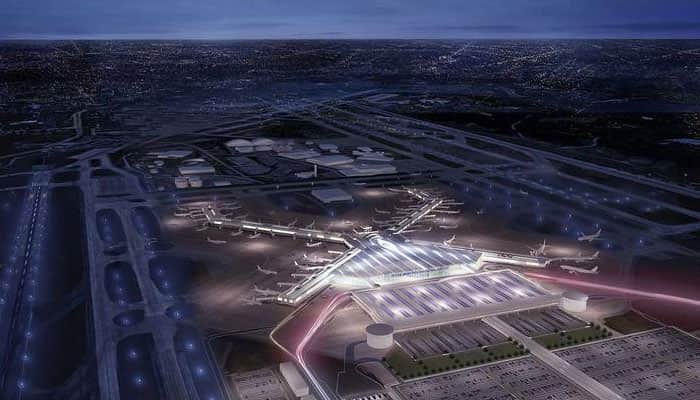
World Construction Today – The Infrastructure Investment and Jobs Act in the US will provide the Federal Aviation Administration with nearly $1 billion to repair and upgrade terminals at 85 airports around the country, the White House announced recently. The FAA gave projects with rapid implementation time, solid labour standards, and the use of sustainable building materials priority.

One of three aviation financial assistance programmes established by the infrastructure act, the $5 billion Airport Terminal Program, is giving out funds for the first time over a five-year period. An additional $5 billion and $15 billion for aviation infrastructure are included in the infrastructure act.

The funds boost energy efficiency, foster competitiveness, and enhance access for people with disabilities at the country’s airport terminals, according to a news statement from the White House. Enhancing airport gateway design will strengthen U.S. competitiveness, boost customer experiences, and ship goods through the economy more effectively to reduce prices.

Typically, airport upgrades are funded by local authorities and airlines. As per the American Society of Civil Engineers, the federal government has also contributed around $15 billion per year from 2017 to 2020, largely for runways, traffic control towers, and back-of-house infrastructure. However, there is still a financing gap and a stockpile of maintenance and improvement requirements. According to the ASCE’s 2021 Infrastructure Report Card, which graded U.S. infrastructure, terminal expenditures are the most pressing requirement for airports of all sizes across the nation.

As per the funding mechanism for the Airport Terminal Program, large hub airports will get up to 55% of the overall funding, medium airports will still get 15%, and small airports will get 20%. Projects of all sizes were among the recipients of the initial round of grants.

There was a lot of demand for the Airport Terminal Program’s initial funding round. According to Forbes, the FAA received 658 petitions from 532 airports.

The following terminal projects are scheduled to receive funding:

  • The construction of four gates at Orlando International Airport will cost $50 million.
  • The Dallas-Fort Worth International Airport will receive $35 million to build a central utility plant with zero carbon emissions.
  • A new terminal will be built at Pittsburgh International Airport with the help of $20 million.
  • With enhanced sustainability, access, and navigation features, Austin Bergstrom International Airport will get $15 million to finish Phase 2 of its expansion project.
  • The Phoenix-Mesa Gateway Airport will receive $14.4 million to upgrade and expand an interim terminal into a long-term building that complies with ADA standards.

According to the White House, this round’s funds include elements to increase sustainability, improve access for historically underserved communities and remote airports, improve access for travellers with impairments, and expand terminal capacity in 70 of the grants given out.

Additionally, two grants totaling $15 million will be used to build new air traffic control towers, one at Asheville Regional Airport in North Carolina and the other at Peoria International Airport in Illinois.

Achema Middleeast

Latest stories

Related stories

Managing Material Costs in a Volatile Construction Market

Construction material price volatility presents significant challenges to project budgeting and risk management. Strategic procurement approaches, supply chain resilience strategies, and contract mechanisms that balance risk effectively enable stakeholders to navigate market fluctuations successfully. Understanding market dynamics, implementing escalation clauses, developing flexible procurement strategies, and maintaining strong supplier relationships help construction professionals maintain project viability despite unpredictable material cost movements.

Concrete Solutions for Long Life Transportation Infrastructure

Concrete has emerged as the material of choice for transportation infrastructure, from highways and bridges to complex traffic interchange systems. Strategic material selection, advanced design methodologies, and refined construction practices ensure that concrete pavements and structures deliver exceptional longevity under the demands of heavy traffic and severe environmental exposure. These concrete solutions reduce lifecycle costs through minimized maintenance requirements and extended service life, making them the most economical choice for critical transportation networks.

How Strategic Packaging and Transport Design Improve Prefab Installation Readiness

Smarter packaging, labeling, protection systems, and transport strategies ensure modules arrive safely and in correct sequence. Transport design directly impacts installation speed and quality through enabling efficient staging and rapid assembly integration.

Subscribe

- Never miss a story with notifications

- Gain full access to our premium content

- Browse free from any location or device.

Media Packs

Expand Your Reach With Our Customized Solutions Empowering Your Campaigns To Maximize Your Reach & Drive Real Results!

– Access the Media Pack Now

– Book a Conference Call

Leave Message for Us to Get Back

Translate »