




























Key Takeaways
- Automation-ready BIM structures geometry specifically for CNC machines, enabling direct translation from digital models to fabrication instructions
- Modeling standards and rules ensure consistency enabling algorithms to reliably interpret designs for automated fabrication
- Geometry optimization tailors component shapes for manufacturing efficiency while maintaining structural and functional requirements
- Metadata embedded in BIM models communicates fabrication intent, material specifications, and assembly requirements to fabrication equipment
- Direct BIM-to-CNC workflows eliminate intermediate software translation steps, reducing errors and accelerating fabrication initiation
- Robotic integration enables complex assembly sequences orchestrated directly from BIM models with minimal manual intervention
The digital-to-physical manufacturing process represents one of prefabrication’s most critical transitions. Design models, whether sophisticated BIM environments or simple CAD files, must ultimately translate into fabrication instructions that machines execute. Traditional translation involves human interpretation—engineers reading designs, creating shop drawings, translating drawings into fabrication instructions that fabrication personnel input into machines. This multi-step translation introduces interpretation opportunities where human understanding might diverge from design intent, creating errors and requiring corrections.
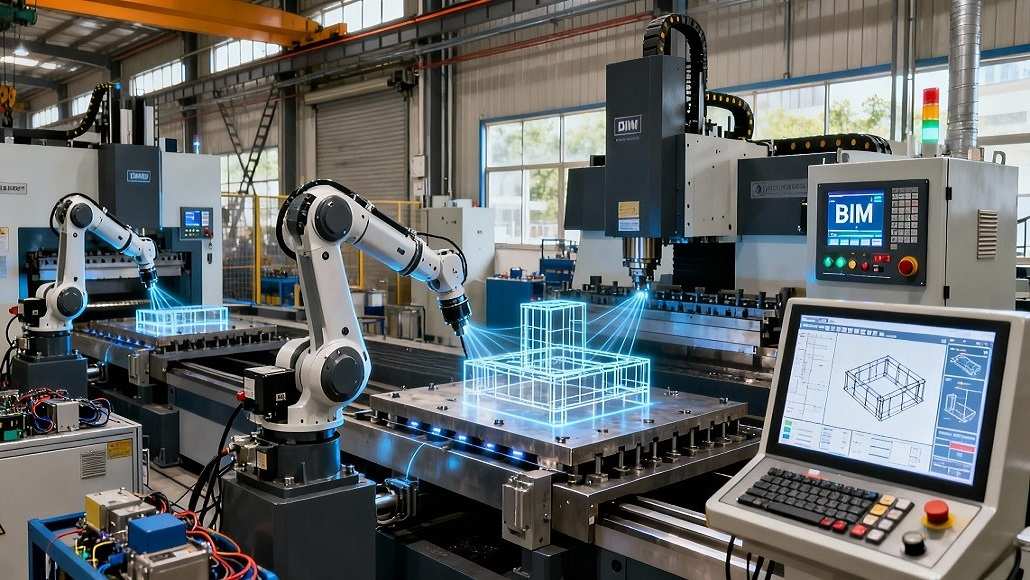
Automation-ready BIM models eliminate this translation cascade. Rather than designs requiring human interpretation before manufacturing, BIM models are structured specifically to be read directly by automated fabrication equipment. CNC machines access BIM geometries directly. Robots read BIM-embedded assembly sequences. Fabrication equipment interfaces directly with design models, executing fabrication precisely as designed without human interpretation intermediaries.
This direct BIM-to-fabrication connection represents a fundamental shift in manufacturing methodology. Rather than humans being essential bridges between design and manufacturing, automated systems read designs directly. The result combines remarkable precision with dramatic efficiency improvements. Manufacturing that might require days when involving human translation completes in hours through direct automation.
Understanding Automation-Ready BIM Concepts
Automation-ready BIM differs fundamentally from traditional BIM through deliberate structuring for machine readability. Traditional BIM emphasizes geometric accuracy and information completeness for human interpretation. Designers create models containing information relevant to design intent—spatial relationships, material properties, structural requirements, aesthetic considerations.
Automation-ready BIM additionally emphasizes machine readability through standardized formats, consistent geometry, and embedded fabrication metadata. Rather than leaving fabrication intent to human interpretation, automation-ready BIM encodes fabrication requirements directly into models. Rather than allowing geometric variations that humans might understand as equivalent, automation-ready BIM enforces strict geometric standards enabling machines to interpret models unambiguously.
This structuring requires discipline and standardization. Geometry must follow defined rules ensuring machines can interpret dimensions consistently. Components must follow standardized patterns enabling algorithms to process designs systematically. Metadata must follow established schemas ensuring machines understand fabrication intent accurately.
The discipline required for automation-ready BIM proves challenging for designers accustomed to flexible design approaches. Rather than designing components to achieve desired functionality and aesthetics, leaving fabrication details to fabricators, designers must consider how machines will interpret and execute designs. This manufacturing awareness during design improves manufacturability but requires different design thinking.
Geometry Standards and Manufacturing Rules
Automation-ready BIM enforces strict geometry standards ensuring machines can interpret designs unambiguously. Rather than allowing interpretive flexibility about dimensions or tolerances, standards specify exactly how dimensions are encoded. Rather than allowing geometric variations humans might understand as equivalent, standards enforce consistent approaches.
For example, standards might specify that all dimensions must be encoded in specific BIM properties rather than in text annotations. This standardization enables algorithms to extract dimensions reliably without requiring human interpretation of dimensional notation. Standards might specify that all cuts, holes, and fabrication features must be represented as explicit geometric elements rather than implied through annotations. This ensures machines detect all required fabrication operations.
Manufacturing rules embedded in geometry standards ensure designs respect equipment capabilities. If CNC machines have maximum cutting speeds limiting feature complexity, rules might restrict minimum feature sizes or spacing. If equipment has weight capacity limitations, standards might restrict component mass. These rules built into design systems prevent designs violating equipment capabilities from progressing to fabrication, where discovering capability violations would require costly redesign.
Geometric tolerancing standards specify acceptable variation ranges. Rather than assuming tolerances arbitrarily, standards specify tolerances that equipment can achieve reliably. If CNC machines achieve 2mm dimensional accuracy consistently, tolerance standards enforce 2mm or looser tolerances. This prevents specifying tolerances equipment cannot achieve, avoiding quality issues and rework.
Parametric Generation for Fabrication Efficiency
Automation-ready BIM frequently leverages parametric design enabling algorithms to generate fabrication-optimized geometries. Rather than designers specifying exact component geometries, designers specify parametric rules that algorithms use to generate geometries. Algorithms generate optimized geometries respecting fabrication constraints and optimizing manufacturing efficiency.
For example, rather than designers manually dimensioning beam connections, parametric systems might accept beam size and connection loads as parameters, then generate optimal connection geometry. The generated geometry respects fabrication constraints, optimizes for material efficiency, and ensures equipment can fabricate the connection. Multiple connection scenarios automatically generate without manual design effort.
Parametric generation proves particularly valuable for component families where variations share fundamental characteristics. A building project might incorporate hundreds of wall panels with varying configurations. Rather than manually designing hundreds of variations, parametric systems generate all variations from base parameters. Every variation automatically respects fabrication standards and constraints, ensuring consistent quality across all panels.
The efficiency of parametric generation enables comprehensive design exploration. Rather than manually designing a dozen component variations, algorithms can generate hundreds of variations automatically, enabling thorough optimization. Projects benefit from designs truly optimized for manufacturing rather than designs constrained by manual design effort.
Metadata and Fabrication Intent Encoding
Machine interpretation of designs depends on understanding fabrication intent. Machines must know which features require cutting, which require holes, which require welds. They must understand material types, quality standards, and assembly requirements. Traditional designs leave this information implicit for human fabricators to interpret. Automation-ready BIM encodes this information explicitly.
Metadata systems embedded in BIM models communicate fabrication requirements. Material properties encode material types, grades, and specifications. Feature metadata encodes operation types—cutting, drilling, welding—and operation parameters. Quality metadata encodes inspection requirements and acceptance criteria. Assembly metadata encodes assembly sequences and fastening specifications.
Standardized metadata schemas ensure machines interpret metadata consistently. Rather than each project inventing unique metadata approaches, standardized schemas provide consistent frameworks. Machines trained on standard schemas can process designs automatically regardless of project specifics. This standardization enables true plug-and-play fabrication where designs from diverse sources flow seamlessly into fabrication equipment.
Metadata completeness ensures machines perform all required operations. If metadata specifies that components require specific inspections, quality control systems execute those inspections automatically. If metadata specifies fastening requirements, robotic assembly systems apply specified fasteners. Missing metadata results in operations being overlooked. Complete metadata ensures comprehensive fabrication.
Direct BIM-to-CNC Integration
The ultimate goal of automation-ready BIM is direct translation of BIM models into CNC machine instructions. Rather than humans interpreting designs and creating CNC programs, software extracts fabrication intent from BIM models and generates CNC code directly.
Advanced BIM systems can export models in formats compatible with CNC machine software. Geometry information translates directly into cutting paths. Hole specifications translate into drill operations. Structural elements become machining sequences. The BIM-to-CNC translation eliminates human interpretation steps where errors might emerge.
Error reduction proves substantial through direct BIM-to-CNC translation. Human translation introduces operator errors—misreading dimensions, overlooking features, misinterpreting intent. Direct translation eliminates these opportunities. Machines execute exactly what designers intended without interpretation gaps.
Fabrication initiation accelerates dramatically through direct translation. Traditional workflows require hours or days for humans to create shop drawings and CNC programs. Direct BIM-to-CNC translation can initiate fabrication immediately after design approval. Projects compressing the design-to-fabrication transition gain significant timeline advantages.
Quality and precision improve through direct translation. Manual CNC program creation sometimes includes approximations or simplifications for convenience. Direct translation enforces design precision throughout fabrication. Components fabricated directly from design models maintain design accuracy precisely, rather than drifting through manual translation steps.
Robotic Integration and Complex Assembly Orchestration
Automation-ready BIM extends beyond machining into assembly, enabling robotic systems to execute complex assembly sequences directly from design models. Assembly metadata embedded in BIM models specifies assembly sequences, fastening requirements, and quality verification procedures. Robotic systems read these specifications and execute assembly automatically.
The complexity of assembly sequences robotic systems can execute far exceeds human capabilities. Rather than multi-step manual assembly processes, robots can execute sophisticated sequences involving precise positioning, fastening, inspection, and adjustment. Complex prefabricated assemblies that would require extensive manual work can be robotically assembled from design specifications.
Assembly flexibility emerges through reprogramming without hardware changes. If design assembly sequences change, software updates robot programming. Rather than redesigning robotic systems, updated specifications guide robot execution. This flexibility enables rapid configuration changes supporting diverse product variations.
Quality control integrates into robotic assembly. Sensors verify component positioning accuracy. Fastening torque monitors ensure proper fastening. Dimensional verification confirms assembled dimensions meet specifications. Quality procedures execute automatically alongside assembly, ensuring every assembly meets quality standards without requiring separate quality control operations.
Implementation Challenges and Adoption Barriers
Successfully implementing automation-ready BIM requires substantial organizational change. Design teams must adopt strict modeling disciplines ensuring compliance with automation standards. Fabrication equipment requires programming to interpret BIM formats. Organizations must develop translation systems converting BIM information into fabrication instructions.
Standardization adoption represents a significant barrier. Currently, no single universal standard for automation-ready BIM has achieved complete industry consensus. Different equipment manufacturers support different formats and standards. Organizations must often develop proprietary translation systems accommodating their specific equipment and software ecosystems.
Design philosophy shifts prove challenging for architects and engineers accustomed to design flexibility. Automation standards constrain design choices. Designers must work within frameworks optimized for manufacturing rather than pursuing unrestricted design freedom. This constraint frustrates some designers despite producing more manufacturable, efficient designs.
Equipment integration requires technical expertise and ongoing maintenance. BIM-to-fabrication translation systems require development, testing, and refinement. Equipment programming requires specialized knowledge. Organizations implementing automation-ready BIM must develop and maintain these capabilities or contract with specialized service providers.
Competitive Implications and Future Direction
Organizations successfully implementing automation-ready BIM develop substantial manufacturing advantages. Fabrication efficiency improvements reduce manufacturing costs. Timeline compression from design to fabrication accelerates project delivery. Quality improvements from direct digital-to-physical translation reduce defects and warranty claims. These advantages compound as organizations refine automation-ready BIM practices.
The industry increasingly recognizes automation-ready BIM as essential infrastructure for competitive prefabrication. Equipment manufacturers increasingly support BIM integration. Software platforms increasingly emphasize BIM-to-fabrication workflows. Educational programs increasingly emphasize automation-ready design practices.
The future of prefabrication will involve comprehensive automation-ready BIM throughout design and manufacturing. Rather than BIM models being primarily designed for human interpretation, with machine use as secondary consideration, future BIM will be designed simultaneously for human understanding and machine execution. Designs flowing seamlessly from conception through digital fabrication to physical production will become standard practice.
Organizations currently investing in automation-ready BIM infrastructure position themselves at the industry forefront. As standardization advances and tools mature, organizations with established capabilities will leverage their investments for sustained competitive advantage. Organizations continuing traditional design-to-fabrication translation approaches will find themselves increasingly unable to compete with organizations leveraging direct BIM-to-fabrication automation.
