

























Key Takeaways
- Fully automated production cells achieve throughput increases of 200-400% compared to traditional semi-automated systems
- Robotic assembly maintains precision tolerances of 2-5mm consistently across all production cycles
- Multi-axis robotic arms perform complex fastening, welding, and assembly sequences automatically with minimal human intervention
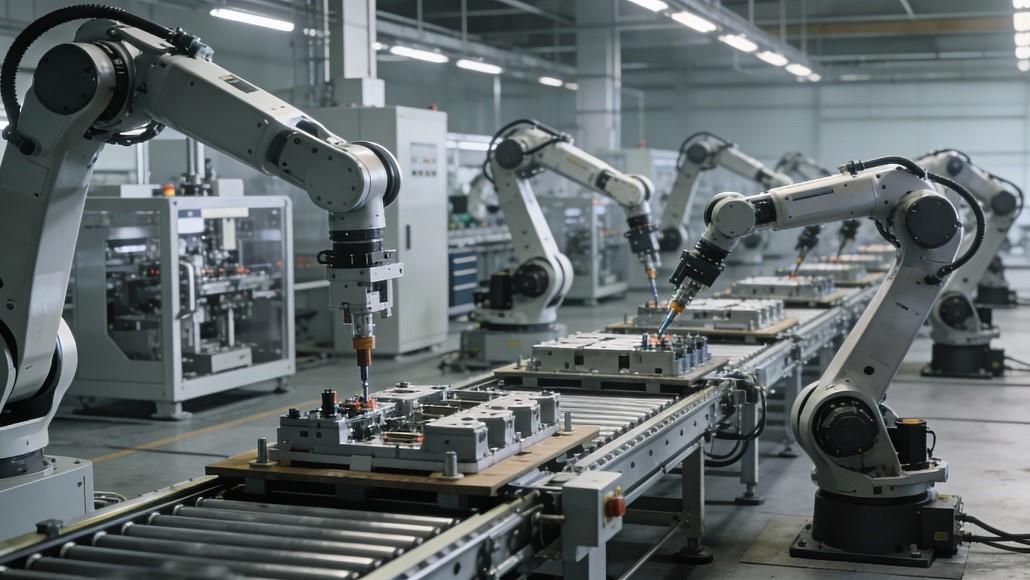
- Production cells coordinate multiple robots working simultaneously, maximizing equipment utilization and minimizing idle time
- Integration with BIM models enables robots to execute designs precisely as specified without human interpretation
- Shift from semi-automated to fully robotic systems reduces labor intensity while dramatically improving consistency and output quality
The traditional prefab factory operated on semi-automated principles where machinery handled routine tasks but skilled workers performed complex assembly, fastening, and precision work. Workers moved between stations, guided components into machines, verified alignment, and executed specialized operations requiring human judgment and dexterity. This hybrid approach balanced automation efficiency with human flexibility, but introduced inherent limitations—humans work at finite speeds, fatigue affects consistency, and skill variability creates quality inconsistency.
Modern robotic assembly lines transform this paradigm. Rather than humans directing automated processes, fully robotic production cells execute complex operations independently. Multiple robots coordinate simultaneously—one positioning components, another fastening them, a third verifying alignment and quality. These coordinated robotic systems achieve consistency and speed impossible with human-centered approaches. The evolution from semi-automated facilities to fully robotic production represents perhaps the most significant transformation in prefab manufacturing.
The market response validates this transformation. Leading prefab manufacturers increasingly operate robotic assembly lines as competitive essentials. Organizations that automated assembly lines report productivity improvements of 200-400%, quality improvements reducing defects by 60-80%, and labor savings enabling operations in high-cost markets where traditional construction proves economically impossible. The transition to robotic assembly is accelerating as equipment costs decrease and capabilities improve.
Understanding Robotic Assembly Systems
Robotic assembly lines employ multiple robots working within coordinated production cells. Rather than single robots handling complete assembly sequences, specialized robots perform specific operations. Placement robots position components precisely. Fastening robots apply bolts or welds. Inspection robots verify alignment and quality. Material handling robots move components between stations. This specialization enables optimization—each robot type is purpose-engineered for its specific task, achieving exceptional performance.
Robot coordination represents perhaps the most sophisticated aspect of modern assembly systems. Multiple robots must work in precise sequence without interfering with each other. If fastening robot A begins operations before placement robot B completes positioning, misalignment results. Advanced control systems orchestrate robot movements, ensuring each robot performs operations in correct sequence and spatial positioning.
The progression from semi-automated to fully robotic systems followed a logical evolutionary path. Early semi-automated systems positioned components manually, with machines performing attachment operations. Subsequent systems automated positioning but required human oversight. Modern systems achieve full automation—components arrive from upstream, robots position them, robots fasten them, robots inspect them, completed assemblies depart to subsequent operations. Human operators monitor system performance but intervene only if problems require problem-solving beyond automated system capability.
Fastening and Material Joining Automation
Fastening represents one of the most labor-intensive and error-prone assembly operations. Traditional approaches involve workers applying fasteners—bolts, welds, adhesives—requiring specialized skills and careful execution. Inconsistent fastening creates structural problems. Under-tightened fasteners may loosen during operation. Over-tightened fasteners strip or damage materials. Inconsistent fastening creates quality variability and warranty issues.
Robotic fastening systems eliminate these problems through precise, consistent execution. Fastening robots apply precisely calibrated torque to bolts, ensuring optimal fastening without under or over-tightening. Robotic welding systems maintain exact heat input, travel speed, and arc stability, producing consistent welds. Adhesive application robots dispense precise amounts at correct locations, ensuring reliable bonding. Fastening automation converts an operation prone to human variation into a precisely controlled process.
The sophisticated sensing in modern fastening robots enables verification and correction. Torque sensors measure bolt tension and trigger alerts if fastening deviates from specifications. Weld quality sensors detect porosity or inconsistent bead profiles and flag quality issues. Vision systems verify fastener placement and alignment before components move to subsequent operations. This comprehensive quality verification ensures finished components meet specifications consistently.
Assembly Line Sequencing and Production Flow
Modern robotic assembly lines organize work around takt time principles adapted from manufacturing. Rather than allowing unlimited time for assembly operations, takt time establishes consistent cycle times aligned with overall production demand. If factories must produce 100 units daily during 20-hour operational periods, takt time becomes 12 minutes per unit. Assembly operations are designed to complete within takt time, creating predictable, consistent production flow.
Achieving takt time requires meticulous planning and coordination. Every operation—component positioning, fastening, inspection, material movement—must complete within allocated time. Operations that exceed takt time create bottlenecks stalling subsequent operations. Successful takt time systems balance workload across operations, ensuring no single operation limits overall throughput.
Material flow represents another critical consideration. Components must arrive at assembly stations precisely when needed. If components arrive early, storage requirements increase and components might be damaged or misaligned. If components arrive late, assembly robots stand idle. Just-in-time material delivery coordinated with takt time ensures components arrive precisely when needed, enabling lean manufacturing principles.
Production cells exploit parallel operations where multiple robots work simultaneously on different subassemblies. While robot A assembles structural components, robot B assembles mechanical systems, and robot C assembles electrical systems. Upon completion, completed subassemblies merge into final assembly where integration robots coordinate final connections. This parallel workflow compresses total production time far below what sequential operations would require.
Adaptive Robotic Systems and Flexibility
A persistent challenge with fully automated systems involves adapting to design variations. Traditional fully-automated assembly lines operated on single products—the line was optimized for that specific design and struggled with variations. This limited applicability for prefab environments where customers demand design customization.
Modern robotic systems introduce flexibility through reprogramming capabilities and adaptive sensing. Rather than requiring hardware changes to accommodate design variations, software updates reprogram robots for new designs. Robots receiving new design specifications automatically adjust positioning, fastening sequences, and inspection parameters. Design variations that would require weeks of equipment modification can be accommodated through software updates in days or hours.
Adaptive sensing enables robots to accommodate component variations within tolerance ranges. Vision systems detect component positions precisely and communicate positions to assembly robots, which adjust positioning accordingly. Rather than requiring components positioned with micrometer precision, systems accommodate normal manufacturing variation, greatly simplifying upstream component fabrication constraints.
Precision and Quality Improvements
Quality metrics demonstrate robotic assembly superiority. Manual assembly might achieve consistency where 85-90% of assemblies meet specifications on first production. Robotic assembly typically achieves 99%+ first-pass quality. The remaining defects typically result from component defects rather than assembly errors.
Precision tolerances achievable through robotic assembly approach engineering limits. Fastening torque variation might be ±5% compared to human manual fastening where variation approaches 25%. Fastener placement accuracy approaches ±1mm compared to human manual placement where accuracy might be ±10mm. This precision improvement enables designs that would be impossible with human assembly.
The consistency of robotic assembly creates downstream benefits. Quality control processes can focus on component incoming inspection rather than assembly verification. Installation teams receive assemblies they can install with confidence they’ll fit together correctly. Warranty costs plummet as assembly-related defects essentially vanish.
Labor Transition and Workforce Implications
Robotic assembly raises valid concerns about labor displacement. If robots replace workers, what becomes of factory personnel? The transition proves nuanced. Rather than eliminating factory jobs entirely, robotic assembly transitions jobs from manual assembly toward machine programming, maintenance, quality oversight, and process improvement roles.
Factories transitioning to robotic assembly typically maintain comparable employment levels, though job composition shifts significantly. Rather than 80% of workforce performing manual assembly, post-transition factories might employ 30% in assembly programming and equipment tending, 20% in equipment maintenance, 25% in quality oversight, and 25% in planning and supervision. The new roles often demand higher technical capability but prove less physically demanding.
Workforce transition requires training and investment. Organizations cannot simply install robotic systems and expect workers to immediately program and maintain them. Systematic training programs develop worker capability in robotics programming, electrical/mechanical maintenance, and quality systems. Workers willing to develop new capabilities find themselves in higher-value roles earning wages matching their increased capability.
Implementation Challenges and Critical Success Factors
Successfully implementing robotic assembly lines requires substantial capital investment, technical expertise, and organizational commitment. Equipment costs alone might represent millions of dollars for sophisticated production cells. Organizations must commit to utilization levels justifying capital expenditure. Facilities operating single-shift or with highly variable demand struggle to achieve payback.
Design standardization prerequisites successful robotic implementation. Highly customized designs create complexity robots struggle to accommodate. Organizations implementing robotic assembly typically standardize designs around modular platforms where variations operate within defined parameters. This standardization simultaneously benefits customers through predictable performance and manufacturers through robotic compatibility.
Supply chain integration proves critical. Robotic assembly depends on consistent component quality and arrival timing. If upstream suppliers deliver components with dimensional variation exceeding robot sensor tolerance ranges, robotic precision provides little benefit. Organizations implementing robotic assembly invest heavily in supplier development ensuring components meet specifications.
Competitive Implications and Industry Transformation
Organizations operating robotic assembly lines develop substantial competitive advantages. Superior productivity enables lower costs while maintaining profitability. Superior quality strengthens reputation and customer satisfaction. Superior flexibility enables efficient customization. These advantages compound as organizations refine robotic operations.
The industry increasingly recognizes robotic assembly as competitive necessity rather than optional innovation. Equipment manufacturers increasingly design components for robotic assembly compatibility. Industry standards increasingly codify practices enabling robotic automation. Educational institutions increasingly teach robotic programming and integration. These systemic changes make robotic assembly increasingly accessible and necessary.
The future of prefab manufacturing will involve comprehensive robotic automation. Rather than facilities employing human labor for assembly operations, future facilities will operate largely robotic, with humans focused on oversight, programming, and continuous improvement. The transition is underway and accelerating. Organizations continuing traditional semi-automated approaches will find themselves unable to compete with robotic facilities achieving superior productivity, quality, and flexibility simultaneously.
