
























Key Takeaways
- Standardized building platforms enable high-volume construction at scale while maintaining design consistency
- Kit-of-parts systems reduce engineering time by 40-50% compared to custom design processes
- Platformization streamlines procurement through predefined, interoperable components reducing supply chain complexity
- Standardized components accelerate decision-making processes, enabling parallel design and manufacturing
- Building platforms accommodate customization within consistent frameworks, balancing flexibility and efficiency
Developers increasingly adopt standardized platforms as costs decrease and market demand for rapid housing solutions increases. The construction industry has historically approached each project as a unique engineering challenge requiring bespoke design and custom solutions. This approach, while enabling architectural creativity, introduces inefficiencies that accumulate across every project. Engineers redesign elements others have designed countless times. Procurement teams source components from multiple suppliers for similar functions. Quality varies based on individual project management capability. Timelines suffer from the complexity of managing unique specifications.
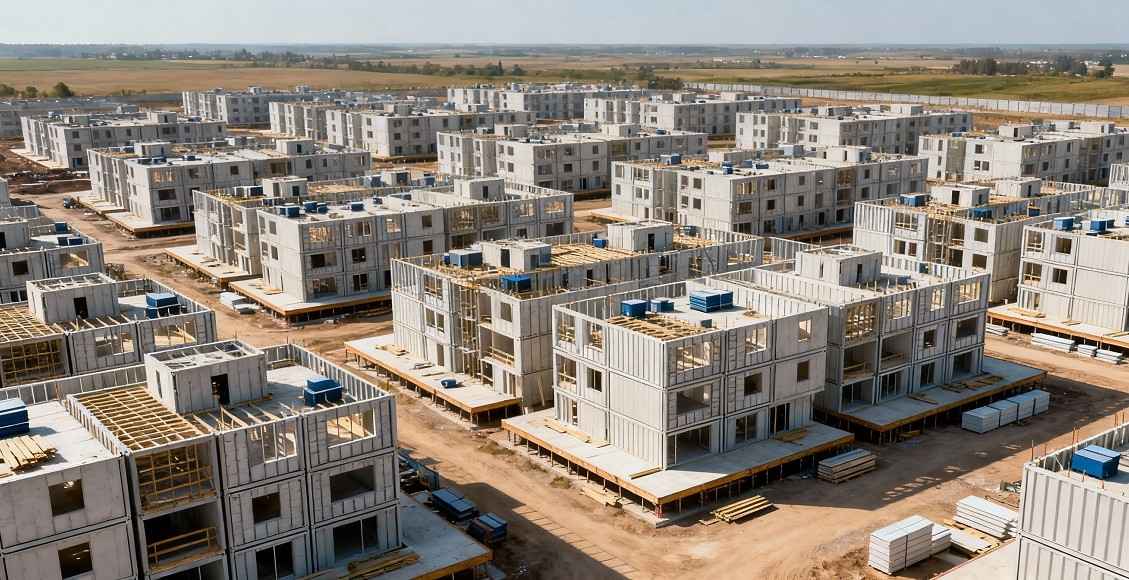
A fundamentally different approach is emerging through standardized building platforms. Rather than treating each building as a novel engineering challenge, developers increasingly adopt kit-of-parts systems where buildings are assembled from predefined, interoperable components designed and optimized for specific purposes. These standardized building platforms enable high-volume construction at scales previously impossible, compressing timelines, reducing costs, and ensuring consistent quality across multiple projects.
The modular and prefabricated construction market, expanding at 6.9% annually and projected to reach $219.2 billion by 2035, increasingly reflects this standardization trend. Successful developers recognize that standardized platforms represent a competitive advantage, enabling rapid scaling while maintaining operational discipline and quality consistency that distinguishes them from traditional competitors.
The Platform Concept Explained
Standardized building platforms operate on principles that revolutionized manufacturing in other industries decades ago. Rather than custom engineering each vehicle, automobile manufacturers developed platforms—foundational structural systems that accommodate multiple models through modular variations. The platform approach dramatically reduced development costs, accelerated time-to-market, and enabled global manufacturing scalability.
Construction is now embracing similar discipline. Standardized building platforms define fundamental systems—structural grids, mechanical systems, utility distribution networks, and component interfaces—that accommodate multiple building configurations. Developers design variations within these platforms rather than creating entirely new structures for each project.
The kit-of-parts philosophy extends this concept through interoperable components. Rather than unique components for each project, standardized parts connect through consistent interfaces. A window frame, door assembly, wall panel, or mechanical component from one project connects identically to systems in other projects. This standardization enables efficient manufacturing, predictable supply chains, and straightforward assembly processes.
Design Efficiency Through Platformization
Platformization fundamentally accelerates the design process. Traditional custom design requires extensive engineering for structural systems, mechanical layouts, electrical distribution, and countless other systems. Each design element must be individually calculated, detailed, and coordinated with other systems. This complexity extends design timelines to months or even years for large projects.
Standardized building platforms compress this timeline dramatically. Rather than designing structure from scratch, engineers select platform variants appropriate to project requirements. Mechanical systems follow established patterns rather than requiring custom design. Electrical distribution follows documented standards. Component selection occurs from pre-engineered options rather than requiring specification development.
The time savings prove substantial. Design development that might require three months of engineering can compress to four to six weeks when leveraging standardized platforms. This acceleration benefits developers through faster design approval, reduced consulting fees, and accelerated project delivery. It provides contractors and manufacturers with earlier certainty regarding material requirements, enabling supply chain optimization.
Standardization and Design Consistency
A persistent challenge in construction involves maintaining design consistency across multiple projects or within large developments. Different design teams interpret requirements differently. Individual architects introduce stylistic variations. Structural engineers select alternative systems. Mechanical designers implement different approaches. This diversity, while enabling creativity, introduces inefficiency and inconsistency.
Standardized building platforms establish consistent design frameworks. All projects utilizing a specific platform inherit its design discipline. Structural systems remain consistent, ensuring quality and enabling predictable performance. Mechanical systems follow proven approaches, reducing defects and operational challenges. Electrical distribution networks work reliably because they follow established patterns refined through multiple installations.
This consistency delivers multiple benefits. Building performance becomes predictable—developers understand how buildings will perform in operation. Maintenance becomes straightforward as building systems follow known patterns across multiple facilities. Training building operators becomes more efficient when systems are similar across properties. Long-term operational costs decrease as predictability reduces surprises and emergency repairs.
Procurement Streamlining and Supply Chain Efficiency
Traditional construction procurement processes are notoriously complex. Each project specifies unique components—windows from multiple suppliers, doors of varying specifications, mechanical equipment with differing characteristics. Procurement teams navigate these specifications, source materials from multiple vendors, manage logistics for diverse components, and coordinate delivery across extended timelines.
Standardized building platforms dramatically simplify procurement. Rather than specifying custom components for each project, developers order from a predefined component palette. Suppliers manufacture components in volume, reducing per-unit costs and improving availability. Supply chains become straightforward—manufacturers know exactly what components to produce, reducing inventory costs and improving delivery reliability.
The efficiency gains compound across multiple projects. Developers operating multiple standardized platforms develop long-term supplier relationships built on volume commitments. Manufacturers invest in production capability for components they manufacture repeatedly. Supply chains optimize around predictable demand. Quality improves through focused manufacturing of specific components. Costs decrease through volume purchasing and manufacturing efficiency.
Modular Systems and Interoperable Components
The foundation of effective standardized platforms lies in well-designed modularity and interoperable component interfaces. Rather than unique connections for each component type, standardized platforms define universal connection standards. A wall panel connects to structural grid points using identical fastening systems regardless of wall type. Mechanical distribution pipes connect through standard fittings. Electrical conduits follow consistent installation methods.
This interoperability enables flexibility within standardized frameworks. Developers can select from multiple wall panel types—different thermal performance, acoustic properties, finishes—while maintaining identical connection interfaces. Mechanical systems can incorporate various equipment selections while using identical distribution networks. Electrical systems can distribute power through alternative circuit configurations while maintaining standard connection points.
The flexibility proves particularly valuable for accommodating customization while maintaining standardization efficiency. Office buildings utilizing standardized platforms can vary floor plans substantially while maintaining core structural and system standards. Residential buildings can offer multiple unit types—studios, one-bedroom, two-bedroom—while sharing common building systems. Hospitality facilities can customize guest rooms extensively while maintaining standard corridor systems and central mechanical plants.
High-Volume Construction Scalability
Standardized building platforms enable scalability previously impossible in construction. Traditional construction operates at relatively small scales—individual projects with unique designs. Scaling traditionally means replicating custom approaches across multiple sites, essentially redesigning and rebuilding the same thing repeatedly.
Platformization inverts this dynamic. Developers establish standardized platforms, then replicate them across hundreds of locations with minimal customization. Large housing developers build thousands of units using standardized platforms. Retail chains standardize store designs around platforms, enabling rapid expansion. Hotel operators implement standardized platforms across dozens of properties.
This scalability delivers remarkable cost advantages. Initial platform development requires investment, but spreads across hundreds or thousands of units. Manufacturing achieves industrial scale. Supply chains optimize around massive volume. Operational procedures standardize across projects. Unit costs decrease dramatically as volume increases, a pattern impossible with custom design and construction.
Technology Enabling Platformization
Advanced digital tools increasingly enable and enhance standardized platform approaches. Building Information Modeling (BIM) enables detailed documentation of standardized platforms, with component libraries representing platform variations. Designers access standardized components and assemblies, selecting options rather than designing from scratch.
Parametric design tools enable variation within standardized constraints. A platform might define a structural grid spacing, but parametric tools automatically adjust component dimensions and connection details as spacing varies slightly between projects. This flexibility accommodates site-specific variations while maintaining standardization discipline.
Digital fabrication equipment—CNC cutting, laser systems, robotic assembly—manufactures standardized components with precision impossible to achieve manually. Consistent quality results from repetitive manufacturing of identical components. Manufacturing variances minimize, ensuring components fit together reliably across projects.
Case Studies in Successful Platformization
Forward-thinking developers increasingly demonstrate platformization success. Major residential developers operate platforms generating thousands of housing units. Standardized structural systems, mechanical packages, and component specifications enable rapid project delivery across multiple geographies. Unit costs prove substantially lower than custom construction, enabling affordable housing targets while maintaining profitability.
Commercial real estate developers similarly benefit from standardized platforms. Office building platforms accommodate varying floor plate sizes and lease configurations while maintaining core structural and system consistency. Modular office components enable rapid reconfiguration as tenant requirements evolve. This flexibility extends building relevance through changing market conditions.
Hospitality operators extensively use standardized room modules. Guest rooms designed as standardized assemblies enable rapid construction when replicated across multiple properties. Corridor systems, mechanical distribution, and building systems follow consistent patterns. Quality control proves stringent—guest experience consistency strengthens brands when each property operates identically.
Implementation Challenges and Realistic Considerations
Successfully implementing standardized building platforms requires discipline and long-term vision. Initial platform development demands investment in design, engineering, and documentation. Organizations must commit to platforms across multiple projects to recover these investments. Market conditions must support sufficient volume to justify platform development.
Design flexibility constraints present real challenges. Standardized platforms cannot accommodate every customization desire. Architects and developers must accept design limitations imposed by platform constraints. Achieving balance between standardization discipline and legitimate customization needs requires thoughtful platform design.
Code compliance considerations arise from standardized approaches. Building codes vary geographically, creating challenges for platforms intended for multiple jurisdictions. Platform designs must accommodate regulatory variations while maintaining core standardization. This requires either platform flexibility or acceptance that some locations require platform adaptations.
The Future of Standardized Building Platforms
As housing demand accelerates globally and construction labor becomes increasingly constrained, standardized platforms will likely become industry standard rather than innovative exception. Developers recognizing that platformization delivers competitive advantages through faster delivery, predictable costs, and consistent quality will increasingly adopt this approach.
Advanced manufacturing technologies will enhance platformization value. Modular bathroom and kitchen pods manufactured as complete assemblies reduce on-site work. Mechanical plants arrive as integrated systems. Structural prefabrication continues advancing. These developments increasingly enable buildings composed of standardized, prefabricated modules assembled on-site—the logical extension of platformization principles.
Sustainability motivations increasingly favor standardized platforms. Optimized designs reduce material consumption. Manufacturing efficiency minimizes waste. Consistent performance reduces operational energy consumption. Circular economy principles enable platform component recycling and reuse. As environmental requirements intensify, standardized platforms offer pathways to meeting sustainability mandates at scale.
The construction industry is recognizing what manufacturing industries learned decades ago: standardization enables efficiency, scalability, and quality that custom approaches cannot achieve. Standardized building platforms represent not abandonment of design quality or architectural creativity, but rather disciplined frameworks enabling both while delivering projects faster, more affordably, and with greater consistency.
