

























Key Takeaways
- Optimized material flow reduces cycle time by 25-40% through elimination of material movement delays and bottlenecks.
- Strategic workstation layout reduces material handling distances by 30-50%, improving efficiency and reducing worker strain.
- Single-piece flow approaches eliminate work-in-process inventory buildup, reducing tied-up capital and improving responsiveness.
- Value stream mapping identifies waste in material movement, enabling targeted improvements with maximum impact.
- Balanced workload distribution prevents bottlenecks ensuring smooth production flow without excessive inventory accumulation.
- Continuous flow production reduces lead times enabling faster delivery and improved customer responsiveness.
Manufacturing efficiency fundamentally depends on material flow. How smoothly materials move from receiving through production to finished goods staging determines productivity far more than worker effort or equipment capability. Factories with poor material flow experience bottlenecks where materials pile up awaiting work stations, work stations awaiting materials, and rework due to materials being inaccessible or damaged during movement.
Material flow engineering represents a discipline systematically optimizing how materials move through production. Rather than accepting material flow as a byproduct of production design, flow engineering treats movement as a primary design consideration. Engineers analyze how materials currently flow, identify inefficiencies, redesign layouts and sequences eliminating inefficiencies, and measure improvements. The result combines dramatic efficiency improvements with superior working conditions as worker strain from material handling decreases substantially.
Prefab manufacturing increasingly recognizes material flow engineering as competitive essential. Leading manufacturers invest heavily in flow optimization, achieving throughput improvements of 25-40% through improved material movement alone. These improvements translate directly to competitive advantage—higher productivity, faster delivery, lower costs, and improved quality as reduced material movement reduces damage.
Understanding Material Flow Dynamics
Material flow encompasses how materials enter production, move between operations, queue awaiting processing, and exit as finished components. Every movement stage contributes to overall cycle time. Materials awaiting work station availability add waiting time. Materials moving inefficiently add travel time. Materials piling up in staging areas add storage costs and damage risk.
Traditional factories accept these inefficiencies as inevitable. Workers spend substantial time moving materials. Work stations sit idle waiting for materials. Bottlenecks emerge as materials accumulate faster than downstream operations process them. The result combines worker frustration from time-consuming material movement with productivity losses from idle equipment and worker time.
Material flow engineering eliminates these inefficiencies through systematic design. Rather than random material movement, optimized flow creates direct paths from operation to operation with minimal deviation. Rather than materials queuing indefinitely, flow design balances operations so materials move smoothly. Rather than bottlenecks accumulating excessive inventory, design prevents bottlenecks from emerging.
Factory Layout and Workstation Organization
Physical layout proves foundational to efficient material flow. Factories with random workstation arrangement require long material movement paths. Materials navigate circuitous routes between operations. Workers waste time moving materials rather than performing value-added work.
Optimized layouts organize workstations in sequences matching product assembly logic. Rather than materials moving randomly, they flow directly from operation to operation following production sequences. Materials moving from assembly to painting to finishing follow layouts positioning these operations adjacent to each other. The proximity reduces movement distances, improves communication between operations, and enables visual management where supervisors see entire production flow.
Workstation arrangement particularly affects prefabrication efficiency. Modular construction sequences might be assembly, inspection, mechanical systems installation, electrical systems installation, finishing, and shipment preparation. Optimizing layout positions these operations sequentially enabling smooth material flow from one operation to the next.
The flow principle extends beyond simple linear sequencing. Complex products might require parallel operations where different work streams proceed simultaneously. Optimized layouts accommodate these parallel flows with minimal interaction or congestion. Materials flow toward assembly points where separate work streams merge into integrated products.
Value Stream Mapping and Waste Identification
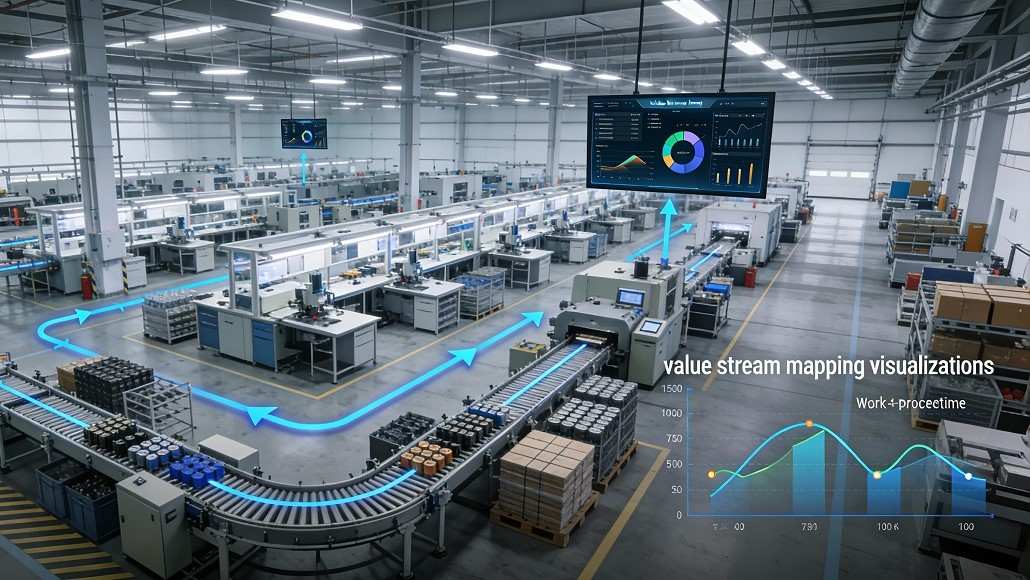
Value stream mapping represents the primary tool for identifying material flow inefficiencies. Engineers trace product journeys from raw materials through production to finished goods, documenting every operation, movement, queue, and inspection. They categorize activities as value-adding (work customers would pay for) or waste (activities necessary but non-value-adding).
The analysis typically reveals shocking waste percentages. Materials might spend 80-90% of time queuing or moving, with only 10-20% of time in actual value-adding production. This means the factory could theoretically achieve five- to ten-fold improvements if queuing and movement could be eliminated.
While eliminating all queuing and movement proves impossible, value stream mapping identifies which wastes prove most impactful. Focusing improvements on high-impact areas delivers maximum benefit from investment. Rather than broad improvements affecting everything slightly, targeted improvements eliminate significant waste.
Common wastes identified through value stream mapping include excessive queuing from unbalanced operations, long material movement paths from poor layout, excessive inspection from inadequate quality control earlier, rework loops from inadequate process control, and inventory buildup from poor demand forecasting.
Bottleneck Identification and Elimination
Bottlenecks represent the most impactful material flow problems. When a single operation processes materials slower than upstream operations produce them, materials accumulate creating bottlenecks. Materials wait for the constrained operation, tying up capital and increasing damage risk.
Identifying bottlenecks requires comparing operation cycle times. If assembly produces 10 units hourly but painting processes 8 units hourly, painting is the bottleneck. Materials accumulate before painting creating excessive work-in-process inventory.
Solving bottlenecks requires either increasing bottleneck capacity or reducing upstream production rate. Increasing capacity might involve adding work shifts, deploying additional equipment, or improving process efficiency. Reducing upstream might involve adjusting production plans or rebalancing operations to match bottleneck capacity.
The key insight is that improving non-bottleneck operations provides no benefit—materials still wait at the bottleneck. Effective improvement focuses exclusively on bottleneck operations. As bottleneck capacity improves, new bottlenecks often emerge, requiring continuous focus on constraint identification and improvement.
Inventory Minimization and Just-in-Time Production
Well-designed material flow minimizes inventory accumulation. Rather than excessive queues before each operation, optimized flow balances operations so materials move smoothly. The result combines reduced inventory levels with improved efficiency.
Just-in-time principles extend material flow optimization. Rather than producing components immediately upon availability, JIT approaches produce materials only when downstream operations need them. This pull-based production prevents upstream from producing excessive inventory overwhelming downstream operations.
Implementing JIT requires operational discipline. Rather than each operation producing continuously at maximum rate, production must adjust to downstream demand. This requires communication systems enabling operations to signal upstream when they need materials. Kanban systems—visual signal systems—typically implement this communication.
The benefits of JIT integrated with flow optimization prove substantial. Inventory levels drop 70%+ compared to traditional push-based systems. Capital tied up in inventory becomes available. Lead times compress as materials move through production rapidly rather than queuing extensively.
Production Sequencing and Takt Time Alignment
Optimized flow requires production sequencing aligning with takt time principles. Takt time establishes the rate work must progress. If daily demand requires producing 100 units during 10 operational hours, takt time becomes 6 minutes per unit. Every operation must complete its portion of work within 6 minutes maintaining this pace.
Production sequencing determines which products produce in which order. Rather than producing randomly, optimized sequences group similar products enabling equipment setup optimization and reducing changeover time. Mixed-model sequencing might interleave different product types enabling constant operational tempo while producing diverse products.
The sequencing discipline enables operator planning. Rather than operators discovering they’re behind schedule when delays accumulate, clear sequencing shows whether current pace maintains takt time. Supervisors monitor takt time performance continuously, addressing deviations immediately.
Single-Piece Flow and Waste Elimination
Advanced material flow approaches employ single-piece flow where materials move individually through production rather than batching. Rather than assembling 50 units before moving to next operation, single-piece flow assembles one unit, moves it to next operation, then assembles the next unit.
This approach eliminates queuing from large batch accumulation. Rather than 50-unit queues before each operation, queues shrink to one or two units. Capital tied up in work-in-process inventory decreases dramatically.
Single-piece flow requires operational maturity. Equipment must be reliable—breakdowns halt production. Quality must be excellent—defects discovered later in flow are expensive. Changeover must be fast—moving between product variations constantly requires quick changeover. Organizations ready for single-piece flow achieve remarkable efficiency.
Worker Engagement and Lean Culture
Material flow optimization profoundly affects worker experience. Rather than workers spending substantial time moving materials, optimized flow brings materials to workstations. Worker focus shifts from logistics toward value-adding work. Worker strain from material handling decreases as mechanical handling systems replace manual movement.
This shift improves worker satisfaction and productivity. Workers appreciate focusing on skilled work rather than manual material handling. Injury rates decrease as physically demanding material movement decreases. Workers develop deeper process understanding as they see smoother production flows.
Culture changes accompany operational changes. Rather than accepting chaos as inevitable, lean cultures treat efficiency improvement as everyone’s responsibility. Workers suggest improvements based on daily work experience. Supervisors coach workers toward continuous improvement. The result combines improved efficiency with improved work experience.
Continuous Improvement and Kaizen Discipline
Material flow engineering proves most effective when integrated with continuous improvement cultures. Rather than one-time optimization, systematic improvement continuously refines flow. Each improvement reveals new opportunities. Cumulative improvements compound into dramatic transformations.
Kaizen principles apply this discipline systematically. Small teams focus on specific flow problems, develop solutions, implement them quickly, and measure results. Rather than waiting for major projects, kaizen enables rapid experimentation and learning.
The discipline proves particularly valuable for addressing unexpected changes. When equipment breaks, production pauses, and flow disrupts. Quick kaizen problem-solving identifies root causes and implements solutions. When demand patterns change, flow designs adjust. The continuous improvement culture enables adaptability.
Implementation Success and Competitive Advantage
Organizations successfully implementing material flow engineering develop substantial competitive advantages. Improved efficiency enables lower costs and faster delivery. Reduced inventory improves cash flow. Improved working conditions strengthen workforce stability. These advantages compound creating market leadership.
The competitive implications prove particularly acute in prefab manufacturing. Organizations with superior flow deliver projects faster at lower costs, outcompeting traditional manufacturers and less-optimized prefab competitors. The advantage accumulates as optimized organizations invest profits into further improvements.
The future of manufacturing belongs to organizations mastering material flow. Rather than factories built around existing processes, future facilities will be designed for optimal flow. Material handling will be mechanized. Layouts will follow product logic. Continuous improvement will drive persistent optimization. Organizations leading this transformation will establish dominant competitive positions.
