























Key Takeaways
- Strategic packaging reduces component damage by 40-60% through protection systems designed for specific component vulnerabilities.
- Smart sequencing labels enable installation teams to efficiently organize components for rapid installation reducing site time by 20-30%.
- Modular packaging enables compact transportation reducing shipping costs while protecting components during transit.
- Protective packaging designed for component characteristics balances protection against shipping cost and installation efficiency.
- Clear visual labeling systems eliminate interpretation errors reducing installation delays from incorrect component identification.
- Optimized packaging dimensions fit standard transportation containers improving logistics efficiency and reducing damage from oversized loads
Prefabricated components arriving at installation sites often have traveled thousands of miles through multiple transportation modes and environmental conditions. Transportation exposes components to shock, vibration, temperature extremes, humidity, and weather. Arrival condition proves critical—damaged components require expensive replacement, modification, or field remediation. Strategic packaging and transport design minimize damage ensuring components arrive installation-ready.
Traditional packaging approaches employ generic protection solutions applied uniformly across diverse component types. Heavy plywood crating protects everything equally, consuming weight and space. Generic labeling provides minimal guidance. The result combines excessive packaging costs with inadequate component-specific protection. Strategic packaging approaches optimize for specific component vulnerabilities.
Modern prefab organizations increasingly recognize that packaging and transport design represent critical competitive factors. Organizations optimizing packaging and transport achieve multiple advantages—reduced damage rates improving profitability, confident delivery enabling tighter scheduling, efficient installation reducing site costs, and environmental benefits from reduced protective material. The strategic approach recognizes that thoughtful design delivers benefits far exceeding additional investment.
Understanding Component-Specific Protection Requirements
Different component types require different protection approaches. Structural steel components resist crushing but corrode if exposed to moisture. Mechanical systems with precision assemblies require shock protection but resist moisture damage. Electrical systems require moisture protection but tolerate mechanical shock. Windows and glass require extensive shock protection but need ventilation preventing condensation.
Strategic packaging begins with detailed analysis of each component type’s vulnerabilities. Rather than applying standard protection uniformly, packaging design addresses specific vulnerabilities. Structural steel receives moisture-resistant protection emphasizing corrosion prevention. Sensitive mechanical assemblies receive shock-absorbing protection and environmental monitoring. Electrical systems receive sealed protective enclosures. Windows receive spacing preventing glass-to-glass contact while maintaining ventilation.
This component-specific approach proves both more effective and more economical than generic approaches. Protection focuses on actual vulnerabilities rather than hypothetical worst-case scenarios. Unnecessary protection is eliminated reducing packaging costs and weight. Component-specific solutions often prove less expensive than heavy generic approaches while providing superior protection.
Smart Labeling and Sequencing Systems
Clear labeling proves critical for efficient installation. Installation teams need to quickly identify components, understand sequence requirements, and verify correct component arrival. Poor labeling creates confusion enabling incorrect installation, rework, and delays.
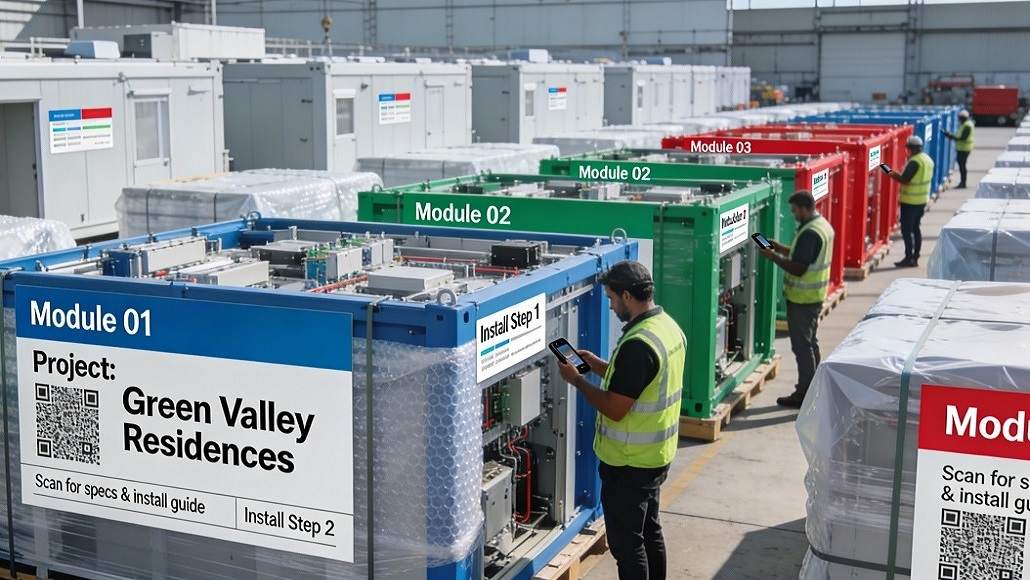
Strategic labeling systems employ multiple information layers. Primary identification uses unique component codes linking to installation documentation. Barcode labels enable rapid scanning. Sequential positioning numbers indicate installation order. Color coding indicates component type. Pictorial diagrams show proper orientation. Instructions highlight handling requirements.
The sophistication of labeling systems increasingly includes digital integration. QR codes link to detailed installation instructions accessible on smartphones. RFID tags enable automatic component detection triggering installation sequence updates. Digital tags can update as site conditions change, enabling real-time installation optimization.
Smart labeling systems dramatically improve installation efficiency. Installation teams quickly locate correct components. Sequencing information enables parallel installation reducing site time by 20-30%. Color coding and pictorial information accommodates diverse worker literacy levels. The result combines faster installation with fewer errors.
Modular Packaging and Compact Transport
Strategic packaging often employs modular approaches enabling compact transportation. Rather than individual crating consuming space, modular packaging nests components compactly. Standardized package dimensions fit transportation containers efficiently eliminating wasted space. Reduced volume enables smaller vehicles and fewer shipments reducing transportation cost.
Modular packaging also improves handling efficiency. Standardized modules enable mechanized handling. Automated systems load, transport, and unload standardized packages. Manual material handling becomes minimal. The improved handling efficiency reduces labor costs and damage risk.
Compact packaging simultaneously reduces weight. Lighter packages require smaller vehicles and less fuel. Transportation emissions decrease. Handling becomes easier reducing worker strain and injury risk. The environmental benefits align with sustainability objectives increasingly important to clients.
Protective Materials and Design Innovation
Traditional protective materials like plywood and foam provide generic protection but prove heavy and consume space. Modern packaging innovates with materials optimized for specific protection requirements. Air cushioning systems provide shock protection with minimal weight. Kraft paper and recycled materials provide moisture protection. Specialized foams absorb vibration while remaining lightweight. Ventilation systems prevent condensation in sealed packages.
Material selection also considers environmental impact. Single-use plastic packaging increasingly gives way to recyclable and compostable alternatives. Recycled content materials reduce virgin material requirements. Reusable packaging reduces overall material consumption. These innovations simultaneously improve environmental performance and often reduce costs.
The sophistication of modern packaging materials enables protection previously impossible. Integrated environmental monitoring tracks temperature and humidity throughout transit. Active protection systems stabilize temperature in heated or cooled containers. Phase-change materials maintain optimal temperature ranges passively. Shock sensors identify rough handling triggering alerts.
Quality Control and Damage Prevention
Strategic packaging includes comprehensive quality control ensuring protection effectiveness. Rather than assuming packaging will protect components, systematic testing validates protection. Components are subjected to simulated transportation conditions—drops, vibration, temperature extremes, humidity exposure. Arrival condition is verified confirming protection effectiveness.
This validation approach identifies inadequate protection before components reach job sites. Rather than discovering protection failures after component damage, testing enables correction. Packaging is iteratively refined until it reliably protects components under realistic conditions.
Damage prevention extends beyond packaging design to transportation management. Vehicles are selected based on component requirements. Sensitive components travel in climate-controlled vehicles. Heavy components travel in vehicles designed for loads. Fragile components travel on smooth routes avoiding rough roads. The holistic approach combines appropriate packaging with appropriate transportation.
Installation Sequence Organization
Strategic packaging organizes components to match installation sequences. Rather than random organization requiring installation teams to locate and organize components, packaging delivers components in installation order. Components needed first are positioned for easy access. Subsequent components are staged behind early components. Installation teams simply work systematically through delivered components.
This sequencing organization dramatically improves installation efficiency. Rather than teams searching for required components wasting time, components are waiting in proper sequence. Work flow becomes continuous without disruption from material unavailability. Site time compresses substantially.
Sequencing organization also reduces errors. Rather than installation teams potentially selecting incorrect components, correct components are presented in sequence. The system essentially guides teams toward correct installation reducing rework from installation errors.
Cost-Benefit Analysis and Financial Impact
Strategic packaging requires investment in design, prototyping, and process implementation. Organizations must justify these investments through measurable benefits. The financial benefits prove substantial—reduced damage, improved installation efficiency, reduced rework—but must be quantified for business case development.
Damage reduction typically delivers the most obvious financial benefit. If traditional packaging results in 10% damage rate and strategic packaging reduces this to 2%, the cost reduction proves substantial. For high-value components, damage prevention alone justifies packaging investment.
Installation efficiency improvements represent another significant benefit. If strategic packaging reduces installation site time by 15-20%, the labor savings prove substantial. For large projects with expensive installation labor, these savings are dramatic.
Environmental benefits increasingly factor into financial decisions. Organizations pursuing sustainability goals value packaging reducing material consumption and enabling recycling. Clients increasingly prefer suppliers demonstrating environmental responsibility.
Integration with Supply Chain Systems
Strategic packaging integrates with broader supply chain systems. Barcode and RFID data links packaging information with supply chain tracking. As components move through transportation, arrival time predictions improve based on actual conditions. Installation teams receive advance notice enabling site preparation.
Packaging information integrates with installation planning systems. Installation teams receive detailed sequencing information enabling optimal crew organization. Rather than improvising installation sequences, teams follow planned sequences enabled by strategic packaging organization.
The integration creates sophisticated logistics ecosystems where packaging, transportation, tracking, and installation coordinate seamlessly. Rather than separate functions operating independently, integrated systems optimize across all functions simultaneously.
Competitive Implications and Industry Evolution
Organizations implementing strategic packaging develop substantial competitive advantages. Superior component quality upon arrival improves customer satisfaction. Faster installation reduces customer project costs. Efficient logistics reduce operational costs. These advantages combine creating market leadership.
The industry increasingly recognizes strategic packaging as competitive necessity. Component manufacturers increasingly design for efficient packaging. Logistics providers increasingly adopt strategic packaging. Installation teams increasingly expect strategically packaged components. These systemic changes drive adoption toward industry standard.
The future of prefabrication will involve sophisticated strategic packaging. Rather than components being packaged generically, every component will be packaged optimally for its characteristics. Installation sequence will be organized in packaging eliminating site organization time. Packaging will include digital intelligence enabling real-time tracking and coordination. Organizations leading this transformation will establish competitive positions others struggle to match.
