

























Key Takeaways
- AGVs reduce workplace injuries by 40-60% through elimination of manual material handling and associated strain
- Autonomous systems maintain continuous production flow with 24-hour operation capability, free from human fatigue limitations
- Conveyor and lift automation reduces repetitive strain injuries (RSI) that traditionally affect workers in manual material handling roles
- Integrated AGV systems optimize material flow, reducing congestion and bottlenecks that disrupt production schedules
- Predictable, collision-free operations through sensor networks and automated routing enhance overall facility safety
- Worker roles transition from dangerous manual handling toward supervision and process improvement activities
Manual material handling represents one of manufacturing’s most persistent safety challenges. Workers lift heavy components, carry them across factories, position them for processing, and move finished components to storage. This continuous manual material movement creates occupational hazards—back injuries, repetitive strain injuries (RSI), dropped loads causing damage and injury. Workers endure physical strain accumulating across careers, with many experiencing chronic pain or career-ending injuries.
Beyond safety concerns, manual material handling creates operational inefficiencies. Workers move at limited speeds. They require breaks, shift changes, and sick leave. Bottlenecks emerge as material accumulates waiting for manual movement. Production disruptions cascade when key manual handling personnel become unavailable. Traditional manufacturing accepted these inefficiencies as inherent to factory operations.
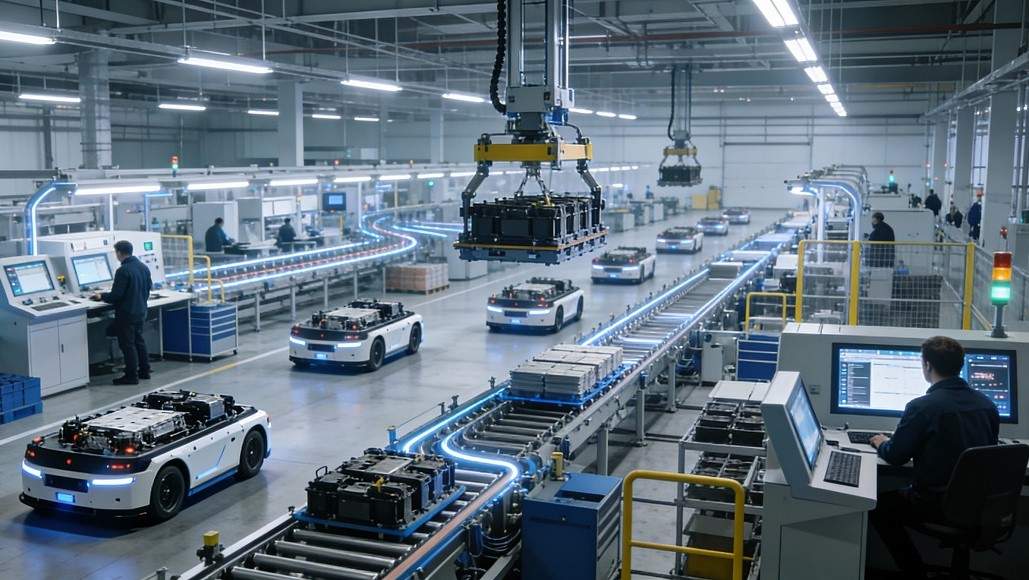
Autonomous handling systems fundamentally reorganize factory logistics. Rather than workers manually moving materials, automated systems continuously transport components between operations. Automated guided vehicles (AGVs) autonomously navigate factory floors, moving pallets and assemblies. Automated conveyor systems flow components between work stations. Automated lifts raise and lower heavy components. These systems operate continuously without fatigue, maintain perfect safety discipline, and eliminate manual material handling injuries entirely. The transformation represents one of the most significant safety improvements prefab manufacturing has experienced.
Understanding Autonomous Handling Technologies
Autonomous guided vehicles represent the most visible autonomous handling technology. AGVs are driverless vehicles following predetermined routes using onboard sensors and navigation systems. Rather than requiring human operators, AGVs perceive their environment, detect obstacles, follow routes optimally, and adjust operations based on current conditions. Modern AGVs employ laser-based navigation (LIDAR), magnetic tape guidance, or natural feature recognition enabling autonomous operation without infrastructure modifications.
AGVs transport diverse loads—pallets of raw materials, component assemblies, finished products, equipment. Specialized AGV types accommodate different load handling requirements. Flat deck AGVs carry pallets. Tugger AGVs pull carts filled with multiple components. Stacker AGVs retrieve items from racking systems. Counterbalance AGVs handle heavy loads. Rather than requiring universal vehicles accommodating all scenarios, specialized AGVs optimize for specific applications.
Conveyor systems form another critical autonomous handling element. Rather than manual movement between work stations, components flow through conveyor systems. Traditional conveyors move at constant speeds. Modern intelligent conveyor systems vary speeds based on downstream demand. If work stations operate at full capacity, conveyors slow, preventing component accumulation. As work stations complete operations, conveyors accelerate, delivering new components promptly. This demand-responsive operation creates smooth production flow without manual intervention.
Automated lift systems eliminate manual component lifting. Rather than workers manually lifting components, lifts raise and lower heavy items. Operators position components onto lifts, press buttons, and lifts automatically move components to required elevations. For extremely heavy components exceeding reasonable manual lifting capacity, automated lifting proves essential.
Safety Transformation Through Automation
The safety benefits of autonomous handling prove dramatic. Manual material handling causes approximately 800,000 workplace injuries annually in developed economies. Injuries range from minor muscle strains to severe back injuries, crushed fingers, and crushing accidents. Many injuries prove cumulative—repetitive motions accumulate stress resulting in chronic conditions affecting workers decades after injury incidents.
Autonomous handling eliminates these injuries through replacing humans with machines. Rather than workers lifting, carrying, and positioning heavy components, machines handle these tasks. Repetitive stress injuries vanish—if machines repeatedly move components rather than humans, human repetitive strain disappears. Crushing and impact injuries vanish—if AGVs transport heavy loads rather than manually-pushed carts, manual crushing risks vanish. Strain injuries vanish—if machines lift heavy components rather than human backs, back injury rates plummet.
Research quantifies safety improvements. Organizations implementing comprehensive autonomous handling report injury rate reductions of 40-60%. For organizations with significant manual material handling, safety improvements often exceed 70%. Beyond reducing injury incidents, severity of injuries when they do occur decreases substantially. Rather than workers suffering serious injuries, occasional accidents typically involve equipment damage rather than human injury.
Psychological safety benefits accompany physical safety improvements. Workers no longer experience daily strain and physical discomfort. Anxiety regarding repetitive strain injury risk diminishes. Job satisfaction improves as dangerous, physically demanding tasks disappear. Organizations report improved worker morale and retention following autonomous handling implementation.
Operational Continuity and Production Flow
Beyond safety, autonomous handling dramatically improves operational continuity. Manual material handling introduces inevitable operational disruptions. Workers become unavailable—illness, vacation, shift changes. Material handling slows dramatically with fewer workers. Production bottlenecks emerge as material movement cannot keep pace with production capacity. These disruptions create schedule delays and cost impacts.
Autonomous handling systems operate continuously. Twenty-four-hour operations maintain production flow regardless of shift schedules. AGVs operate night shifts without rest. Conveyor systems flow components 24/7. When morning crews arrive, overnight production is waiting for them. The continuous operation maximizes facility utilization dramatically.
Production flow smoothness improves substantially through autonomous handling. Manual material handling creates erratic flow—sometimes bottlenecks as material accumulates, sometimes work station idle time as material waiting for manual delivery. Autonomous systems maintain consistent flow. If upstream produces faster than downstream consumes, autonomous systems carefully manage accumulation preventing overflow. If downstream consumes faster than upstream produces, autonomous systems maintain steady feed preventing starvation. This flow smoothness compresses overall production timelines.
Labor Transition and Workforce Implications
Autonomous handling raises similar labor displacement concerns as robotic assembly. If machines handle material movement, what becomes of material handlers? The answer proves nuanced. Rather than eliminating all material handling roles, automation transitions roles toward higher-value activities.
Organizations implementing autonomous handling typically maintain comparable employment in material handling functions but shifted toward different responsibilities. Rather than 100% of workforce physically moving materials, post-automation facilities might employ 20% supervising autonomous systems, 30% maintaining equipment, 25% planning material flow, and 25% handling exceptional situations requiring human judgment. The new roles often demand technical capability exceeding traditional material handling but provide safer, more intellectually engaging work.
Worker transition requires training. Organizations cannot install AGVs and expect workers to immediately maintain and troubleshoot them. Systematic training programs develop capability in vehicle maintenance, software programming, troubleshooting, and process improvement. Workers willing to develop new capability find themselves in technical roles often commanding higher wages than traditional material handling positions.
For workers resistant to transition, organizations face difficult decisions. Some offer early retirement packages. Some transition workers to other departments. Some gradually reduce hiring, allowing workforce to decrease through natural attrition as roles disappear. Enlightened organizations prioritize worker transition, recognizing that workers who adapt successfully often become valuable technical contributors.
Practical Implementation Considerations
Successfully implementing autonomous handling requires substantial planning and coordination. System design must accommodate facility layout, production requirements, and integration with existing systems. Facilities with complex geometries, multiple production lines, and variable material flows prove more challenging to automate than facilities with simple linear flows.
Integration with upstream production systems proves critical. If upstream produces components at rates autonomous handling cannot accommodate, bottlenecks emerge despite automation. Organizations must balance upstream production rates with autonomous handling capacity. Sometimes this requires upstream modifications to synchronize with handling capacity.
Data systems integration represents another consideration. Manufacturing execution systems (MES) must communicate with AGV systems regarding material movements. If MES indicates downstream operation requires specific materials, AGV systems should autonomously deliver those materials. If AGV systems indicate bottlenecks emerging, MES systems should adjust upstream production accordingly. This integration enables sophisticated just-in-time operations.
Safety systems require careful attention. While autonomous systems generally prove safer than manual alternatives, safety hazards emerge if systems malfunction. System failures could cause AGVs to collide with workers or damage components. Organizations must implement robust safety systems including emergency stop mechanisms, collision avoidance, and failure detection triggering immediate intervention.
Economic Analysis and Return on Investment
Autonomous handling systems require significant capital investment. AGV fleet costs, conveyor system installation, integration costs, and system programming represent substantial expenses potentially exceeding $500,000 for moderate-sized facilities. Organizations must justify these investments through improved productivity and safety outcomes.
Financial analysis typically examines several factors. Labor cost savings from reduced manual material handling represent obvious benefits. Safety cost reduction through injury elimination proves significant—medical costs, workers compensation insurance, replacement worker costs, and productivity loss from injuries add up substantially. Productivity improvements from continuous operation and improved flow represent another benefit. Timeline compression reducing facility overhead costs provides additional benefits.
Most organizations implementing comprehensive autonomous handling see payback periods of 3-5 years. For facilities with high labor costs, high injury rates, or significant material handling challenges, payback occurs faster. For facilities with simple flows and low labor costs, payback extends longer. Organizations typically require payback within reasonable timeframes justifying the capital investment.
Integration with Smart Manufacturing Systems
Modern autonomous handling systems integrate into broader Industry 4.0 ecosystems. Rather than operating independently, autonomous systems provide data feeding into manufacturing analytics. AGV utilization metrics reveal material flow bottlenecks. Conveyor performance data identifies work station imbalances. Equipment diagnostics provide predictive maintenance alerts. This comprehensive data enables continuous optimization.
Artificial intelligence increasingly enables predictive material flow management. Rather than reacting to current conditions, AI systems predict future material demand and position materials preemptively. If production schedules indicate fabrication will generate large volume of specific components next week, AI systems might position AGVs to efficiently handle anticipated flows. This anticipatory positioning further optimizes operations.
Competitive Advantages and Industry Evolution
Organizations operating autonomous handling systems develop significant competitive advantages. Superior operational continuity enables reliable delivery performance. Superior safety reduces liability exposure and insurance costs. Superior productivity enables cost competitiveness. These advantages compound as systems mature and optimization deepens.
The industry increasingly recognizes autonomous handling as competitive necessity. Equipment manufacturers increasingly design components for autonomous handling compatibility. Facility designs increasingly accommodate autonomous systems. Workforce increasingly develops autonomous handling competencies. These systemic changes drive autonomous handling toward industry standard.
The future of prefab manufacturing will involve comprehensive autonomous handling. Rather than manual material movement creating bottlenecks and safety hazards, autonomous systems will manage material flows seamlessly. Organizations leading this transition establish competitive positions others struggle to match.
