


























Key Takeaways:
- The transition to digital construction sites is centered on the integration of connected machinery and advanced construction telematics, which allow for the real-time tracking of every asset’s location and performance. This unprecedented visibility enables project managers to make data-driven decisions that minimize downtime and optimize resource allocation, ensuring that even the most complex projects remain on schedule and within budget.
- Leveraging construction data analytics on smart construction sites transforms raw information into actionable insights, helping to identify operational bottlenecks and improve overall safety protocols. By fostering a digital jobsite environment where every machine communicates with a central hub, contractors can achieve a level of coordination and efficiency that reduces material waste and enhances the long-term sustainability of the build process.
Digital Construction Sites Powered by Connected Equipment
The construction industry is entering an era where data is becoming as valuable as the diesel that powers its machines. We are witnessing the birth of the digital construction sites projects where the physical boundaries of the jobsite are mirrored by a precise, real-time digital replica. In this new world, the siloed operations of the past are being replaced by a highly integrated ecosystem of connected machinery and intelligent software. The goal is no longer just to move earth and pour concrete, but to do so with a level of surgical precision and informational clarity that was once the exclusive domain of manufacturing and logistics.
The Foundation: Construction Telematics and Connected Machinery
The pulse of the digital jobsite is construction telematics. This technology, which involves the remote transmission of data from heavy equipment to a centralized platform, has evolved from a simple GPS tracking tool into a comprehensive diagnostic and operational system. Modern connected machinery is equipped with dozens of sensors that monitor everything from engine health and hydraulic pressure to fuel consumption and idle time. This constant stream of data is the lifeblood of smart construction sites, providing the transparency needed to manage a sprawling operation effectively.
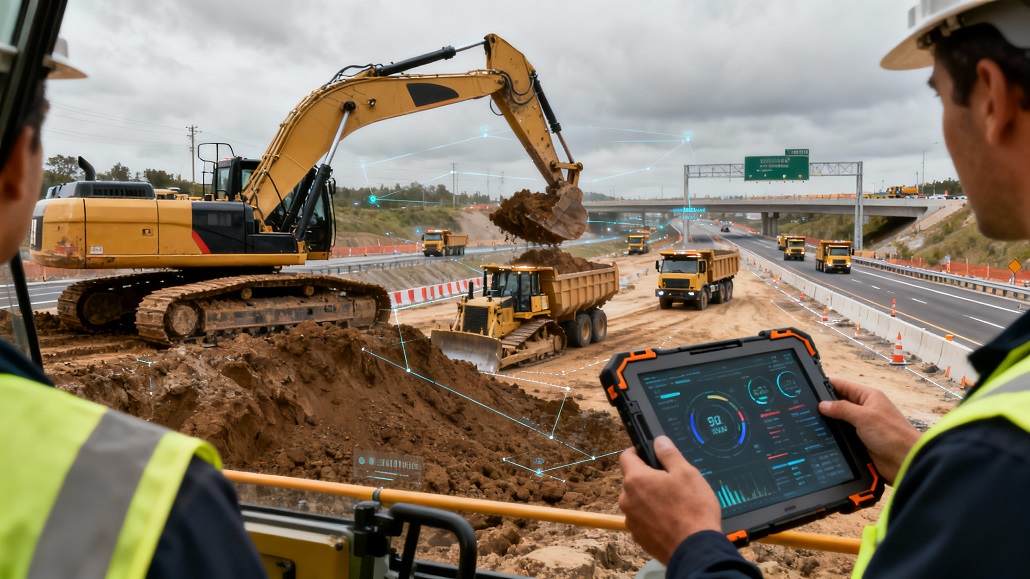
When machines are connected, they cease to be isolated tools and become part of a larger, coordinated network. For example, on a large-scale highway project, a connected excavator can communicate with a fleet of haul trucks to synchronize the loading and hauling cycle. If the excavator encounters unexpectedly hard soil that slows down its work, it can alert the trucks to adjust their pace or route, preventing a queue from forming and wasting fuel. This level of machine-to-machine communication is the hallmark of the modern digital construction sites, turning the chaotic environment of a jobsite into a controlled, optimized process.
The Intelligence Hub: Construction Data Analytics
Data in its raw form is of limited use; its true power is unlocked through construction data analytics. On smart construction sites, sophisticated algorithms process the millions of data points generated by the fleet every day to identify patterns and trends. This analytical layer allows project managers to move from “seeing” what is happening to “understanding” why it is happening and “predicting” what will happen next.
One of the most valuable applications of analytics is in the realm of predictive maintenance. By analyzing the historical performance and real-time health data of connected machinery, the system can identify the subtle signs of impending mechanical failure long before a warning light appears on the dashboard. This allows for “just-in-time” repairs during planned breaks, avoiding the massive costs and logistical headaches of an unexpected breakdown in the middle of a critical phase. On a digital jobsite, downtime is not just a nuisance; it is a data-driven variable that can be managed and minimized.
Synchronizing the Office and the Field
The emergence of digital construction sites is bridging the traditional gap between the engineering office and the field. In the past, changes to a project design could take days or even weeks to filter down to the machine operators, often leading to costly errors and rework. Today, the digital jobsite allows for the instantaneous synchronization of data. When an engineer updates a 3D model in the office, the new design is pushed wirelessly to the entire fleet of connected machinery.
This seamless flow of information ensures that everyone on the project from the lead architect to the junior operator is working from the same “single source of truth.” It also allows for a much higher degree of accountability. Project managers can compare the “as-built” data transmitted by the machines against the “as-designed” digital model in real-time. If a trench is dug 5 centimeters too deep or a road is graded at the wrong angle, the system can flag the discrepancy immediately, allowing for a quick correction before the error is compounded.
Safety and Risk Management in a Digital Environment
Connectivity is not just about efficiency; it is also a powerful tool for improving safety on smart construction sites. Connected machinery can be equipped with “geofencing” capabilities, which allow managers to draw virtual boundaries around hazardous areas, such as underground utilities or steep drops. If a machine enters a restricted zone, the system can send an instant alert to both the operator and the site supervisor, or even remotely disable the equipment to prevent an accident.
Furthermore, construction data analytics can be used to monitor operator behavior. By identifying instances of harsh braking, over-speeding, or improper machine use, safety managers can identify individuals who may need additional training. This proactive approach to safety is a key feature of the digital jobsite, moving beyond reactive investigations to a culture of continuous risk assessment and prevention. In this environment, every data point is a potential lesson in how to protect the workforce more effectively.
The Economic Advantage of the Digital Jobsite
The business case for digital construction sites is undeniable. While the initial investment in construction telematics and analytics platforms is significant, the ROI is realized through multiple channels. Reduced fuel consumption, lower maintenance costs, and the virtual elimination of rework contribute directly to a healthier bottom line. Perhaps more importantly, the level of data provided by a digital jobsite allows contractors to bid more accurately for future work.
By analyzing their performance data from past projects, firms can develop highly accurate benchmarks for productivity and material usage. This “informational advantage” allows them to offer more competitive prices while maintaining their margins. In a world where project tenders are becoming increasingly complex and competitive, the ability to demonstrate a data-driven approach to project delivery is a powerful differentiator. The digital construction sites of today are the successful companies of tomorrow.
Conclusion: The Future of the Built World
The transition to digital construction sites represents a fundamental shift in the identity of the building industry. We are moving from an era of “brute force” to an era of “intelligent build.” By embracing connected machinery and the power of construction data analytics, the industry is proving that it can meet the challenges of the 21st century building faster, safer, and more efficiently than ever before. As the technologies of the digital jobsite continue to evolve, including the integration of AI and 5G, the potential for further optimization is limitless. The jobsite is no longer just a place of work; it is a high-tech laboratory where the world of tomorrow is being built, one data point at a time.