

























Key Takeaways:
- The longevity and safety of contemporary skyscrapers depend on the sophisticated application of fire resistant structural components modern buildings use, which include both the base materials like concrete and steel and their protective coatings.
- Advancements in passive fire protection, such as high-performance intumescent coatings and the predictable charring of mass timber, have expanded the aesthetic and structural possibilities for architects while maintaining strict compliance with international safety standards.
- A holistic approach that combines advanced building safety materials with integrated active fire suppression systems is the most effective way to ensure structural integrity and occupant safety during a fire event.
Fire Resistant Structural Components in Modern Buildings
The evolution of modern architecture has brought forth breathtaking skylines and complex structural designs that push the boundaries of engineering. However, with these advancements comes an increased responsibility to protect these structures from one of the most persistent threats: fire. The integration of fire resistant structural components modern buildings requires today is not merely a matter of meeting minimum regulatory standards; it is a fundamental pillar of resilient design. When we examine the skeletal framework of a contemporary high-rise or a sprawling commercial complex, we are looking at a sophisticated interplay of materials designed to maintain their load-bearing capacity even under extreme thermal stress. This commitment to structural fire protection ensures that in the event of a disaster, the building provides sufficient time for evacuation and for emergency services to perform their duties without the immediate risk of structural collapse.
The Fundamentals of Structural Fire Resistance
To understand the necessity of fire resistant structural components modern buildings depend on, one must first appreciate how heat affects common construction materials. Steel, while non-combustible, begins to lose its structural integrity significantly at temperatures around 550 degrees Celsius. At this point, the yield strength of steel drops to approximately 50 percent, which can lead to catastrophic failure in a fully loaded building. Similarly, concrete can suffer from spalling a process where the moisture within the concrete turns to steam and expands, causing the surface to break away and exposing the reinforcing steel to direct heat. Therefore, the goal of modern engineering is to shield these core elements using a variety of passive fire protection measures.
Passive Fire Protection Strategies
The primary method for achieving fire resistance is through passive systems that are built directly into the structure. Unlike active systems like sprinklers, passive protection does not require a trigger to work; it is always “on.” This includes the use of intumescent coatings, which are specialized paints that expand when exposed to high heat, creating a char layer that insulates the steel. Another common method involves the application of spray-applied fire-resistive materials (SFRM), which are typically cementitious or mineral-fiber-based coatings. These materials provide a thermal barrier that slows the transfer of heat to the structural members, extending the time the building can stand during a fire.
Advancements in Cementitious and Intumescent Technologies
In recent years, the chemical engineering behind these coatings has advanced remarkably. Modern intumescent paints are now more durable and can be applied in thinner layers while providing the same, if not better, protection than their predecessors. This allows architects to leave structural steel exposed for aesthetic reasons without compromising safety. On the other hand, cementitious sprays have become more resistant to moisture and physical impact, ensuring that the fireproofing remains intact throughout the lifecycle of the building. These fire resistant structural components modern buildings utilize are often tested against rigorous standards, such as UL 263 or ASTM E119, to verify their performance under real-world fire conditions.
The Role of Timber in Fire Rated Construction
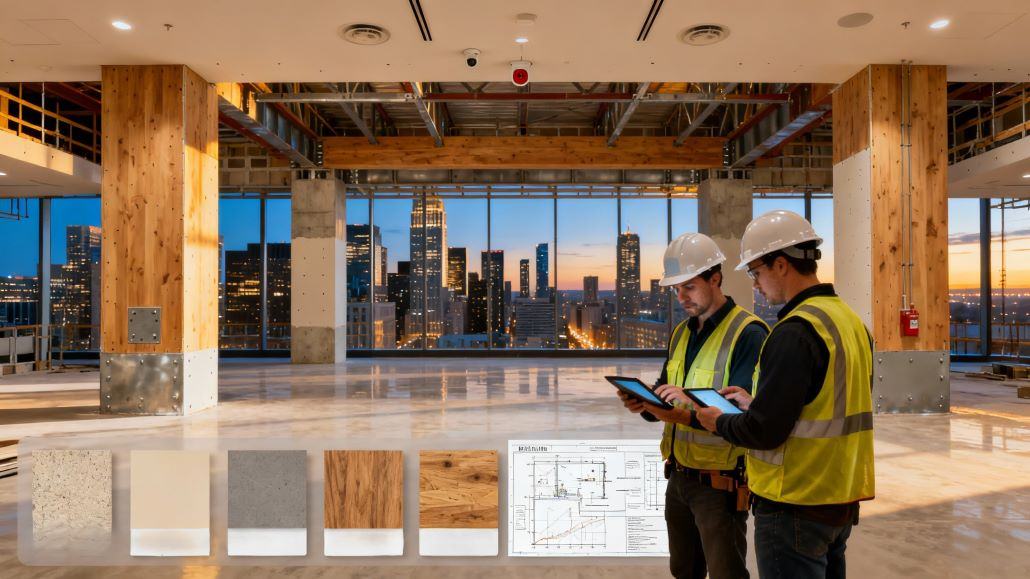
One of the most surprising shifts in modern construction is the return to wood, specifically in the form of mass timber and cross-laminated timber (CLT). While wood is inherently combustible, heavy timber acts differently than light-frame lumber. When a large timber beam is exposed to fire, the outer layer chars, creating a natural insulating barrier that protects the inner core. This charring rate is predictable, allowing engineers to design timber structures that meet high fire resistance ratings. The use of mass timber as one of the key fire resistant structural components modern buildings are adopting is a testament to the fact that sustainability and safety can go hand in hand.
Engineering Safety in Mass Timber Structures
To further enhance the safety of timber buildings, engineers often combine the natural charring properties of wood with additional protective layers or fire-stop systems. For instance, gypsum board encapsulation is frequently used to provide extra minutes of protection to the timber core. Furthermore, the connections between timber members often the weakest point in a fire are meticulously designed with recessed steel plates and intumescent gaskets to ensure the entire assembly remains stable. This holistic approach to fire rated construction is what allows modern wooden “plyscrapers” to compete with traditional steel and concrete structures in terms of safety and compliance.
Compliance and International Safety Standards
No discussion of fire resistant structural components modern buildings require would be complete without addressing the regulatory framework. Building codes, such as the International Building Code (IBC) in the United States or the Eurocodes in Europe, dictate the minimum fire resistance ratings for different parts of a building based on its height, occupancy, and proximity to other structures. These codes are constantly updated to reflect new research and lessons learned from historical fire events. Compliance is not just about avoiding fines; it is about ensuring the long-term viability of the asset and the safety of its inhabitants.
The Impact of Building Safety Materials on Insurance and Valuation
Beyond the legal requirements, the choice of high-quality building safety materials has a direct impact on the financial health of a project. Insurers are increasingly looking at the fire resistance profile of a building when determining premiums. A structure that goes above and beyond the minimum code requirements by utilizing superior fire resistant structural components modern buildings can offer is often seen as a lower risk, leading to significant savings over time. Furthermore, tenants in the commercial sector are becoming more aware of building safety, and a high fire-safety rating can be a strong selling point that increases the overall market value of the property.
Innovation in Material Science for Future Safety
As we look toward the future, the field of material science continues to provide new tools for structural fire protection. Research into carbon-fiber-reinforced polymers and ultra-high-performance concrete is opening up new possibilities for even lighter and stronger buildings that are also more fire-resistant. Geopolymer concretes, for example, exhibit much higher thermal stability than traditional Portland cement-based concretes. Integrating these cutting-edge materials into the suite of fire resistant structural components modern buildings use will likely be the next frontier in urban development.
Integrating Active and Passive Fire Systems
While this article focuses on structural components, it is essential to mention that the most effective fire safety strategy is an integrated one. Fire resistant structural components modern buildings feature must work in harmony with active systems like smoke detectors, alarms, and automated sprinklers. When a building’s skeleton can withstand heat and its active systems can suppress flames and manage smoke, the result is a truly resilient environment. This synergy represents the pinnacle of modern building safety materials application.
The Crux of Structural Fire Protection
In conclusion, the implementation of fire resistant structural components modern buildings demand is a complex but rewarding endeavor. It involves a deep understanding of thermal dynamics, material science, and regulatory landscapes. By prioritizing high-quality structural fire protection, developers and architects are not just building structures; they are building legacies of safety and resilience. The core of this effort the key phrase being fire resistant structural components modern buildings is what ensures that our cities can continue to grow upward safely and sustainably.
