



























Key Takeaways
- JIT implementation reduces onsite inventory by 30-50%, eliminating costly storage requirements and site congestion.
- Synchronized factory-to-site delivery ensures components arrive precisely when installation teams are ready, eliminating waiting time.
- Advanced planning tools enable accurate delivery sequencing, preventing arrival of incorrect components or wrong quantities.
- Route optimization reduces transportation costs and delivery time while improving reliability of arrival timing.
- Integration with production schedules enables parallel manufacturing and site preparation, compressing overall project timelines.
- Real-time tracking and monitoring enable immediate adjustments when disruptions threaten delivery accuracy
Construction logistics traditionally operated on conservative assumptions. Rather than relying on accurate delivery timing, contractors stockpiled materials on-site maintaining buffer inventory protecting against supply disruptions. While this approach provided security against unexpected delays, it created inefficiencies—materials arrived weeks or months before use, occupied expensive storage space, required management oversight, and risked damage or deterioration.
Just-in-time (JIT) logistics inverts this paradigm. Rather than stockpiling, JIT delivers materials precisely when installation teams are ready. Materials arrive the day they’re needed, or sometimes within hours. This synchronization eliminates storage requirements, minimizes site congestion, reduces inventory carrying costs, and ensures components remain undamaged through minimal storage exposure.
Implementing JIT in prefabrication construction proves substantially more feasible than in traditional construction. Factory production is scheduled and predictable. Prefabricated components are manufactured to precise specifications enabling reliable integration with installation schedules. Digital coordination systems enable real-time synchronization between factory production and site requirements. The result combines JIT’s efficiency benefits with reliability previously impossible in construction.
JIT Fundamentals and Prefabrication Compatibility
Just-in-time originated in automotive manufacturing where suppliers delivered components precisely synchronized with assembly line demand. Toyota pioneered JIT principles, achieving dramatic improvements in productivity, quality, and cost efficiency. The automotive model influenced other industries including construction, where early adopters demonstrated that JIT principles could deliver comparable benefits.
JIT success requires prerequisite conditions aligning perfectly with prefabrication characteristics. First, demand must be predictable—suppliers must understand when components will be needed. Prefabrication planning provides this predictability through detailed installation schedules. Second, quality must be consistent—components arriving without inspection capability must be defect-free. Factory quality control achieves this. Third, logistics must be reliable—delivery delays cannot be accommodated. Careful planning and real-time tracking achieve this.
The compatibility between JIT principles and prefabrication explains why leading prefab organizations increasingly embrace JIT approaches. Rather than struggling against JIT prerequisites, prefab operations are naturally suited to JIT implementation.
Logistics Planning and Sequencing Accuracy
Implementing JIT requires meticulous planning determining precise component delivery timing. Rather than rough estimates, JIT planning specifies when individual components will be needed, often down to specific days or even shifts.
Planning begins with detailed installation schedules working backward from project completion. Installation sequences are defined—which components install in which order, how long installation of each component requires, what prerequisite activities must complete before subsequent activities begin. This detailed understanding of installation logic enables planners to determine when materials must arrive.
Working backward from installation requirements, planners coordinate with factory production. If a specific component must arrive on day 42 of the project, and transportation requires 5 days, components must ship on day 37. If manufacturing requires 10 days, production must begin day 27. If materials must be available for production start, procurement must order them by day 20. This backward integration from site requirements through factory to suppliers creates comprehensive supply chain synchronization.
Buffer time proves important despite JIT principles. Rather than eliminating all buffer, enlightened JIT includes reasonable buffers protecting against foreseeable risks. Bad weather might delay transportation. Unexpected production delays might occur. Modest buffers accommodate these variations without requiring wasteful large stockpiles. The goal becomes right-sizing buffers—sufficient protection against realistic risks without excessive waste.
Factory-to-Site Synchronization
The core of JIT success lies in factory-to-site synchronization. Factories must coordinate production timing with site installation readiness. Rather than factories producing at maximum rate and hoping buyers will eventually need components, JIT factories align production with actual demand.
This synchronization proves challenging without sophisticated coordination systems. Communication failures could cause production misalignment. Transportation disruptions could cascade through entire schedules. Weather delays could disrupt carefully planned sequences.
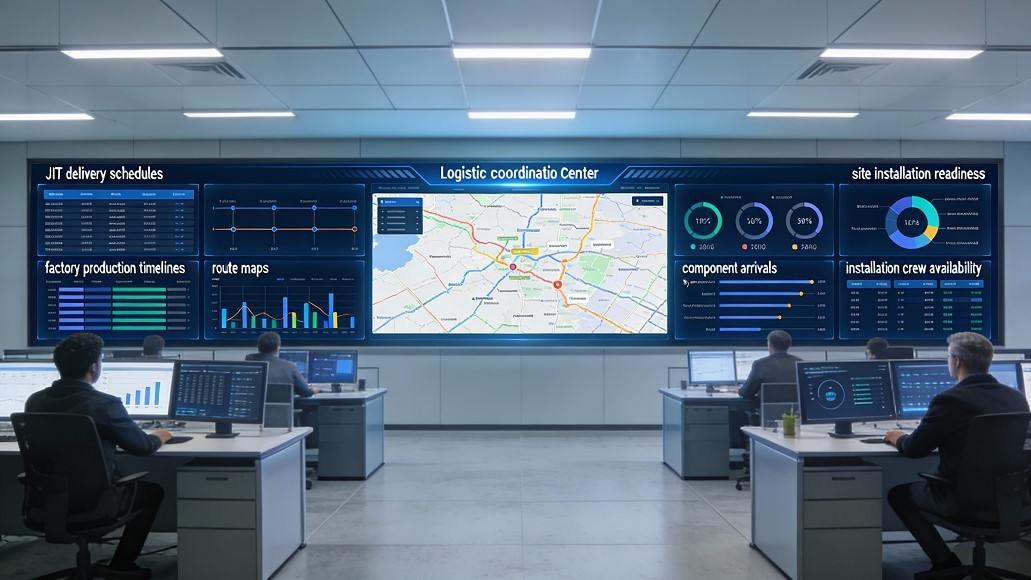
Modern coordination systems address these challenges through real-time communication and visibility. BIM models indicate current site progress and upcoming material requirements. Factory systems receive this information and adjust production schedules accordingly. If site progress exceeds plans, factory accelerates production. If site progress lags, factory slows production preventing excess inventory accumulation.
Transportation coordination similarly synchronizes factory output with site readiness. Rather than dispatching components as soon as production completes, logistics coordinators hold components in staged preparation areas pending site signals. When site teams are ready for next materials, transportation is triggered. Components spend minimal time in transit or holding areas.
Route Optimization and Delivery Reliability
Successful JIT depends on reliable delivery timing. Late arrivals disrupt installation, forcing schedule compression or work stoppages. Early arrivals create staging congestion and risk component damage. Precise timing proves essential.
Route optimization contributes to both reliability and efficiency. Advanced logistics software analyzes routes identifying optimal paths balancing delivery time, traffic patterns, toll costs, and vehicle capacity. Rather than drivers choosing routes intuitively, optimized routes reduce travel time, improve fuel efficiency, and minimize cost.
Real-time traffic monitoring enables dynamic route adjustments. If unexpected traffic congestion emerges on planned routes, drivers receive alternative routing avoiding delays. GPS tracking enables immediate intervention if deliveries fall behind schedule.
The reliability benefits prove substantial. JIT implementation enables contractor confidence in delivery timing, allowing just elimination of safety stock buffers. Rather than padding schedules with assumed material delays, reliable delivery enables precise scheduling.
Storage Elimination and Space Benefits
Perhaps the most visible JIT benefit involves eliminating onsite storage requirements. Traditional construction projects maintained material storage yards accommodating weeks of inventory. These yards required space, security, and management.
JIT eliminates these storage requirements. Rather than maintaining material yards, just-in-time delivery brings components directly to installation points. Site space dedicated to storage becomes available for productive work. Equipment arrives when needed for installation, minimizes site congestion, and reduces theft or damage risks from extended storage exposure.
The financial benefits prove substantial. Storage yards require land, fencing, security systems, and management labor. Eliminating these requirements reduces project overhead costs. For urban projects where storage space commands premium real estate prices, JIT delivery proves particularly valuable.
Inventory Reduction and Cash Flow Benefits
Beyond space elimination, JIT dramatically reduces inventory carrying costs. Traditional approaches maintained valuable component inventory across entire project duration. Carrying substantial inventory tied up capital in materials not yet generating value.
JIT reduces inventory levels by 30-50% compared to traditional approaches. Reduced inventory directly improves project cash flow. Rather than capital being tied up in excessive inventory, funds become available for other uses. For contractors managing cash-constrained projects, this improvement proves transformative.
The inventory reduction also reduces inventory management burden. Fewer materials require tracking, storage, protection, and eventual installation. Management systems become simpler and less error-prone.
Integration with Lean and Continuous Improvement
JIT operates most effectively within broader lean manufacturing contexts. Rather than viewing JIT as isolated delivery optimization, leading organizations embed JIT within comprehensive lean approaches. Continuous improvement programs identify and eliminate waste systematically. Value stream mapping reveals material flow
inefficiencies. Production scheduling optimizes resource utilization.
The integration multiplies benefits. Organizations implementing JIT alone might achieve 15-20% improvement. Organizations implementing JIT within comprehensive lean approaches achieve 30-50% improvements as JIT combines with other efficiency initiatives.
Risk Management and Contingency Planning
JIT introduces risks that must be managed systematically. Delivery disruptions create site bottlenecks. Production delays cascade through carefully planned schedules. Forecast errors could result in shortages or excess components.
Effective JIT implementation includes sophisticated risk management. Supplier redundancy ensures backup suppliers if primary suppliers fail. Flexible scheduling accommodates minor delays without cascading impact. Real-time monitoring enables early problem detection triggering contingency plans before disruptions propagate.
The risk management approach proves crucial distinguishing successful JIT implementations from problematic ones. Organizations treating JIT as simply “order later and hope” often struggle. Organizations implementing disciplined JIT with comprehensive risk management achieve reliable results.
Competitive Implications and Implementation Success
Organizations successfully implementing JIT develop substantial competitive advantages. Reduced carrying costs improve profitability. Improved cash flow enhances financial flexibility. Faster projects achieve revenue generation sooner. Customer satisfaction improves through reliable delivery.
The industry increasingly recognizes JIT as competitive necessity. Early adopters demonstrate results inspiring followers. Software tools enabling JIT implementation become increasingly sophisticated. Industry standards increasingly codify JIT best practices. These trends drive JIT toward standard practice rather than innovative exception.
The future of prefab construction will involve systematic JIT implementation. Rather than traditional conservative material management, future projects will operate with precisely synchronized delivery. Organizations leading this transition establish competitive positions others struggle to match.
